Client
Issues
The client’s IT infrastructure was fragmented; patient records were mostly paper-based or siloed, causing delays and duplicate work. Appointments were handled manually, leading to long wait times. The organization also lacked any telehealth capability, putting it behind national strides – e.g. the government invested $1.5 billion in e-health and achieved ~70% telehealth adoption. Pressure was mounting to digitalize services to improve efficiency, access, and quality of care.
Solution
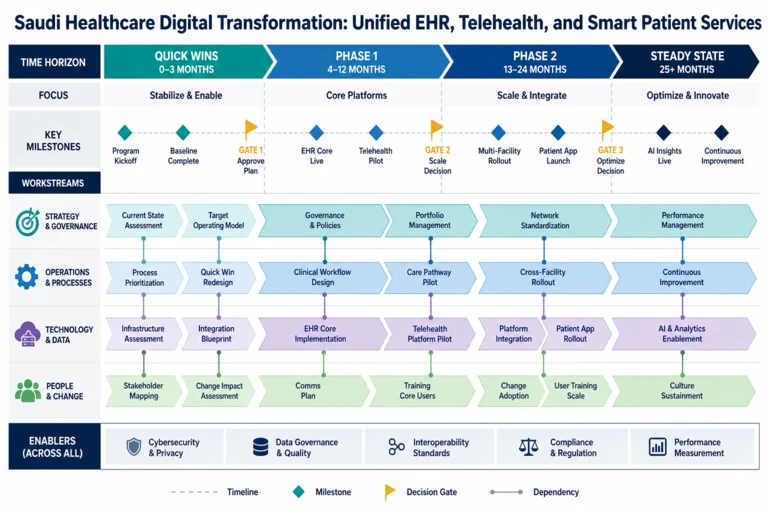
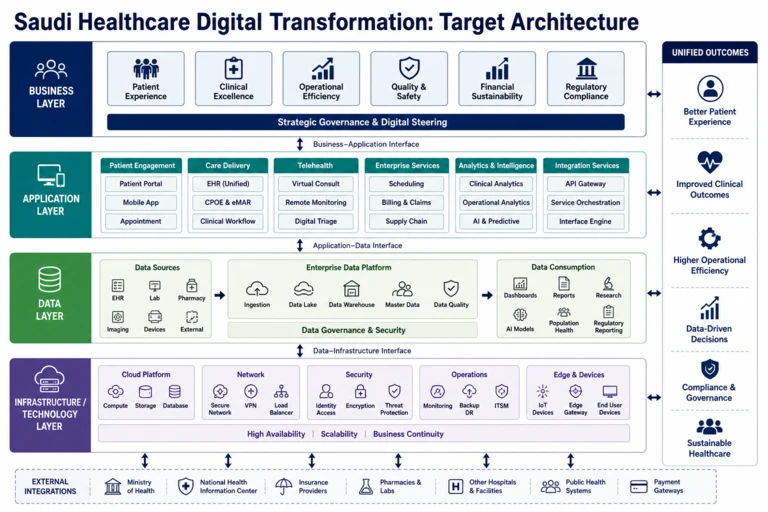
Our team delivered a digital transformation roadmap for the healthcare system. We proposed an integrated Health Information System (HIS) connecting all facilities under one platform, enabling a unified Electronic Health Record for each patient. We introduced a patient portal and mobile app to allow online appointment booking, access to medical records, and telemedicine consultations. The solution also included implementing telehealth services for remote care (e.g. virtual doctor visits and teleradiology) to extend reach to rural areas. We recommended deploying AI-driven analytics for clinical decision support (to assist diagnoses and predict patient needs) and automating routine administrative tasks (e.g. e-prescriptions). Cybersecurity upgrades were built into the plan to protect sensitive health data. Overall, the solution aimed to create a seamless digital patient journey and smarter workflows for providers.
Approach
We began with a comprehensive IT audit and workflow analysis. This involved mapping out current processes – from patient registration to discharge – and identifying pain points where technology could improve speed or accuracy. We consulted clinicians, nurses, and admin staff to ensure the new system would meet user needs and integrate with clinical workflows. Our team evaluated various software vendors and platforms, prioritizing those compatible with Saudi Arabia’s national e-health standards. We also drew on global best practices in digital health (such as successful telemedicine models and EHR implementations in leading hospitals). A pilot program was conducted in one hospital, where we introduced a new appointment-scheduling system and telemedicine pilot, then gathered feedback and performance metrics (like wait time reduction) before scaling up. We developed a phased rollout plan for all facilities, coupled with extensive staff training to ensure smooth adoption of the new tools.
Recommendations
We structured our recommendations into immediate, mid-term, and long-term actions. Immediately, we urged the client to implement a unified EHR across all facilities to eliminate fragmented records and duplicate data entry. We also recommended launching a telehealth initiative by partnering with or adapting existing national telemedicine platforms to quickly enable virtual consultations. In the mid-term, we advised integrating advanced tools such as AI-based diagnostic support and predictive analytics to improve clinical outcomes (for example, using AI to assist in radiology and early disease detection). We stressed ensuring interoperability – making sure the new systems can exchange data with national health information exchanges and insurance systems. For the long-term, we proposed continuous enhancement of digital capabilities, such as remote patient monitoring for chronic disease management and the exploration of emerging tech (like wearable health devices integration). We also recommended establishing a dedicated Digital Transformation Office within the organization to govern the change and ongoing IT staff training programs to build in-house expertise.
Engagement ROI
The digitalization program is already showing transformative results. After implementing the unified EHR and patient portal, administrative workload and errors dropped – retrieving patient information that once took hours is now instantaneous. Appointment wait times have fallen as online scheduling and automated queuing optimized patient flow. Patients have rapidly embraced the new portal and telemedicine services, aligning with the Kingdom’s high telehealth adoption. Hospitals report improved efficiency and communication: electronic orders and records have reduced paperwork and streamlined referrals. Early telehealth offerings have enabled the system to handle more consultations without additional clinic space, improving access especially for remote patients. Overall, the client’s network is becoming more patient-centric, efficient, and data-driven. These improvements not only enhance patient satisfaction and outcomes but also position the organization as a national leader in healthcare innovation.
Pharmaceutical