Client
Issues
The client’s operations were run in silos with many manual processes. Massive data from field sensors was not fully utilized. Maintenance was reactive, and unplanned outages in refineries and fields caused costly downtime. Competitors were embracing Industry 4.0 technologies (AI, IoT, big data), and the client risked falling behind. It needed to digitize its value chain to boost efficiency, cut costs, and improve decision-making.
Solution
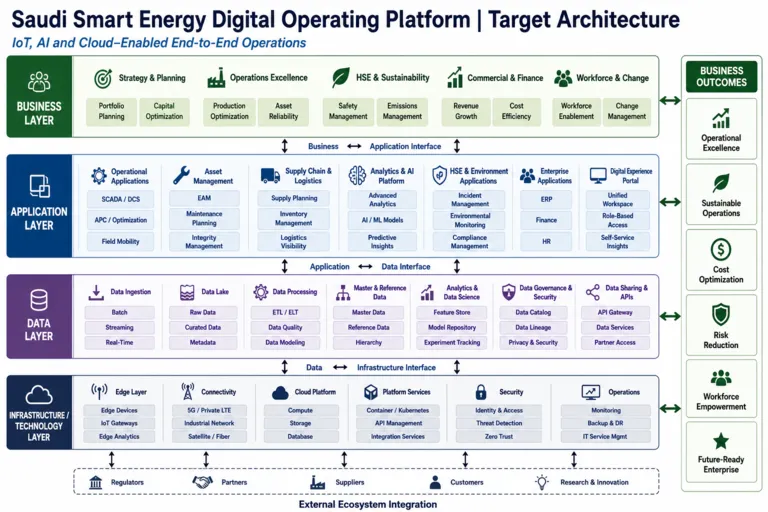
We formulated a comprehensive digital transformation strategy for the energy company, focusing on five key technology pillars: Artificial Intelligence (AI), Internet of Things (IoT), Big Data analytics, Cloud computing, and Cybersecurity. The solution involved deploying IoT sensors across the company’s operations – from drilling rigs and wells to pipelines and refineries – to create real-time data streams. This data would feed into a new centralized data platform (cloud-based) where big data analytics and AI algorithms could continuously run. For example, AI models would analyze seismic and geological data to identify optimal drilling sites and predict equipment failures for predictive maintenance, while IoT sensors would enable digital twins of facilities for instant diagnostics. We also recommended automating routine operations: implementing advanced process control systems in refineries and using robotics for remote inspection of pipelines. Importantly, we included a robust cybersecurity framework to safeguard the company’s critical infrastructure and data in this more connected environment. Additionally, the plan called for establishing a dedicated Digital Innovation Unit within the company and upskilling employees through digital training programs to foster a data-driven culture.
Approach
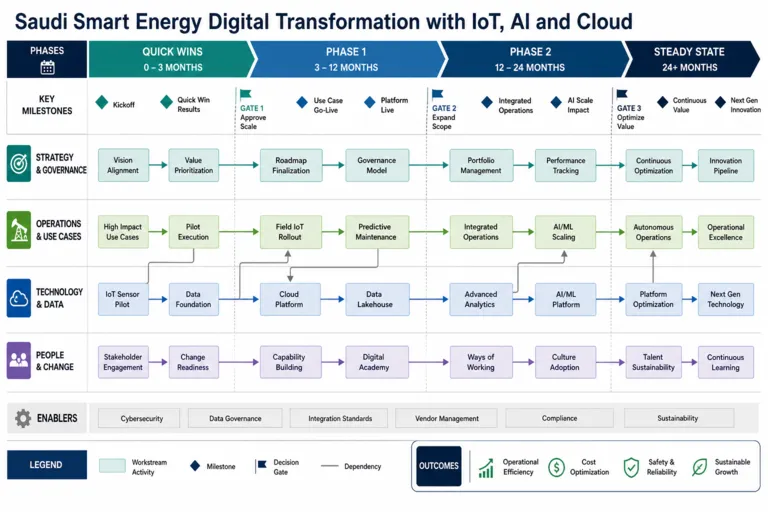
We took a phased approach to implementation, starting with high-impact pilot projects. Our team, alongside the client’s engineers, identified two pilot areas: one upstream (an oilfield for implementing IoT sensors and predictive analytics on pumps and compressors) and one downstream (a refinery unit for AI-driven process optimization and predictive maintenance). For these pilots, we deployed sensor networks and connected them to a cloud analytics platform, then developed AI models using historical data to predict equipment issues and optimize operations. We measured the outcomes – for instance, in the refinery pilot, energy consumption dropped and unplanned downtime was eliminated over a six-month period due to early fault detection. Building on pilot success, we crafted a detailed rollout plan covering all major assets. We also assessed the company’s existing IT/OT infrastructure and identified gaps (e.g. insufficient data storage and legacy control systems needing upgrades), forming a blueprint to upgrade networks and computing resources. Throughout, we worked closely with the company’s staff, conducting workshops on new tools and encouraging cross-departmental collaboration (like IT specialists working directly with field engineers). We also set up governance, establishing a steering committee to oversee the digital transformation and ensure alignment with business goals.
Recommendations
We presented several key recommendations. First, implement predictive maintenance company-wide by equipping all critical machinery with IoT sensors and using AI to predict failures – this reduces unplanned outages and maintenance costs. Second, adopt a unified data platform (moving to cloud-based infrastructure) to break down silos and enable advanced analytics across exploration, production, and distribution data. Third, deploy an integrated operations center that gives engineers and managers real-time visibility into the entire operation, from oil wells to refinery output, enabling faster decision-making and proactive adjustments. We also recommended specific technology investments: for exploration, use AI and big data to enhance seismic interpretation and reservoir modeling (leading to higher success rates in finding oil/gas); for production, implement digital twins for complex facilities to simulate and optimize performance; for distribution, use IoT for real-time monitoring of pipelines and logistics to improve safety and efficiency. Strengthening cybersecurity was another major recommendation – we advised adopting a zero-trust security model and continuous monitoring to protect the increasingly connected operations. Lastly, we emphasized change management: recommending that the client incentivize digital innovation internally (for example, launching “digital champion” programs and rewarding teams for process improvements driven by data).