Client
Issues
As solar capacity expanded, the utility faced big swings in supply: excess power at midday, shortfalls by evening, and this intermittency threatened grid stability. Without storage, surplus solar was wasted and gas plants had to ramp up after sunset. Achieving 50% renewables required grid-scale energy storage, but the client had no experience with these systems. The client needed a strategy to deploy large storage to stabilize the grid and maximize renewable usage.
Solution
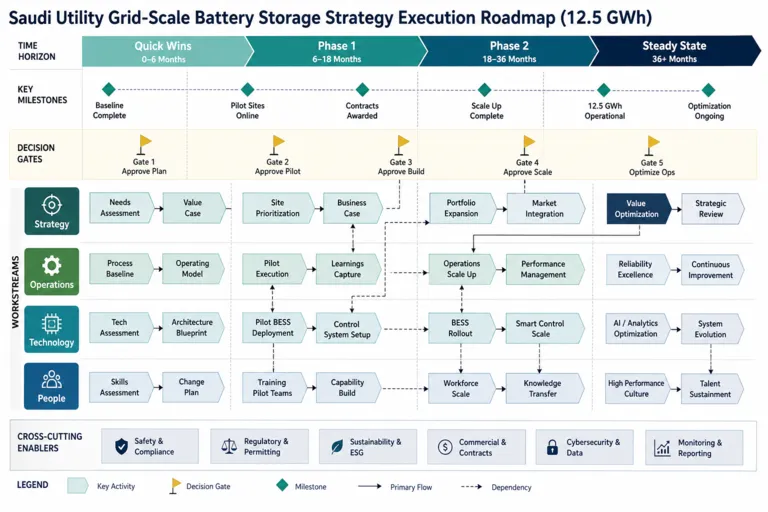
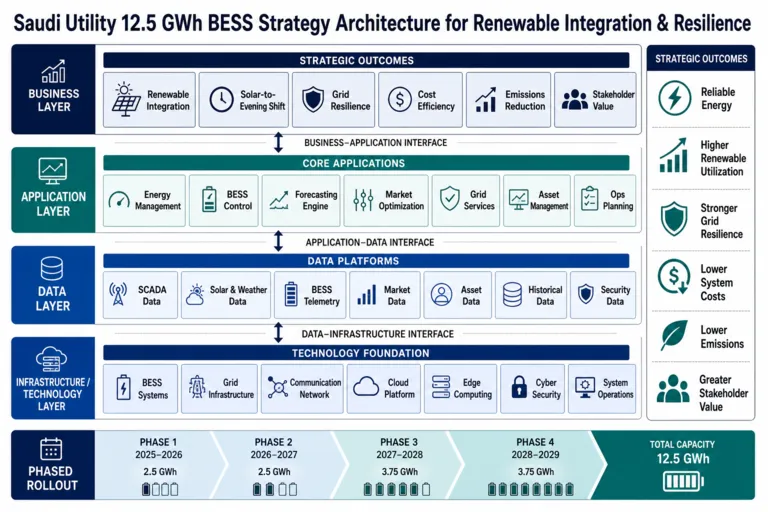
We designed a strategic energy storage deployment plan for the utility, centered on installing a grid-scale Battery Energy Storage System (BESS) network. The highlight of our solution was the proposal for a landmark battery storage project on the order of 10+ GWh of capacity – a project of unprecedented scale globally to handle Saudi Arabia’s renewable fluctuations. This would involve deploying large lithium-ion battery banks at key nodes in the grid (particularly at major solar generation sites and near high-demand urban centers) to absorb surplus power and discharge it during peak demand or grid contingencies. We structured the project in phases: an initial phase of around 2 GWh as a pilot in one region, followed by a scale-up to the full 10+ GWh system across multiple sites. Alongside batteries, we evaluated alternative and complementary storage technologies such as pumped hydro storage (though limited by geography/water), thermal storage, and green hydrogen (for long-term seasonal storage), recommending that the utility keep these in R&D or small pilot scope while the main investment would be in batteries given their maturity. The solution also included developing the software and control systems to integrate storage into the grid’s operations – effectively creating a smart energy management system that would charge and discharge the batteries optimalland forecasts and renewable output. We provided guidelines for procurement (as this scale of battery project would likely involve international battery technology providers in partnership with local engineering firms) and a financial model showing the long-term cost savings from fuel displacement and improved grid reliability.
Approach
To arrive at this solution, our team conducted an extensive analysis of power generation and demand patterns. We gathered data on hourly power production from solar plants and load curves across seasons. Using this, we simulated various storage scenarios (varying capacities and discharge durations) to determine how much storage would be needed to significantly reduce renewable curtailment and offset evening peak needs. We found, for example, that on a typical day a multi-GWh storage could flatten the late afternoon ramp-up of gas y shifting solar energy to that period. We also examined case studies of large storage deployments worldwide – such as big battery projects in Australia and the US – to glean technical and operational lessons. Our engineers worked on sizing the system: we determined the optimal locations for battery facilities by looking at grid congestion points and where solar capacity was concentrated. We consulted battery manufacturers to understand current and future costs, lifespans, and safety considerations of large lithium-ion systems. The approach also involved working closely with the utility’s grid operations team and regulators to ensure that using storage for grid services (like frequency regulation and spinning reserve replacement) unted for and valued. We helped draft an operational strategy for the storage system – including algorithms for charging when prices or demand are low and discharging when high, thereby also potentially participating in any future electricity market or saving fuel costs internally. Stakeholder management was key; we had to justify the investment to the utility’s leadership and government backers by demonstrating both reliability benefits and long-term economic gains of such a project, which we did through detailed cost-benefit analysis and reliability simulations.
Recommendations
We recommended the immediate initiation of a flagship battery storage project of around 12 GWh capacity, implemented in partnership with a leading global battery provider. Specifically, the project could be split into multiple sites (for example, four sites with ~3 GWh each) to increase resilience and cover different regions. We advised that the utility issue an international tender to attract top battery energy storage firms, while mandating requirements for local content (assembly or maintenance) to build local expertise. In terms of technology, our analysis favored lithium-ion batteries for this decade due to their proven track record and declining costs, but we also recommended allocating a small portion of budget to pilot newer technologies (like a flow battery installation or a hydrogen storage demo) to future-proof the strategy. We outlined an operational plan where the storage would provide peaking power for at least 4 hours each evening, effectively replacing a significant amount of gas-fired peaker generation, and also serve as a regulating reserve to instantly inject or absorb power to stabilize the grid frequency (something batteries excel at). We also recommended working with the national regulator to update grid codes and market rules to fully utilize storage – for example, allowing the utility to count stored energy as reliable capacity in planning, and to monetize ancillary services provided by the batteries. Maintenance and safety protocols were highlighted, including thermal management for battery containers in Saudi’s hot climate and emergency response plans. Finally, we advised a stakeholder communication plan to publicize the project’s role in enabling Saudi Arabia’s renewable energy ambitions, thus garnering public and investor support.
Engagement ROI
The energy storage initiative is set to be a game-changer for the utility. With our guidance, the client moved forward and inked a record-breaking agreement for a 12.5 GWh battery energy storage deployment, the largest of its kind in the world. This massive project, when fully commissioned, will enable the grid to capture surplus daytime solar generation and release roughly the same amount of energy during the critical evening hours, effectively shaving the peak and reducing the need for additional gas power plants. The expected benefits are substantial: the utility will save on fuel costs by substituting expensive peaking generation with stored sand it will reduce greenhouse gas emissions by using clean energy more fully. Grid reliability will improve as well – the battery network can respond within milliseconds to power fluctuations, acting as a giant shock absorber for the grid. Already, early phases of the battery project have demonstrated value: a 2.6 GWh pilot installation became operational and provided crucial support during a summer peak, preventing what would have been an overload situation. Economically, while the upfront investment is large, the utility is projected to gain a strong return over the system’s life through fuel savings and deferred capital expenditure on new power plants that are no longer needed immediately. Moreover, the initiative has positioned Saudi Arabia as a global leader in renewable integration; the client’s project is now internationally recognized, attracting visits from other utilities and potential investors. This reputational boost and the technical know-how gained (with a new cadre of Saudi engineers trained to operate and maintain large-scale batteries) are immeasurable returns on their own. In summary, the engagement’s outcomes enable the client to confidently expand renewable energy, knowing the storage backbone is in place to deliver power when the sun isn’t shining, thereby ensuring a stable, sustainable power supply for the Kingdom.