Client
Issues
The client produced low-value disposable supplies, while advanced medical devices were all imported. Saudi’s medical device market (~$2 billion) was growing fast, and the government incentivized local manufacturing of high-value equipment. However, the client lacked the technical expertise to make complex devices and faced strict regulatory requirements. Global competitors dominated the market, so the client needed a plan to acquire know-how and enter select high-demand device segments locally.
Solution
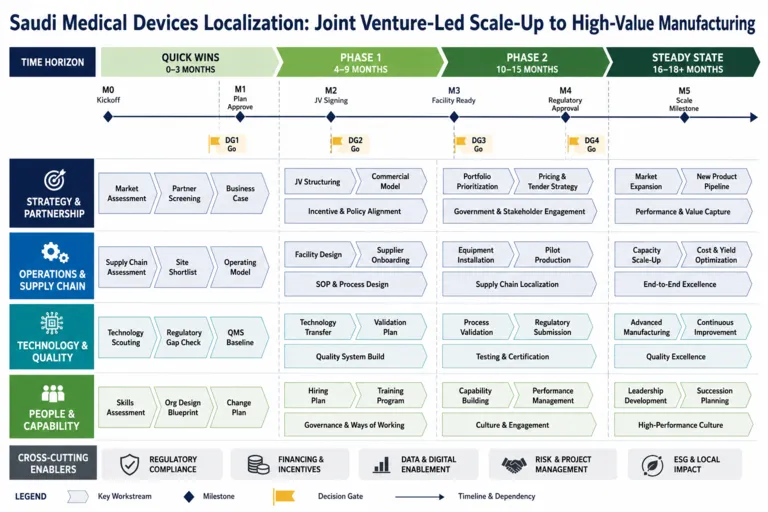
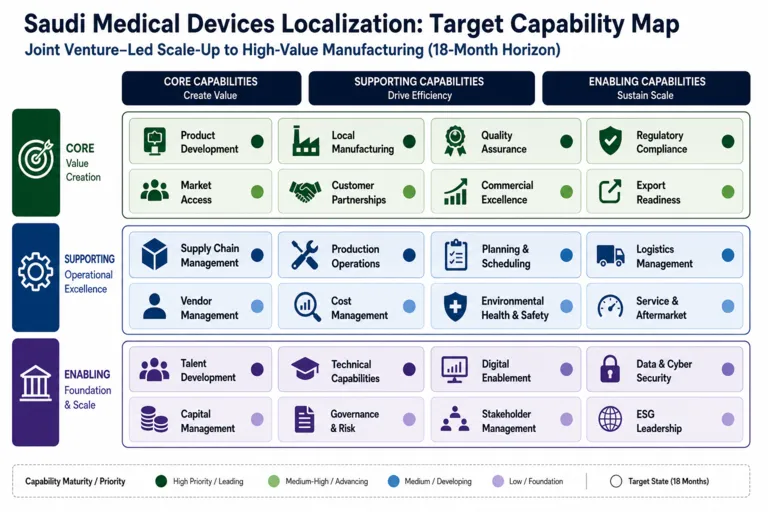
We proposed a strategic transformation for the client to move up the value chain. The solution centered on establishing local manufacturing for selected high-demand, high-value medical devices. Through market analysis, we identified product categories suitable for domestic production – for example, digital patient monitoring devices and mid-range diagnostic equipment – where local demand was strong and manufacturing feasibility was reasonable. We recommended investment in a new manufacturing and assembly facility equipped with modern machinery and clean-room environments needed for device production. Recognizing the client’s capability gap, we advised entering a technology licensing or joint venture with a global medical device manufacturer to obtain designs and training for producing certain devices domestically. The plan also included building a robust quality management system (aiming for ISO 13485 certification) to meet SFDA regulatory standards. In addition, we formulated a go-to-market strategy to help the client supply devices to local hospitals, leveraging government procurement programs that favor locally made products. Overall, the solution aimed to turn the client into a competitive local producer of select medical devices, aligned with Vision 2030’s localization goals.
Approach
Our approach began with an industry landscape study. We analyzed import data and hospital procurement trends to find device types with large demand and viable production potential. We also examined case studies of localization in other countries to understand best practices. Next, we performed a technical audit of the client’s operations to determine what new capabilities (equipment, skills, certifications) would be required to make more advanced devices. We then facilitated outreach to a short-list of reputable international device manufacturers for potential partnerships. Concurrently, our regulatory specialists mapped the SFDA approval process for medical devices and the specific requirements for local manufacturing (e.g. documentation, clinical evaluations), guiding the client on steps to compliance. We developed a phased implementation plan: Phase 1 for assembling imported device kits locally (to build experience and market presence), Phase 2 for manufacturing a larger portion of the device components domestically once expertise grew. We also collaborated with local universities and technical institutes to create a pipeline of biomedical engineers and technicians, helping address the talent gap in the client’s workforce.
Recommendations
We advised the client to focus on specific device categories for localization in the near term – for instance, starting with patient monitors and simple imaging devices which have steady demand and moderate complexity. We recommended investing in a modern production facility in an industrial zone with the infrastructure for high-tech manufacturing, and outfitting it for precision electronics assembly and testing. To bridge the expertise gap, we strongly encouraged forming a joint venture or licensing deal with a global device firm, where the partner provides technology and training while the client offers local market access and manufacturing capability. We also stressed implementing a rigorous quality assurance program: hiring quality engineers and obtaining ISO 13485 certification to ensure the devices meet international standards, which will build credibility. On the market side, we suggested working closely with the Ministry of Health and the national procurement body (NUPCO) to get the new devices evaluated and listed for government purchasing, capitalizing on the government’s local preference policies. Lastly, we recommended gradually expanding the product line – after establishing one or two product successes, move to other related devices (e.g. expanding from patient monitors to ventilators or imaging accessories) to steadily increase the client’s presence in the high-value segment.
Engagement ROI
The engagement set the client on a path to become a notable local device manufacturer. Following our plan, the client forged a partnership with an international medical device company, which is transferring technology for assembling digital patient monitors locally. Within 18 months, the client’s new facility began producing its first batches of Saudi-made medical devices. These monitors have already been delivered to several Saudi hospitals, reducing the need for imports in that category. The government’s support (via incentives and procurement preference) has ensured the venture’s commercial viability. The client has attained ISO 13485 certification and SFDA approval for its initial product line, establishing trust in its quality processes. Financially, the company has opened a new revenue stream and improved margins by capturing value-added manufacturing rather than just distribution. Perhaps most importantly, this success has positioned the client as a pioneer in the local medical device industry – a case study in effective localization. Buoyed by the results, the company is now planning to expand into additional device categories, further contributing to Saudi Arabia’s goal of being more self-sufficient in healthcare supplies.