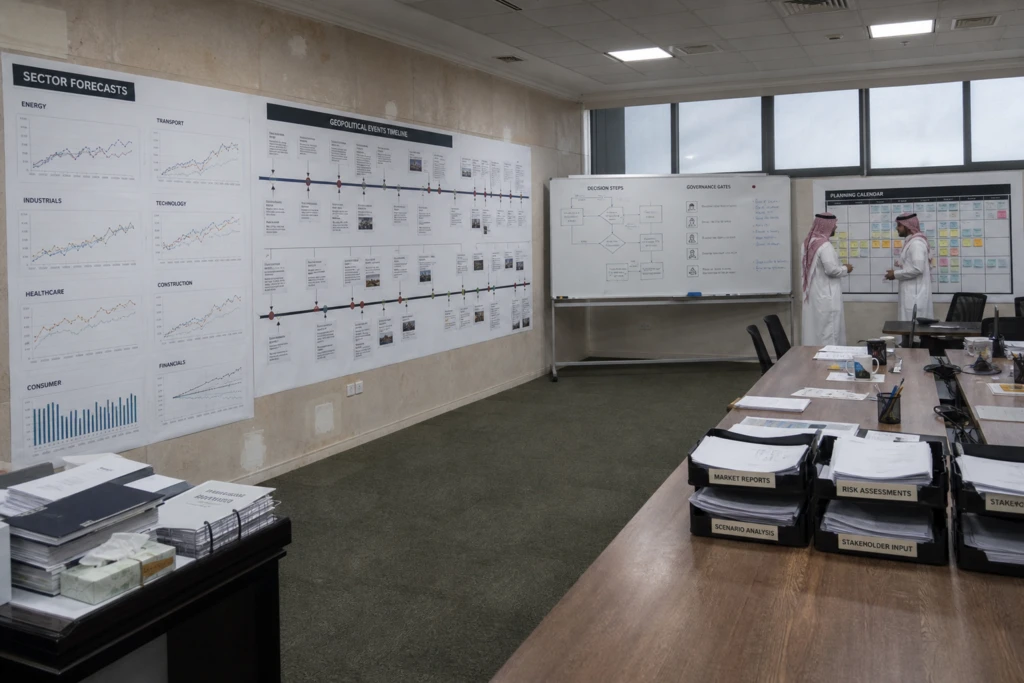
In 2026, volatility in Saudi Arabia is not abstract. Fitch Solutions slightly lowered its 2026 GDP growth forecast for Saudi Arabia from 4.8% to 4.6% in response to the ongoing US–Iran conflict, with impacts concentrated in tourism and logistics. Those kinds of shocks can travel quickly across supply chains and customer demand. A market intelligence function must therefore do more than publish dashboards. It must connect external risk signals to specific actions, owners, and timelines, so executives can decide what to pause, accelerate, hedge, or reprice.
Start by mapping the sectors where the pace of change is structurally high. In construction, GlobalData describes a market shaped by ambitious infrastructure investment and Vision 2030 objectives, with government spending expanding across transport, housing, renewable energy, healthcare, education, and industrial development. The practical implication is that intelligence work should track project pipelines, contractor benchmarking, regulatory and macro risks, and PPP opportunities, then convert these into bid priorities and partner shortlists. In parallel, e-commerce is scaling fast. Mordor Intelligence estimates Saudi Arabia’s e-commerce market at USD 31.29 billion in 2026, up from USD 27.96 billion in 2025, with projections of USD 54.87 billion by 2031 at an 11.92% CAGR over 2026–2031.
A 2026 Blueprint: Signals, Systems, and Decision Loops
Build the function around a small set of decision loops. First, define the questions leaders must answer weekly, monthly, and quarterly. Then choose the signals that change those decisions. Saudi Arabia’s data and analytics backbone is expanding. Mordor Intelligence values the Saudi big data and artificial intelligence market at USD 0.68 billion in 2026, forecasting growth to USD 2.81 billion by 2031 at a 32.87% CAGR (2026–2031). The same source notes NEOM’s sensor network streams more than 1 petabyte of data every day, and that mandatory e-invoicing has digitized 85% of transactions, producing structured invoices usable for analytics. Use these inputs to move from descriptive reporting to scenario tracking and early-warning alerts tied to commercial actions.
Operationalize intelligence with fit-for-purpose tooling and clear governance. Dimension Market Research projects the Saudi Arabia business intelligence market will reach USD 1.0 billion in 2026 and grow at a 9.9% CAGR to USD 2.3 billion in 2035. That context supports a practical stack: data integration, dashboards, and analytics, plus consulting and deployment services. Technavio also highlights how Saudi boardroom decisions increasingly balance sovereign cloud solutions for data residency with global cloud platforms. The same Technavio source cites measurable outcomes from digitization efforts: implementing business process management increased administrative efficiency by 25%, and digital archiving reduced document retrieval times by 40%.
Finally, make intelligence accountable. Create a cadence where sector owners review a short list of metrics, risks, and competitor moves, then document decisions and expected impact. Add security and resilience because real-time decisioning depends on trusted data flows. Technavio notes that in March 2025, Cisco Systems Inc launched a specialized cybersecurity center in Riyadh to provide local organizations with real-time threat intelligence and incident response services. In industrial and logistics contexts, edge computing can also support faster local processing; Technavio states it can reduce network bandwidth consumption by as much as 60%. This is how Saudi Arabia market intelligence becomes a repeatable management system, not a reporting layer.
What is the first step in building a market intelligence function for Saudi sectors in 2026?
Which 2026 volatility signal should leaders watch closely in Saudi Arabia?
What data foundation trends can strengthen decision-ready analytics in Saudi Arabia?
How big is Saudi Arabia’s e-commerce market in 2026, and why does it matter for intelligence?
How should a Saudi Arabia market intelligence team prove ROI beyond dashboards?