Saudi Arabia’s imaging ecosystem is being reorganized around privatization and public-private partnerships (PPPs). Multiple market reports tie this directly to Vision 2030 and a broader push to modernize healthcare infrastructure and decentralize services. One pressure point is purchasing authority. As procurement moves away from centralized Ministry of Health budgeting toward independent hospital operators and PPP entities, the door opens for private operators to run imaging departments, renew aging systems, and structure long-term service contracts. In parallel, Saudi Arabia’s medical imaging outsourcing market generated USD 65.3 million in 2024 and is expected to reach USD 121.2 million by 2030, showing how off-site and outsourced models are scaling alongside equipment upgrades.
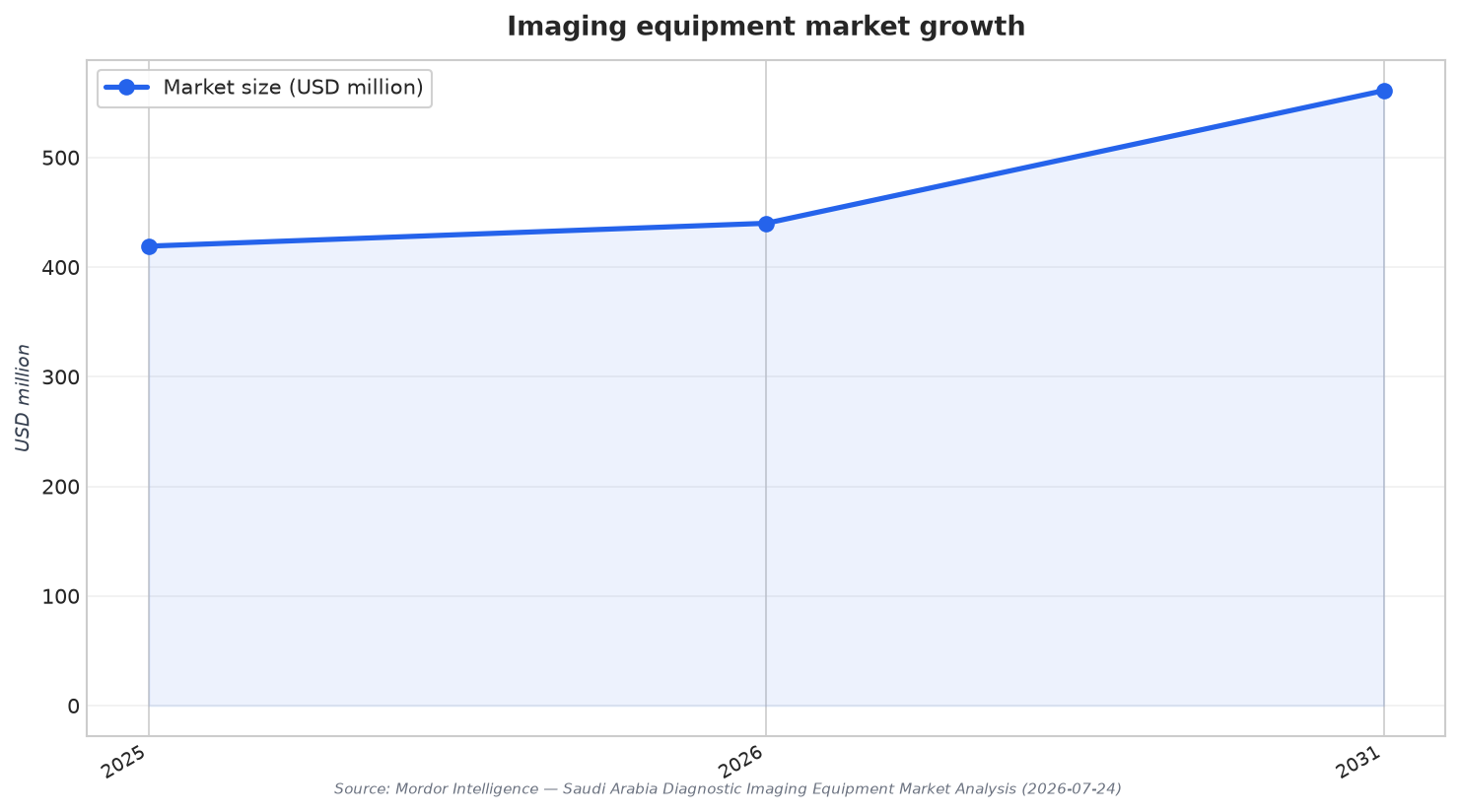
The Saudi Arabia diagnostic imaging equipment market is also expanding, with Mordor Intelligence estimating USD 419.11 million in 2025 and USD 439.97 million in 2026, alongside a projection of USD 560.97 million by 2031 at a 4.98% CAGR (2026–2031). The same source connects growth to capital inflows linked to Vision 2030, the privatization of public hospitals, and demand for high-resolution modalities for chronic disease. It also cites image-exchange networks and virtual-hospital initiatives that link 224 facilities to central radiology hubs, a model that naturally favors centralized reading, standardized protocols, and operator-led service delivery rather than purely in-house staffing at every site.
Why PPP Models Attract Private Imaging Operators
PPPs are not just a financing tool. They change the operating model. In teleradiology, one source says PPPs are playing a major role in expanding capabilities, enabling hospitals to operate efficiently without maintaining a large in-house radiology workforce. That aligns with the market reality that radiologist shortages are repeatedly flagged as a constraint. Outsourcing and hub-and-spoke reading are also supported by digitization and AI uptake. Mordor Intelligence points to AI protocols at King Faisal Specialist Hospital that cut cardiac MRI turnaround by 33% and notes replication across six tertiary facilities. MarketsandMarkets adds examples of AI-powered tools used in practice, including Lunit INSIGHT CXR and GE Healthcare’s AI-Sonic suite, reinforcing that workflow automation is now part of the competitive playbook for private operators bidding into PPP-style contracts.
Privatization targets add further momentum. An IMARC press release describes a push that includes privatizing 290 hospitals and 2,300 primary health centers, alongside references to a USD 66.6 billion public health budget used to speed purchases of CT, MRI, and hybrid systems across public and private settings. For operators, this matters because equipment mix and refresh cycles drive economics. In the equipment market, Mordor Intelligence reports X-ray held a 28.72% revenue share in 2025, fixed systems represented 80.22% in 2025, and hospitals held 64.30% of end-user share. At the same time, the same dataset signals growth lanes for challengers: ultrasound is forecast at a 6.62% CAGR through 2031, mobile and hand-held systems at a 6.18% CAGR (2026–2031), and diagnostic imaging centers at a 6.32% CAGR over the forecast period.
Private participation is also shaped by vendor strategy and regulation. MarkWide Research describes localized service infrastructure and direct procurement partnerships, with GE HealthCare leveraging a Riyadh training center and spare parts hub to support maintenance contracts, and Siemens Healthineers anchoring hybrid imaging installations at flagship tertiary sites. It also highlights the Saudi Food and Drug Authority’s device registration and post-market surveillance requirements as a factor in qualification timelines and compliance costs. For PPP operators, these constraints can become differentiators: the ability to manage approvals, cybersecurity mandates, and uptime obligations can be as important as buying the scanner. Taken together, these trends show a Saudi imaging market where outsourcing, PPP operations, and outcome-based service contracts are becoming routes to scale.
How fast is Saudi Arabia’s diagnostic imaging equipment market growing?
What evidence shows imaging outsourcing is expanding in Saudi Arabia?
How do PPPs support teleradiology and remote reporting?
Which segments stand out inside the Saudi Arabia diagnostic imaging market by share or growth?
What scale of facility privatization is being discussed for healthcare in Saudi Arabia?