Saudi Arabia’s construction and contracting environment is expanding in scale and in the number of participants. Mordor Intelligence values the Saudi Arabia construction market at USD 78.60 billion in 2025, and estimates it grows from USD 82.80 billion in 2026 to USD 101.83 billion by 2031, at a CAGR of 4.22% over 2026–2031. In parallel, Arab News reports that foreign contracting companies entering the Saudi market have reached 1,648 since the establishment of the Saudi Contractors Authority. The same source says total local and foreign entities registered with the authority reached 140,000, underlining how crowded bidding and subcontracting pools can become even as demand rises.
Sector mix helps explain where competitive intensity concentrates. Mordor Intelligence says infrastructure led with 60.13% of 2025 revenue, and that new construction dominated with an 85.08% share in 2025. It also notes conventional on-site work represented 90.92% of 2025 value, while modern construction methods are expanding at a 5.53% CAGR. These shares matter because they point to where scale, delivery speed, and systems such as BIM become differentiators. IMARC adds that the Ministry of Municipal, Rural Affairs, and Housing mandates BIM Level 2 compliance for major public projects, which can raise the bar for smaller contractors that have not institutionalized digital workflows.
Benchmarking the Foreign Entrants: Who Sets the Pace?
Benchmarking starts with concentration at the top. IMARC states that the top five players—Bechtel Corporation, Fluor Corporation, Jacobs, Tekfen Construction, and Gilbane Inc.—collectively account for an estimated 28–32% of total construction value in 2025. IMARC also describes a moderately fragmented structure with global EPC leaders and multinational engineering firms alongside established regional contractors. That blend is a core feature of the Saudi Arabia foreign contractors competition dynamic: international firms often bring integrated project delivery and multi-stage control, and IMARC notes consolidation through PPP frameworks and integrated project delivery contracts where major EPC contractors manage multiple value chain stages simultaneously. For local players, this changes what “competitive” means: not just price, but governance, program management, and compliance capability.
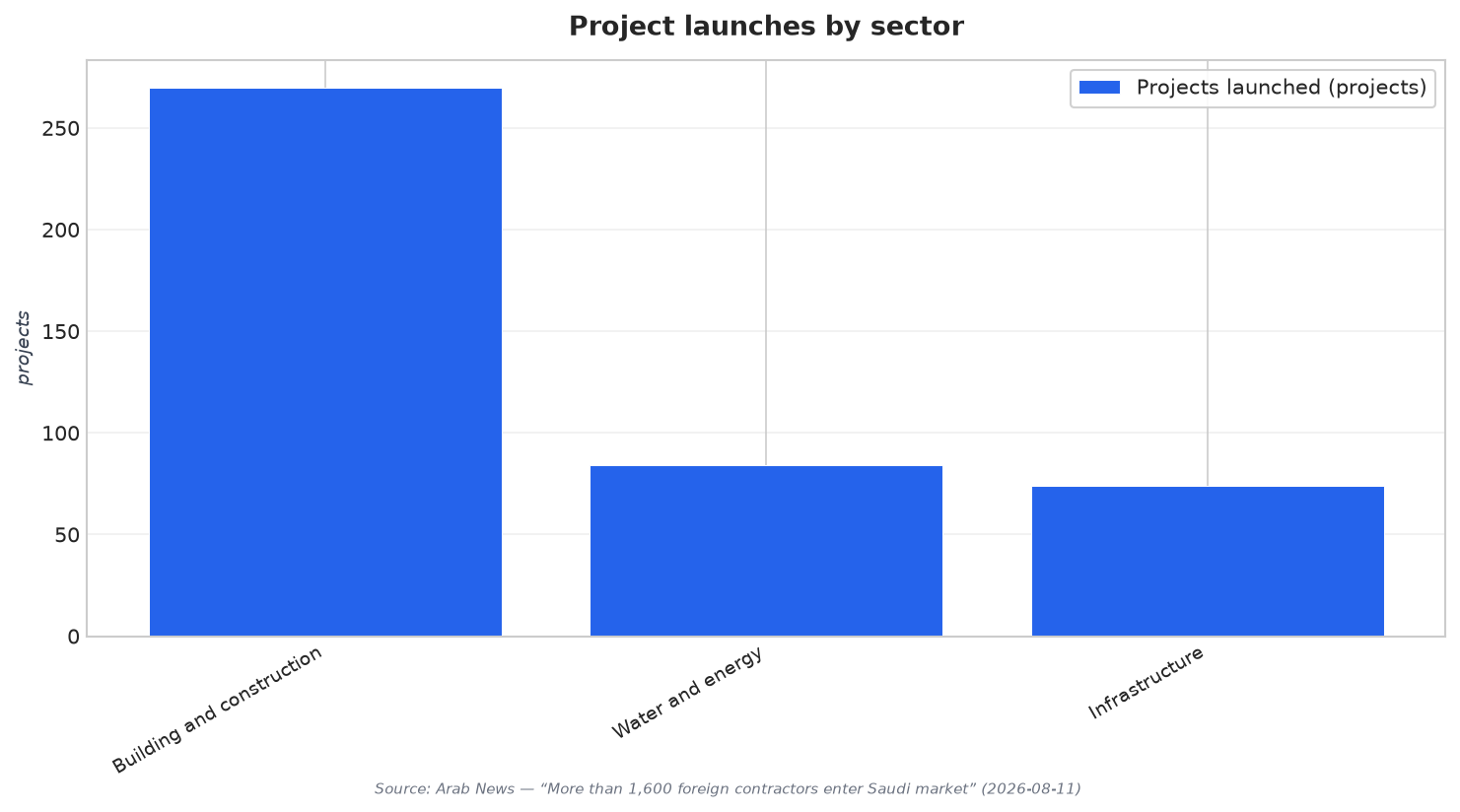
Local opportunity still expands, but it is increasingly linked to how projects are packaged. IMARC says the residential sector is the largest at 42.5% and is the most fragmented, with ROSHN, NHC, and thousands of smaller developers and contractors across regional markets. Arab News reports 472 projects launched last year, with building and construction leading at 270 projects, followed by water and energy at 84 and infrastructure at 74. Arab News also says the contracting sector contributes about 8% of GDP and that the authority previously valued the sector at more than SR855 billion since the launch of Vision 2030. IMARC highlights that under Saudi contract law, main contractors may delegate work to subcontractors while remaining fully accountable to the employer—an arrangement that can deepen local capacity when local firms win repeat specialist scopes.
What should local contractors do in practice as competition tightens? IMARC flags that nationalization targets under Saudization complicate workforce planning because the sector remains heavily reliant on foreign labor, creating a balancing challenge between localization goals and execution needs. It also notes that minority-stake joint ventures with local contractors can be a compliant route for EPC firms to reach preferred status under Saudization rules, which implies locals can win by being the partner of choice. Mordor Intelligence adds that rivalry is intensifying as local champions form joint ventures with global majors to secure technology and balance-sheet strength for large awards. In short, differentiation comes from compliance readiness, delivery systems such as BIM Level 2 where required, and a partner-and-subcontractor strategy aligned to where demand is strongest.
How many foreign contracting companies have entered Saudi Arabia’s market?
How concentrated is the top tier of contractors in Saudi Arabia?
Which segments are dominating recent construction activity?
What does Saudi Arabia’s foreign contractors competition mean for local firms?
How many projects were launched last year, and which category led?