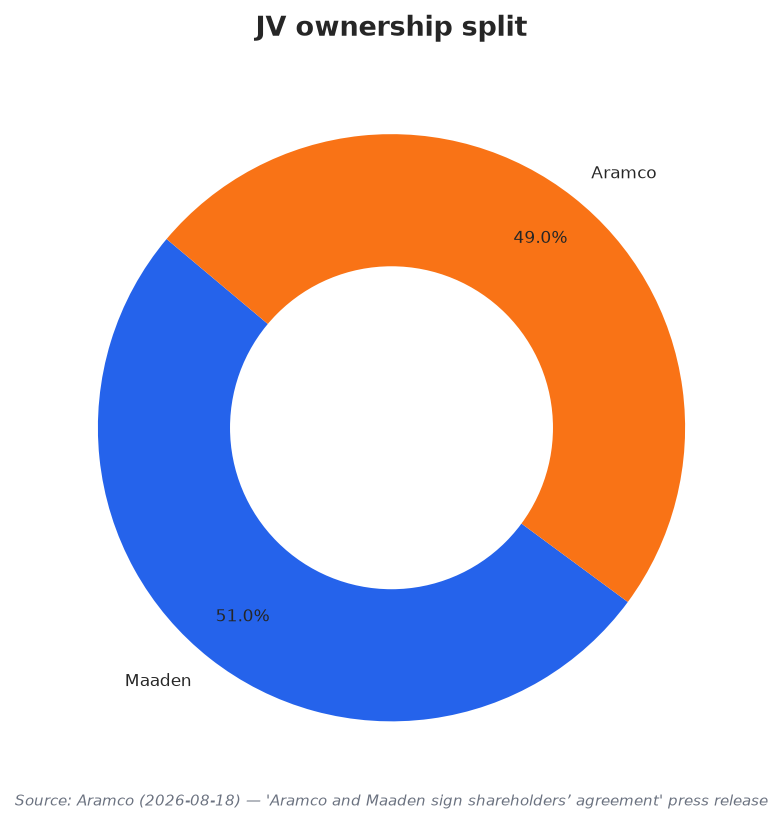
Saudi Aramco and Maaden have signed a shareholders’ agreement to form a joint venture aimed at unlocking a new frontier for mineral exploration and hard-rock mining in Saudi Arabia. The proposed company is expected to be owned 51% by Maaden and 49% by Aramco. Its work would focus on Zone-4, also called the Transition Zone, within the Arabian Platform. The intended exploration area spans approximately 182,000 square kilometers, described as nearly 10% of Saudi Arabia’s total land area, and it is positioned as a major opportunity for mineral discovery in the Kingdom.
The exploration footprint is described as a 100-kilometer-wide zone running parallel to the Arabian Shield, creating a corridor where the partners plan to concentrate early screening and target definition. Copper is a main focus because it is increasingly significant for electric vehicles, power networks, energy storage, and renewable energy systems. Other energy-transition minerals are also in scope. Reporting and analysis around the agreement cite zinc, lead, and rare-earth elements alongside copper as potential targets in the same Zone-4 corridor, reinforcing that the search is broader than a single commodity.
How Data, AI, and Computing Shape the Exploration Approach
The strategic logic centers on combining distinct strengths. Aramco brings subsurface knowledge, advanced AI tools, and high-performance computing, and one analysis describes it as drawing on more than 90 years of geological and geophysical information from a large hydrocarbon program. Maaden contributes mineral exploration expertise, mine development capability, and processing know-how. Together, the partners intend to use combined datasets to rank targets beneath cover faster and at lower cost, shifting effort from broad regional work toward more sharply defined targets. Public statements also emphasize that AI and computing are expected to accelerate discovery at low cost.
Timing and status matter for how the market should read the announcement. Plans for the venture were first disclosed in January 2025 and later advanced to a shareholders’ agreement in August 2026. However, one review stresses that the joint venture had not yet been incorporated as of its cut-off date, and the agreement remains conditional on corporate and regulatory approvals, including antitrust clearance. No exploration budget, license schedule, drilling commitment, target inventory, or resource has been published. In that framing, this is an exploration option with negotiated intended scope and ownership, not yet an operating mining business.
Context on copper demand appears in some coverage, but the numbers vary by source. One outlet states the copper market is currently valued at around $250 billion and projected to exceed $400 billion by 2035, while another repeats the current value but presents a different 2035 figure. The clearest operational facts remain the joint venture’s intended 51:49 structure, the approximately 182,000-square-kilometer Zone-4 focus, and the plan to apply AI, computational capabilities, and legacy subsurface information to prioritize targets. Those elements define the core thesis behind the Aramco Maaden joint venture as announced so far.
What is the Aramco Maaden joint venture expected to do?
How large is the planned Zone-4 exploration area?
What ownership split is expected between Maaden and Aramco?
How are AI and computing supposed to help exploration in the JV?
Is the joint venture already operating and funding drilling programs?