In April 2026, Saudi Arabia became the first Arab nation to participate in the Artemis program when it launched the “Shams” satellite aboard NASA’s Artemis II mission. The satellite is intended to monitor space weather, and the milestone landed in a period framed by broader economic and technology change. In that same April 2026 snapshot, Riyadh ranked 24th globally in the IMD Smart City Index 2026, and eight Saudi cities appeared in the index overall. Together, these signals point to a national push where space capability is increasingly linked with digital readiness and real-world services.
Multiple recent projections outline the pace of growth now expected across the Saudi Arabia space economy. The Communications, Space and Technology Commission (CST) and partners stated that the space economy is projected to expand from $8.7 billion in 2024 to $31.6 billion by 2035, and CST’s KSA Space Market Report 2025 described this trajectory as a 12% compound annual growth rate through 2035. Another estimate also placed the direct space market at approximately $1.9 billion, with the direct market projected to reach around $5.6 billion. These figures frame a market moving beyond symbolism toward scaled services and investment pipelines.
Where the Money Concentrates: Downstream Satellites and Data Services
One detailed market breakdown argues that growth is anchored in downstream activity such as satellite communication, satellite navigation, and Earth observation. In that view, downstream segments command 88% of average market share. Satcom is described as leading with an annual average of $1.8 billion, followed by satellite navigation at $1.5 billion, while Earth observation contributes over $200 million annually. This matters because it ties space investment to practical outcomes: broadband demand, enterprise data services, logistics, and government use cases spanning defense, urban planning, agriculture, and disaster response. It also suggests that value capture is expected to come from applications and services more than hardware alone.
The sustainability case for satellites is also stated explicitly in the Digital & Space Sustainability Report 2026. It says more than 50% of essential climate variables can be measured from space, and it highlights satellite technologies for climate monitoring, water management, agriculture, desertification, and disaster response. This framing links orbital capabilities to national resilience priorities and to digital tools such as AI. In the same reporting set, business adoption of AI in Saudi Arabia was reported at 33.1% in 2025, up from 20% in 2024, reinforcing the idea that data-driven workflows are spreading across the economy.
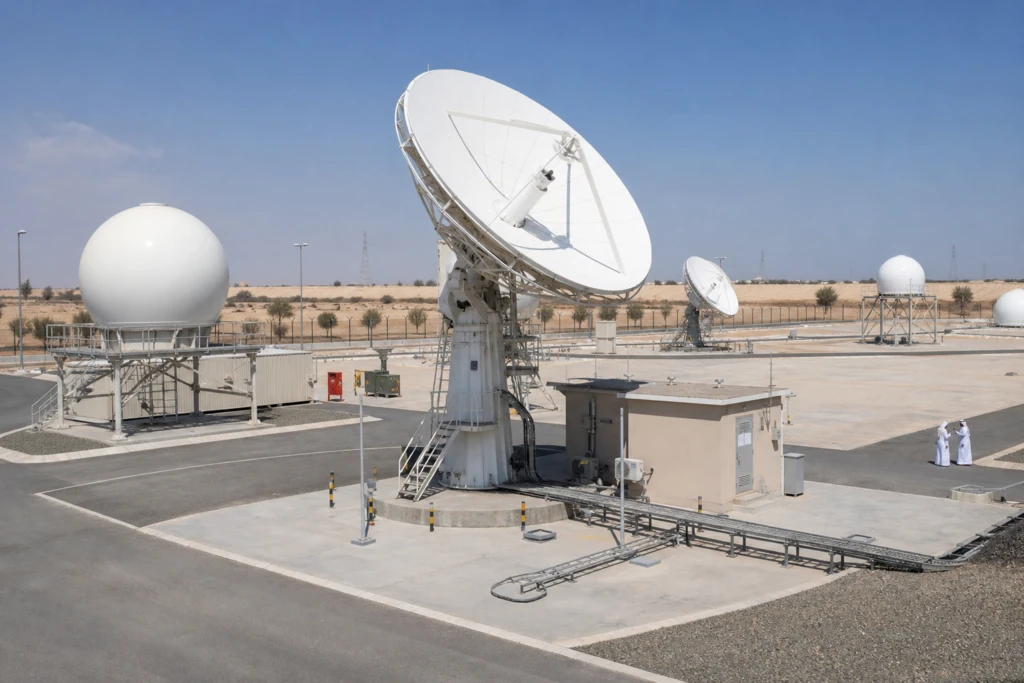
Upstream capacity building is presented as the harder, partnership-heavy side of the story. Upstream activity including satellite manufacturing, launch services, and ground infrastructure is forecast to generate $0.5 billion annually in one sector assessment. Manufacturing is expected to peak between 2027 and 2029 as new LEO constellations roll out, including SARsat’s plan for 18 satellites, but the same source notes constraints such as the absence of local launch capabilities and limited domestic manufacturing capacity. Meanwhile, Saudi Arabia’s digital foundations keep strengthening: internet penetration reached 99.6% in 2025, fiber-optic coverage extended to more than 3.9 million homes, and the Kingdom scored 99.2 points in the ITU’s ICT Development Index 2025, the highest score globally.
What did the Shams satellite mission do for Saudi Arabia’s space push?
How fast is Saudi Arabia’s space economy projected to grow by 2035?
Which parts of the market are expected to dominate the Saudi space sector?
Why are satellites important for sustainability and climate monitoring in the Kingdom?
What constraints could slow upstream space manufacturing and launch progress?