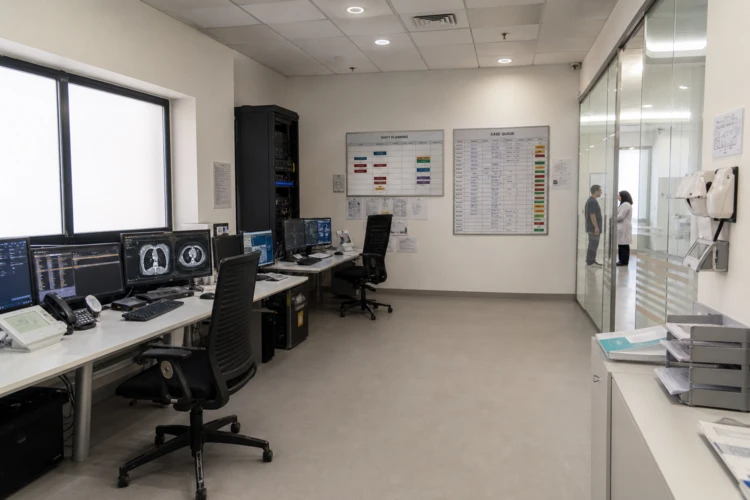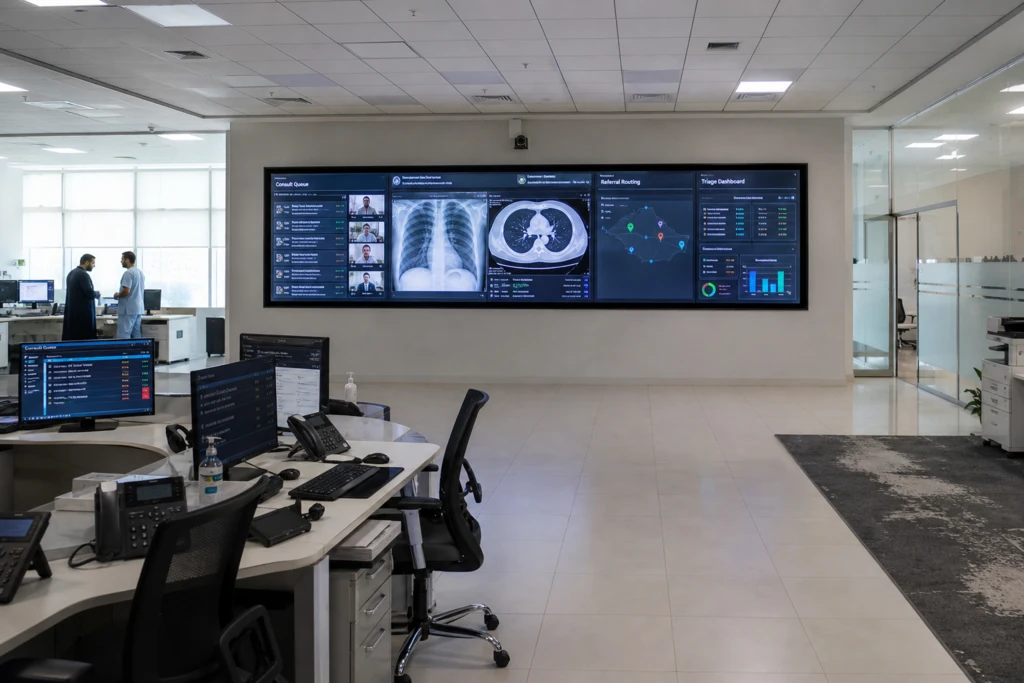
Seha Virtual Hospital (SVH) is a national platform built to make specialist care accessible without forcing patients to travel. A peer-reviewed retrospective analysis notes SVH was established in February 2022 and aligns with Vision 2030, with the study examining its growth, service delivery, and patient outcomes from 2022 to 2024. Multiple sources describe SVH as the world’s largest virtual hospital and a core pillar in Saudi Arabia’s digital health transformation. It is designed as a network, not a single building, so remote clinical services can be delivered across regions while keeping care pathways connected to local hospitals and primary-care sites.
The scale is repeatedly quantified. SVH connects 224 hospitals across the Kingdom, according to World Economic Forum and Saudi Market Research Consulting. The Vision 2030 encyclopedia entry also describes a network of over 200 connected hospitals and adds that more than three thousand primary-care centres are linked to the platform, spanning all thirteen administrative regions of Saudi Arabia. In practice, that footprint supports a broad menu of virtual services, from emergency triage to specialist referrals and chronic disease management. For readers tracking the Saudi Arabia virtual hospital telehealth story, the key point is that SVH is structured to distribute specialist expertise nationally, rather than concentrating it only in major cities.
What SVH Delivers: Volume, Specialties, and AI-Enabled Care
Several sources describe SVH’s clinical breadth and high throughput. The Vision 2030 encyclopedia says SVH delivers virtual consultations across more than forty medical and surgical specialties, while a Futurism overview states the network serves 71 major specialties and connects 224 facilities. On volume, the World Economic Forum reports SVH “facilitates over 16 million virtual appointments,” spanning emergency triage, specialist referrals, and chronic disease management. Futurism also states SVH has facilitated over 1.6 million virtual consultations with real-time specialist collaboration nationwide and highlights AI-driven use cases such as breast cancer detection and diabetic retinopathy screening across facilities, alongside AR-enhanced consultations.
SVH’s role sits inside a broader government-led digitization push. Futurism attributes Vision 2030’s Health Sector Transformation Program with attracting over USD 66 billion in health and social development spending, with SAR 214 billion allocated for healthcare infrastructure, and says USD 1.5 billion has been earmarked specifically for health information technology. In the same source, electronic health records are described as covering 70% of patient activities, with over 140 million online prescriptions issued through integrated platforms. These system-level building blocks matter because SVH depends on connected workflows across facilities, specialties, and regions to keep virtual interactions clinically useful, rather than isolated one-off calls.
Market and adoption signals reinforce why Saudi Arabia is investing in networked telehealth. An IMARC Group figure cited by Futurism values the Saudi Arabia digital health market at USD 5.01 Billion in 2025 and projects USD 15.32 Billion by 2034, with a 13.23% CAGR from 2026–2034. Separately, Waseel cites a digital health market of $4.4 billion in 2024, projected to reach $15.3 billion by 2033, and estimates a 9–13% compound annual growth rate through 2033. On telehealth specifically, Saudi Market Research Consulting projects growth from USD 1.06 billion in 2024 to USD 3.92 billion by 2030, a 25.1% CAGR from 2025 to 2030. Together, these figures frame SVH as both a service-delivery model and a response to fast-moving demand for digital care.
When was Seha Virtual Hospital established?
How large is Seha Virtual Hospital’s network in Saudi Arabia?
How many virtual appointments does SVH facilitate?
What clinical specialties and AI services are highlighted in the Saudi Arabia virtual hospital telehealth model?
What do sources say about Saudi Arabia’s telehealth market growth?