Autonomous and connected mobility in Saudi Arabia is moving from concept to governed rollout. A key marker is the Saudi Road Code, which came into effect in early 2025 and provides formal guidelines for integrating semi-autonomous and self-driving vehicles into road networks. In practice, this regulatory step matters because it anchors how pilots can be approved, monitored, and expanded. The same policy direction is reinforced by government digital transport initiatives, including the Ministry of Transport and Logistics launching a Digitalization and Technical Processing Center and a Unified Documents and Records Platform. Together, these steps set the baseline for safer trials and more predictable deployment pathways.
Connected infrastructure is the other half of the autonomy equation. IndexBox estimates the Saudi Arabia in-vehicle connectivity market at approximately USD 480–620 million in 2026, and says embedded connectivity solutions account for roughly 55–65% of market value that year, reflecting OEM preference for factory-installed systems. The same source also highlights structural import reliance, estimating 85–95% import dependence for connectivity hardware and modules, while local value concentrates in integration, retrofit, and service platforms. These figures show why connectivity policy, supply chains, and platform operations are becoming as important as the vehicle itself.
Pilots, Platforms, and the Software Layer Behind Autonomy
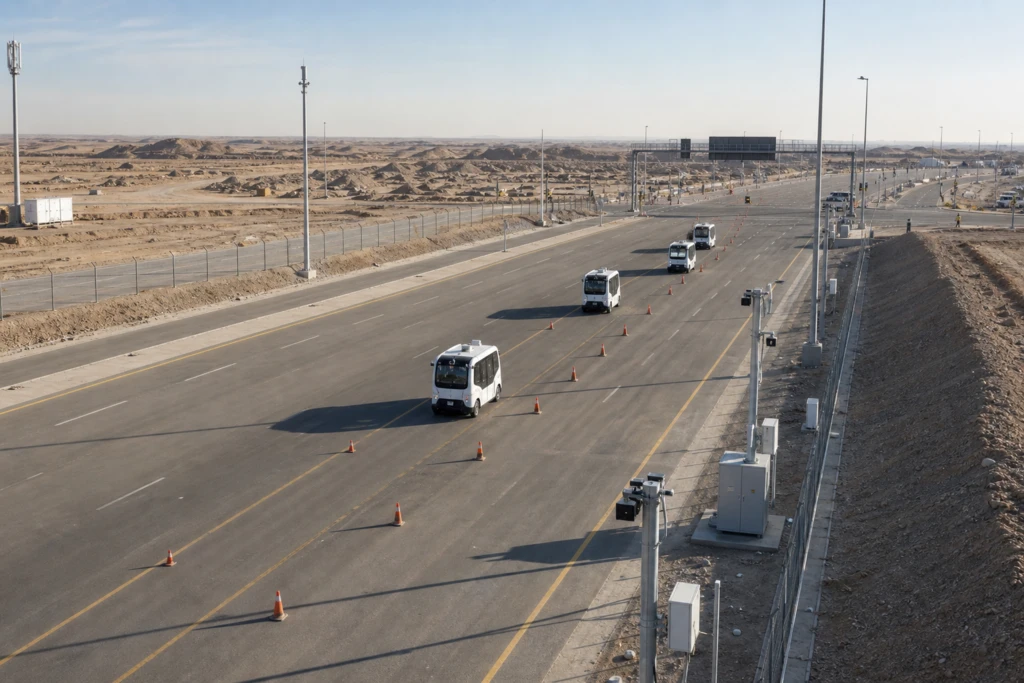
Pilot programs are emerging alongside the push to software-defined transport. Mordor Intelligence notes that NEOM, while still in construction, outlines autonomous-vehicle and hydrogen-fuel pilot programs, pointing to disruptive mobility modalities in the second half of the decade. Separately, the automotive software layer is scaling with demand. IMARC data cited by Vocal Media reports Saudi Arabia’s automotive software market reached USD 237.6 million in 2025, with expectations of USD 706.8 million by 2034 and a CAGR of 12.88% during 2026–2034. The same source ties the Road Code to the opening for larger ADAS and autonomous software deployment, including trial autonomous buses in NEOM City.
By 2026, fleet readiness is also shaped by the broader vehicle market and localization moves. Mordor Intelligence values the Saudi Arabia automobile market at USD 47.46 billion in 2025, estimating growth to USD 50.33 billion in 2026 and projecting USD 67.55 billion by 2031 at a 6.05% CAGR (2026–2031). In February 2025, the same report says Ceer signed SAR 5.5 billion (USD 1.4 billion) in supplier deals, locking in 45% localization ahead of its 2026 model debut. These signals do not guarantee driverless fleets immediately, but they show how production, software, and regulation are being aligned for scaled deployment over time.
Market forecasts also frame why the Saudi Arabia autonomous vehicles 2026 conversation is increasingly about commercialization discipline, not just demonstrations. Grand View Research projects Saudi Arabia’s autonomous vehicle market to reach US$ 3,027.7 million by 2030, with a CAGR of 17.6% from 2025 to 2030. Meanwhile, global context from DataM Intelligence describes how adoption is becoming more practical: L2 systems scaling broadly, fewer L3 deployments in approved domains, and L4 robotaxi fleets expanding city by city under local approvals and defined operational design domains. In Saudi Arabia, the near-term path is therefore likely to combine regulated pilots, connected-vehicle mandates, and software validation that can support repeatable fleet operations.
What changed in Saudi Arabia’s rules for self-driving vehicles in 2025?
How big is the in-vehicle connectivity market in Saudi Arabia around 2026?
What is NEOM doing on autonomous mobility?
How large is Saudi Arabia’s automotive software market, and why does it matter for autonomy?
What should readers watch in the Saudi Arabia autonomous vehicles 2026 roadmap?