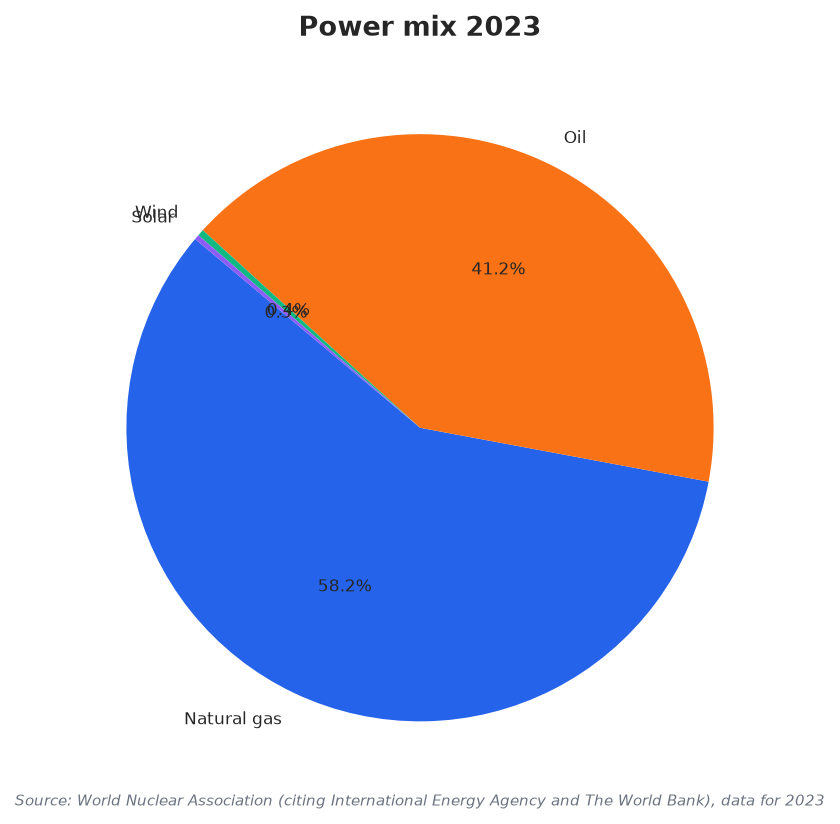
Saudi Arabia’s push to establish a civil nuclear power industry is unfolding against an electricity system that, today, is dominated by fossil fuels. In 2023, total electricity generation was 441 TWh, with natural gas providing 257 TWh (58%) and oil 182 TWh (41%), while wind (1.6 TWh) and solar (1.2 TWh) remained a small fraction of supply. That backdrop helps explain why nuclear remains attractive in policy terms: the country’s electricity demand is large, and per-capita consumption was about 9,400 kWh in 2023. The World Nuclear Association also notes that Saudi Arabia consumes over one-quarter of its oil production, while energy demand is projected to rise substantially even as oil production is not.
Ambition has not been the problem. Saudi Arabia projected 17 GWe of nuclear capacity by 2032 in 2013, but that target was abandoned two years later, illustrating how quickly timelines and assumptions can change. The same pattern shows up in renewables. A KA-CARE proposal adopted in 2012 aimed for 23.9 GWe of renewables by 2020 and 54 GWe by 2032, later pushed back to 2040. Vision 2030 targets were raised again in January 2019 to 27.3 GWe in 2023 and 58.7 GWe in 2030, yet installed capacity at the end of 2024 was about 6.2 GWe of solar and 0.4 GWe of wind. Nuclear planning is therefore developing in an ecosystem where execution risk, procurement choices, and grid integration all matter.
Where the Nuclear Build Stands: Procurement, Fuel-Cycle Plans, and U.S. Terms
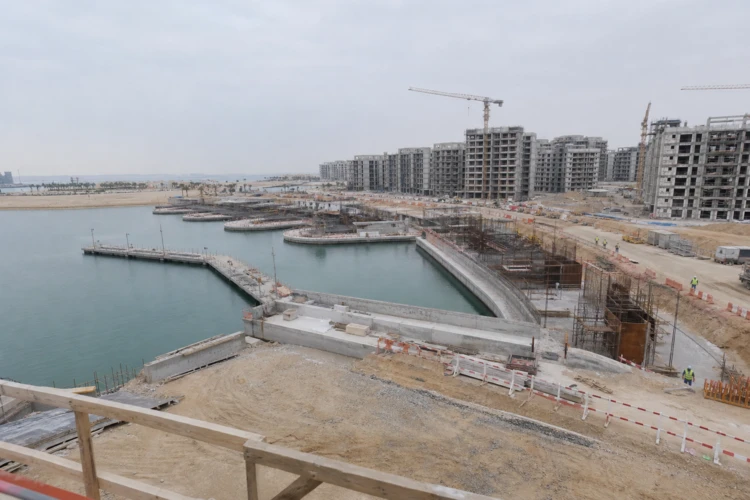
On project definition, the Arms Control Association reports that Saudi Arabia’s nuclear development entity, the Nuclear Holding Company, has solicited bids from four companies—Rosatom, China National Nuclear Corporation, EDF, and KEPCO—to build the Kingdom’s first two power reactors, sized at 1.4 GWe each, at the Duwaiheen site near the border with Qatar and the UAE. Beyond reactors, Saudi officials have articulated a broader industrial scope. Prince Abdulaziz bin Salman stated in 2023 that Riyadh plans to develop the “entire nuclear fuel cycle,” including “the production of yellowcake, low-enriched uranium and the manufacturing of nuclear fuel” for national use and for export. If pursued, that expands the value chain from EPC and O&M into mining, conversion, enrichment, and fuel fabrication-related services.
A major diplomatic milestone arrived in July 2026. Wikipedia and the American Nuclear Society’s Nuclear Newswire both report that the United States and Saudi Arabia finalized and signed a civil nuclear cooperation agreement (a Section 123 agreement), with the Wall Street Journal-reported term described as 30 years. The ANS report also notes President Donald Trump wrote that “there will be no enrichment of material,” while other reporting described concerns about enrichment pathways and verification. The Arms Control Association adds that Trump announced finalization on July 22, and notes the deal must be submitted to Congress for review under the Atomic Energy Act. For suppliers and financiers, these terms influence what technology can be offered, what safeguards apply, and how bankable long-lead projects become.
For the energy value chain, nuclear’s significance is not just generation; it is system strategy. Saudi Arabia’s generating capacity was 83.0 GWe in 2021, up from 25.8 GWe in 2000, and the World Nuclear Association says the Kingdom is unique in the region in having a 60 Hz grid frequency, which “severely limits the potential for grid interconnections.” That makes domestic reliability, dispatch planning, and long-term fuel and maintenance contracting especially important. If the reactor procurement advances and fuel-cycle ambitions are pursued, the programme could create demand for construction capability, skilled operations, safeguards compliance services, and a new nuclear fuel and services stack that interacts with existing gas-and-oil-heavy generation planning.
Where does the Saudi Arabia civil nuclear program stand in 2026?
How fossil-fuel-heavy is Saudi Arabia’s power mix today?
Which companies are bidding to build Saudi Arabia’s first reactors?
What has Saudi Arabia said about building a nuclear fuel cycle?
What grid factor could shape nuclear integration in Saudi Arabia?