Saudi Arabia’s localisation push is no longer a distant Vision 2030 ambition. It is a procurement reality that is reshaping how primes and suppliers structure work packages, where they build capacity, and which tiers of the supply chain can win contracts. A Vision 2030 tracker frames the end goal as localising 50% of military spending by 2030, while describing a low baseline of domestic industrial content estimated at below 5% and reporting that localisation reached 24.89% at end-2024 on GAMI’s published measure. That arc creates urgency. It also creates practical openings for firms that can deliver qualified parts, services, and industrial support that count toward localisation metrics.
Defence budgets provide the demand-side pull that makes localisation investable. One report cites Ministry of Finance figures that Saudi Arabia’s military expenditure was estimated at USD 63.7 billion in 2025, described as an increase of 1.1% over 2024. A separate country commercial guide cites the 2025 budget and states Saudi Arabia will allocate $72.5 billion in 2025, or about 21.2% of its total budget, to defense of the Kingdom and its sovereignty. AGBI, citing SIPRI, reports Saudi Arabia in 2025 spent $83 billion on defence, up 3.5% year on year, equivalent to 6.5% of GDP and about 3% of global military expenditure. These figures do not all use the same definition, but they point in one direction: consistent, large-scale spending that can be steered into local workshare.
Where the Supply Chain Opens First: Services, Sustainment, and Certified Parts
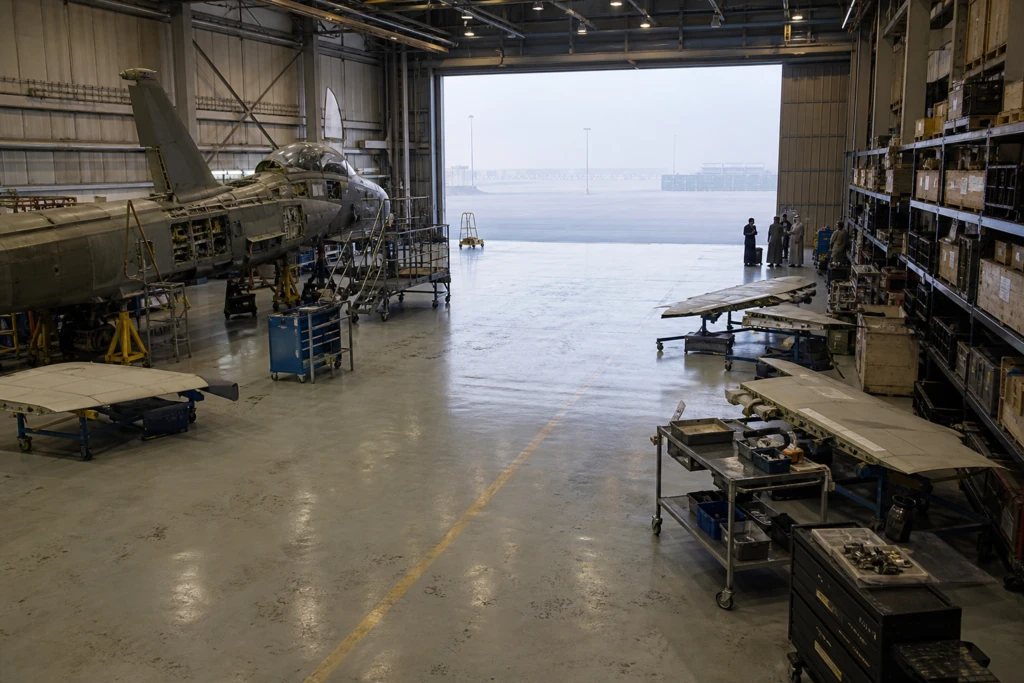
The fastest localisation gains are not only about building whole platforms. The Vision 2030 tracker argues that if localisation includes MRO, sustainment, and through-life support services, achievable percentages rise significantly, because existing fleets need constant maintenance and those contracts can be transferred to Saudi-based entities, including joint ventures. It also notes Saudi Arabia has pragmatically focused on maintenance, ammunition, armoured vehicles, and electronics where localisation is achievable on shorter timelines. That focus matches the areas that need deep supplier ecosystems: test and calibration, consumables and sub-assemblies, repair capability, and quality certification that primes can trust.
Institutions and policy mechanisms are designed to pull suppliers in. The tracker says joint ventures with Lockheed Martin, Boeing, BAE Systems, and Raytheon have created local assembly and MRO capabilities, and that GAMI’s licensing framework has attracted over 100 domestic and international companies to the Saudi defence ecosystem. The U.S. government commercial guide adds that a supply chain localization program identified more than 70 investment opportunities, and lists demand across ground and air equipment, naval and air defense capabilities, cybersecurity, C4ISR equipment, UAV capability and Counter-UAS, aircraft engines, tactical communications systems, MRO capabilities, rotorcraft capabilities, military fixed-wing aircraft, and structural component manufacturing. It also describes the IPP as aiming to stimulate strategic partnerships, facilitate technology transfer, and support SMEs in the local supply chain.
For 2026 planning, the key is to target work that can scale while meeting localisation accounting rules. GAMI states it is working to regulate, license, and develop the sector with the aim of localizing more than 50% of defense expenditure by 2030. The Vision 2030 tracker warns that high-value platforms such as fighter aircraft, advanced missile systems, and naval vessels require decades of capability development, so localisation depends on sequencing: start with sustainment, components, and certified manufacturing, then expand. AGBI reports that US and allied defence manufacturers are looking to set up production in Saudi Arabia as global supply chains come under strain, and cites an ambition for the Kingdom to become an exporter of advanced defence technologies, starting with counter-drone systems. That combination makes the Saudi Arabia defense localization 2026 story a supply-chain story: manufacturing footprints, joint ventures, and qualified local suppliers that can deliver quickly and reliably.
What does Saudi Arabia’s defence localisation target aim to achieve by 2030?
What localisation level has been reported so far on GAMI’s measure?
Which areas are likely to localise faster than whole platforms?
What supply-chain openings are highlighted for the Saudi market?
What is the core focus of the Saudi Arabia defense localization 2026 narrative for suppliers?