Saudi Arabia’s AI data-center expansion is not just a rack-and-server story. It is also a thermal and fluid story. MarketsandMarkets projects the Saudi Arabia AI data center market to grow at a CAGR of 28.10% by 2032, linking momentum to hyperscale cloud computing demand and AI hardware such as GPU clusters and high-density servers that require advanced cooling systems. In parallel, a Saudi-focused immersion-cooling report says the government has committed over SAR 20 billion to develop data centers under Vision 2030, with an expectation that the number of data centers increases from 50 in the future to over 100 in the future. As density rises, cooling stops being “facility plumbing” and becomes a core performance constraint.
That constraint shows up in power and operating cost pressure. The immersion-cooling report projects the Saudi Arabian data center sector will consume approximately 1,200 MW of power in the future, framing why operators are looking for energy-efficient cooling options. The same source states that liquid immersion cooling can reduce energy consumption by up to 50% compared to traditional methods, and it also cites electricity costs reaching SAR 0.18 per kWh in the future. Taken together, these points explain why the buying conversation increasingly includes not only cooling equipment, but also the working fluids, filtration, sensing, and service models needed to keep high-density infrastructure stable.
Why Immersion Cooling Puts Fluids at the Center of the Design
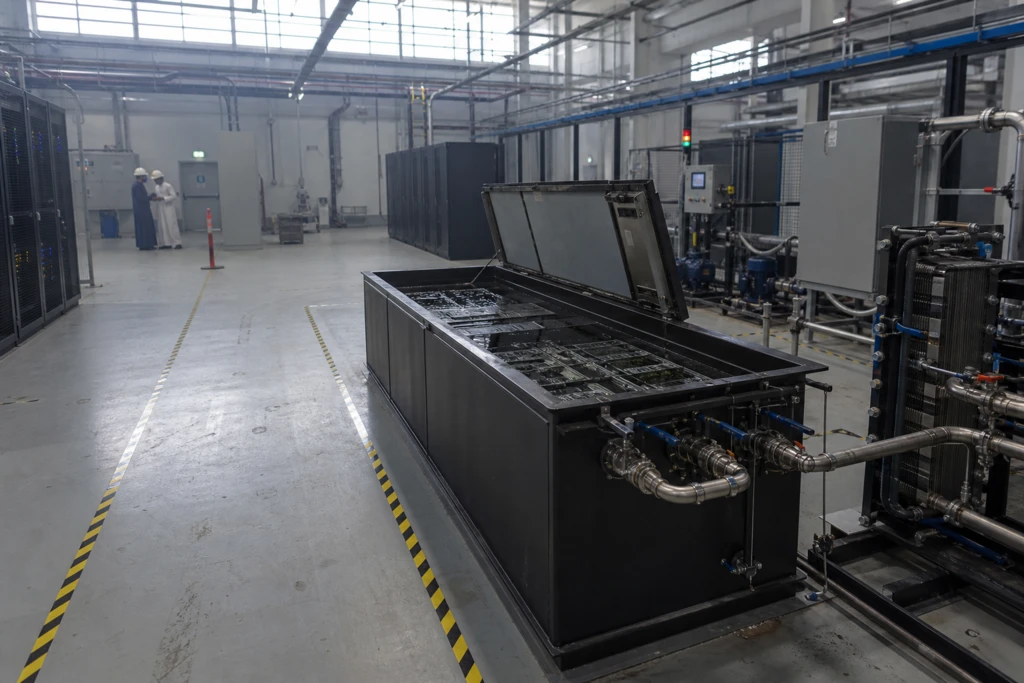
Immersion architectures make the coolant itself a primary asset. The Saudi immersion-cooling report segments the local market by single-phase immersion, two-phase immersion, direct-to-chip liquid cooling, and dielectric fluid-based cooling, and notes that single-phase immersion systems are gaining traction due to operational simplicity and effectiveness for managing heat in high-density environments. On the global side, The Business Research Company defines immersion cooling fluids as specially engineered dielectric liquids used to thermally manage equipment by fully or partially submerging components in fluid. It also breaks out common fluid categories as mineral oil, synthetic fluids, and fluorocarbon-based fluids, reinforcing that “fluid choice” is a design decision, not an afterthought.
The broader liquid-cooling market context helps explain why immersion adoption often arrives alongside direct liquid cooling. Global Market Insights values the data center liquid cooling market at USD 4.8 billion in 2025 and expects 18.2% CAGR between 2026 and 2035, driven by exponential growth in AI and high-performance computing workloads. Market Intelo adds a technology view: direct liquid cooling remains dominant through the forecast period, while immersion cooling sees the most rapid share gains as costs decline and ultra-high-density AI deployments proliferate. It also states that liquid cooling addresses the thermal crisis by transferring heat via fluid mediums with thermal conductivities 25 to 1,000 times superior to air, underscoring why the demand curve for Saudi Arabia data center cooling fluids can rise as AI density rises.
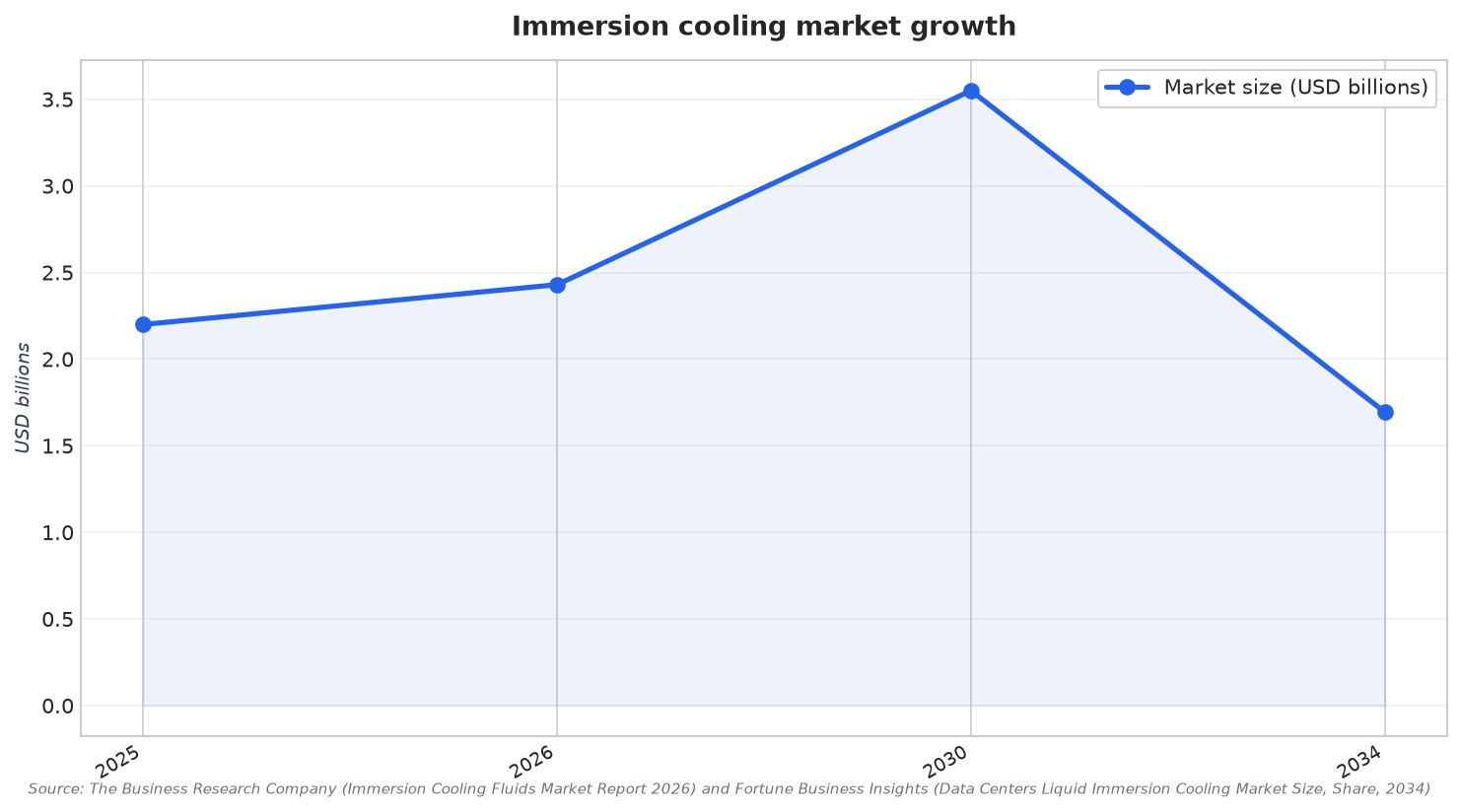
Fluids demand is also connected to monitoring, compatibility, and regulation-driven formulation shifts. Fortune Business Insights projects the global data centers liquid immersion cooling market grows from $348.30 million in 2026 to $1,694.11 million by 2034 at a CAGR of 21.9%, and it highlights that monitoring and control systems are expected to post a 23.3% CAGR as operators scale immersion and require sensing, real-time analytics, and automated fluid management for stability. Meanwhile, Market Intelo flags that the two-phase immersion segment faces headwinds from the phase-out of PFAS-based dielectric fluids under EU REACH regulations and the U.S. EPA’s PFAS strategy, pushing vendors toward low-GWP, PFAS-free alternatives. For Saudi projects sourcing global supply chains, that makes fluid selection, lifecycle management, and supplier qualification part of a bigger risk-and-performance conversation.
What is driving immersion cooling adoption in Saudi Arabia’s data centers?
How much has the Saudi government committed to data-center development under Vision 2030?
Which immersion cooling type is gaining traction in Saudi Arabia, and why?
What are immersion cooling fluids, and what types are commonly discussed?
What is changing in the market for Saudi Arabia’s data center cooling fluids and thermal-fluid systems?