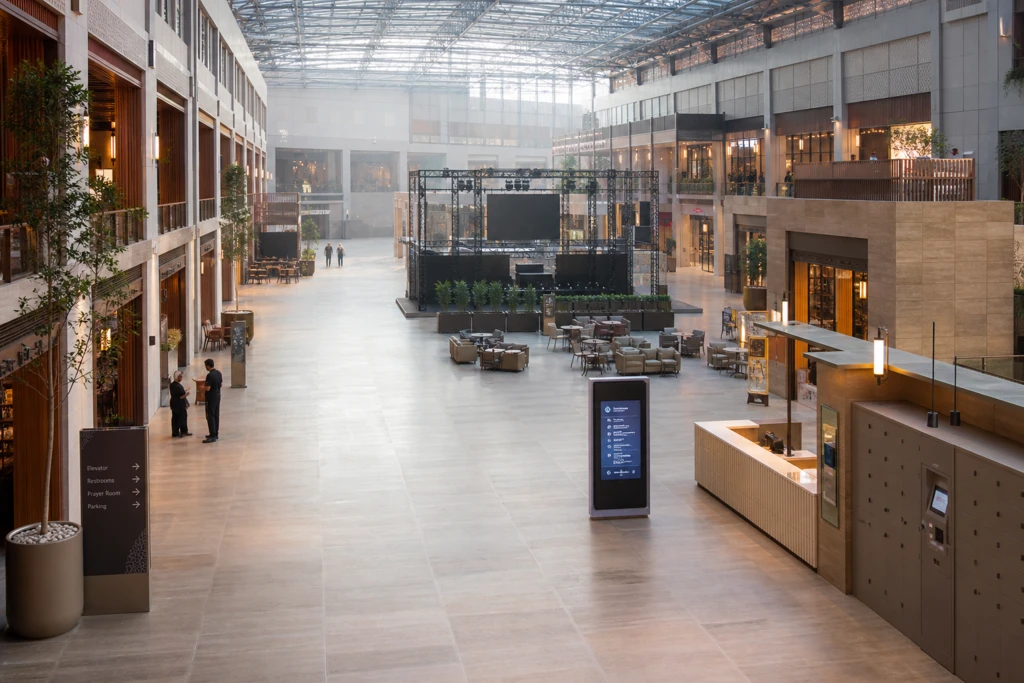
Saudi shopping destinations are moving beyond rows of storefronts. Market signals show why. Technavio valued the Saudi Arabia retail market at USD 168.8 billion in 2025 and forecast a 7.8% CAGR for 2026–2030. In this landscape, mall owners and tenants are leaning into experience-led formats to protect footfall as shoppers blend online and offline habits. Ken Research’s mall-based retail view also points to scale: the Saudi Arabia Mall-Based Retail Market was valued at USD 44.8 billion in 2025, with Riyadh listed as the dominant region. The result is a competitive environment where centers must differentiate through leisure, dining, events, and digitally enabled service.
The momentum is visible in the pipeline and in usage forecasts. Ken Research projects annual mall visitation rising from about 680 million visits in 2025 to 945 million visits in 2031. Over the same period, average spend per visit is forecast to increase from USD 65.9 to USD 73.0. Capacity is also expanding: mall gross leasable area is expected to reach around 12.9 million square metres by 2031, up from 8.9 million square metres in 2025. In Riyadh specifically, Ken Research noted announced projects expected to add about 1.83 million square metres of gross floor area before 2030, raising the bar for older malls that cannot refresh their tenant mix and experiences.
Retailtainment, Lifestyle Space, and a Bigger Riyadh Battle
Developers are explicitly designing for longer dwell times through “retailtainment,” allocating gross leased area to non-retail activities such as entertainment zones, dining experiences, and community events. A construction outlook citing Knight Frank reported that lifestyle retail space in Riyadh and Jeddah is projected to grow by nearly 600,000 sqm to a total of 1.31 million sqm by 2027. The same reporting projected an additional 205,600 sqm in Jeddah from seven new developments, taking Jeddah’s total lifestyle retail supply to 439,000 sqm by 2027. For Riyadh’s wider supply, Knight Frank reporting said total retail supply is expected to grow by 20% to about 5.2 million sqm by 2026, while average rents increased by 4% in the last year.
Operationally, future-proofing is also about tighter integration between physical stores and digital touchpoints. Technavio reported that retailers adopting an omnichannel model see customer lifetime value 30% higher than single-channel operators. It also stated that AI-driven demand forecasting can reduce inventory holding costs by up to 15%. In non-food retail, Technavio noted augmented reality virtual try-ons increased customer engagement by over 20%, and retailers using AI saw a 15% uplift in conversion rates. This is the practical side of Saudi Arabia experiential retail: malls must support tenants with data, connectivity, and services that make experiential concepts measurable and repeatable, not just visually impressive.
Riyadh’s performance signals explain why experience-led concepts are accelerating. A Riyadh-focused mall report described rents rising by 3% to 4% and occupancy reaching 90%, framing the city as a high-demand arena for destination-driven retail. At the same time, that report warned that over 1.0+ million sqm of new Grade A mall space is set to enter the Saudi market by 2026, intensifying competition for premium tenants. In that context, the most resilient malls will likely be those that curate categories Ken Research expects profit pools to shift toward, including experiential foodservice, leisure, beauty, premium fashion, loyalty monetization, and digitally enabled store formats.
What is driving experience-led mall reinvention in Saudi Arabia?
How fast are mall visits and spending expected to grow?
What does the lifestyle retail pipeline look like in Riyadh and Jeddah?
How does omnichannel help Saudi malls and retailers compete?
How is Saudi Arabia’s experiential retail trend showing up in Riyadh performance?