
In 2026, deal teams planning transactions that touch Saudi Arabia face a more predictable, but less forgiving, regulatory path. The General Authority for Competition (GAC) has clearer filing triggers under its 2025 Economic Concentration Review Guidelines. Those triggers matter because the regime is effectively suspensory in substance. If a notifiable deal closes without clearance, the parties risk fines, interim measures, and even an order to unwind the transaction. The practical result is a bigger focus on early jurisdiction mapping, document readiness, and deal conditionality, especially where the transaction has any meaningful economic activity in the Kingdom.
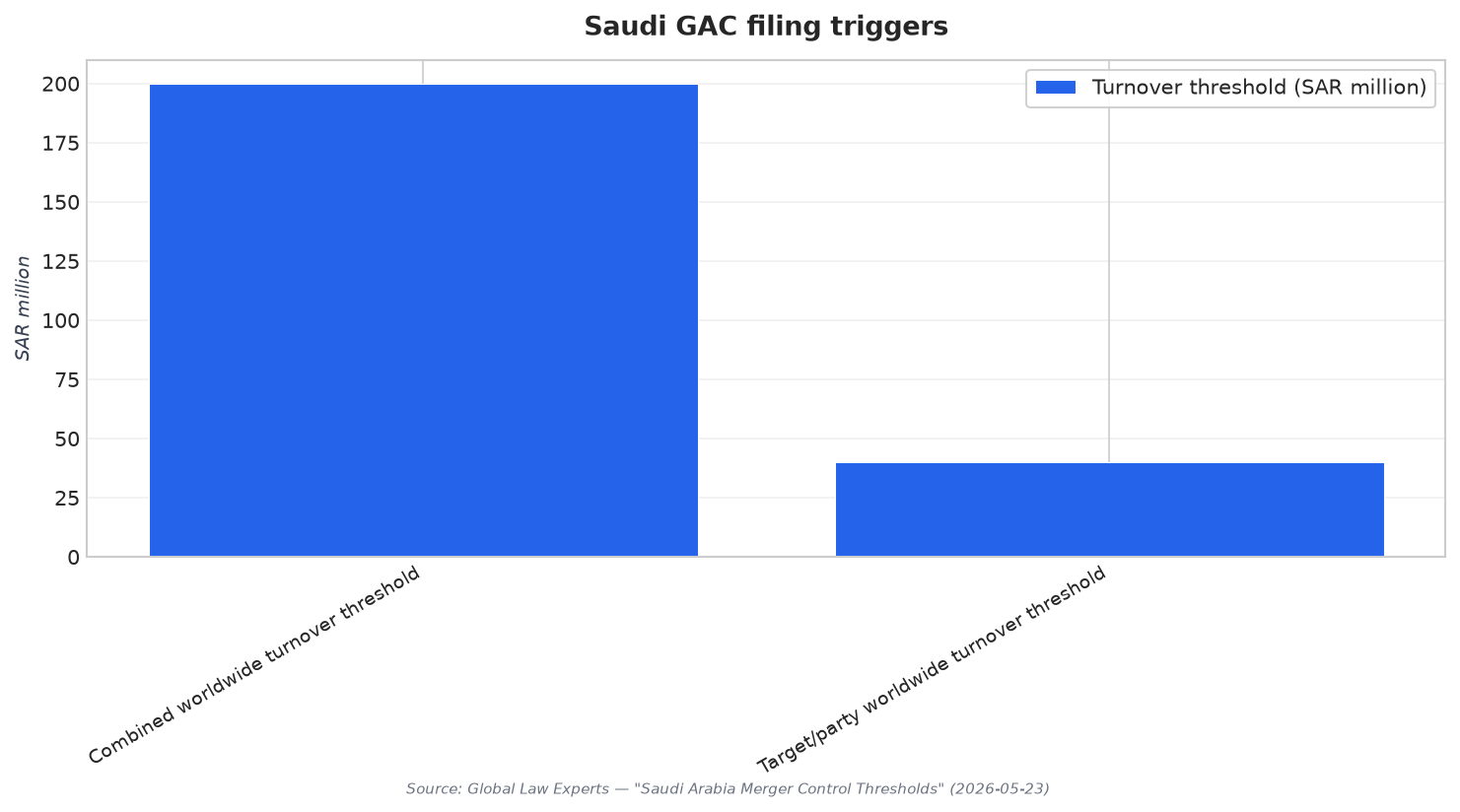
The GAC notification framework uses three cumulative tests that can pull in deals even when a transaction is negotiated abroad. The first test looks at combined worldwide annual sales, which must be at least SAR 200 million (approximately USD 53 million) across all parties. The second test requires at least one party, typically the target, to have worldwide annual sales of at least SAR 40 million (approximately USD 10.7 million). The third test is a Saudi nexus shown through meaningful economic activity, such as local sales, assets, contracts, or employees attributable to the parties. If all three are met, the filing must be made before closing, and timelines must be built around the GAC process rather than treated as an afterthought.
Why 2026 Timelines Change: Sequencing, Not Just Thresholds
In practice, competition clearance is only one part of a broader approvals sequence that can dictate the critical path. For listed targets, the Capital Market Authority (CMA) is described as the principal gatekeeper, and deal counsel often misjudge how approvals interact. A key point in Saudi public M&A is that the CMA usually grants its approval only once other regulatory approvals are in hand. That means the order of work matters, especially in cross-border deals where teams may assume filings can run in parallel and conclude together. The same guide also notes that turnover, not local presence, can trigger review, which increases the need to assess filing exposure early.
Alongside the competition layer, 2026 brings corporate and disclosure changes that affect execution readiness. Companies Law amendments require Saudi entities to identify and register ultimate beneficial owners (UBOs) on a unified commercial register, with a direct impact on data rooms and verification. Another 2026 guide emphasizes that buyers may need to disclose their own ownership chain as part of the transfer filing, while incomplete or inaccurate disclosures can delay Commercial Register filings and may attract administrative penalties. The Companies Law also raises the bar for internal approvals on material transactions, including independent-director sign-off for related-party matters and extraordinary general assembly (EGA) approval where deals exceed prescribed value thresholds relative to net assets.
These moving parts reshape how counsel should draft conditions precedent, long-stop dates, and information covenants. A merger control condition needs to reflect that the GAC can impose remedies, and that closing a notifiable transaction without clearance brings serious consequences, including potential divestiture orders. Separately, public deals often follow negotiated, board-supported structures and statutory mergers by share-for-share exchange, and they require CMA approval plus EGAs of both companies. Market access rules are also evolving: the CMA amended its rules on 6 January 2026 to remove the Qualified Foreign Investor (QFI) regime and discontinue the swap-agreement framework, opening Saudi-listed shares to direct investment by all foreign investors from 1 February 2026, subject to foreign-ownership limits and sectoral restrictions.
What are the key filing thresholds under Saudi Arabia’s merger control framework in 2026?
Can a foreign-to-foreign deal still trigger Saudi competition review?
How do CMA approvals affect deal sequencing for listed targets?
What new disclosure workstream can delay closing in 2026?
How are Saudi Arabia merger control rules changing the way buyers draft conditions precedent?