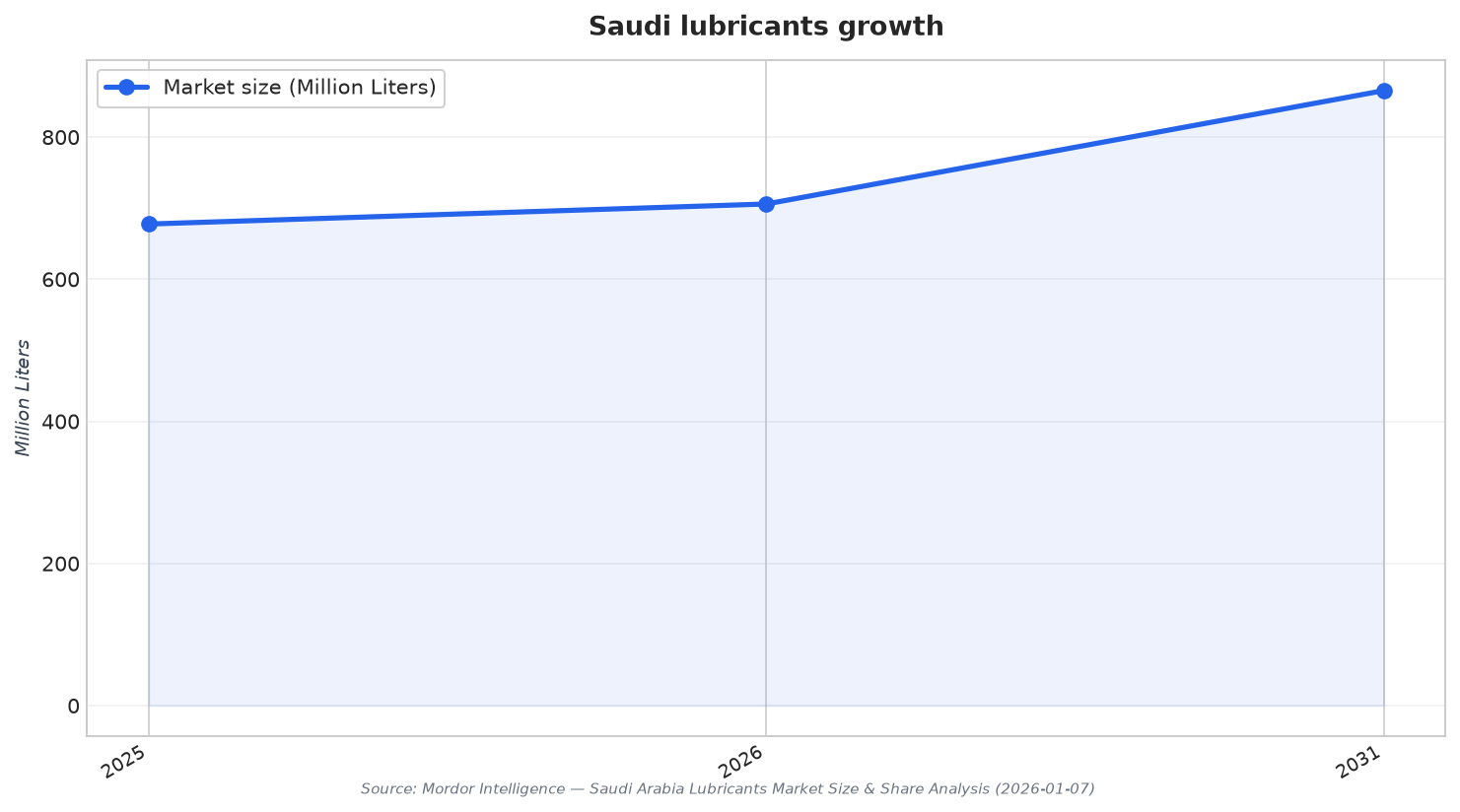
Saudi Arabia’s lubricants demand is rising in a way that benefits specialist products, not only high-volume grades. Mordor Intelligence values the Saudi Arabia lubricants market at 677.67 million liters in 2025 and estimates it will grow from 705.86 million liters in 2026 to 865.41 million liters by 2031, at a 4.16% CAGR for 2026–2031. While engine oil led with 63.72% share in 2025, greases are projected as the fastest-growing product type at a 4.55% CAGR through 2031. This matters for aviation-linked maintenance because greases and turbine-related fluids sit in the “specialist” end of the portfolio where performance approvals and reliability expectations shape buying decisions.
The niche becomes clearer when you look at how aviation lubricants are described globally: specification-driven and tightly linked to utilization rates and maintenance cycles. IndexBox frames the global aviation lubricants market’s core driver as the “inextricable link” between lubricant consumption and aircraft operational activity, with MRO cycles dictating replacement volumes. It also highlights a gradual product-mix shift toward higher-performance synthetic and semi-synthetic oils, supported by adoption in new-generation engines and by evolving maintenance philosophies such as extended drain intervals. Roots Analysis similarly splits aviation lubricants into engine oil, hydraulic fluid, grease, and special lubricants and additives, and states that the engine oil segment is expected to dominate with a 57.8% share. Together, these points explain why turbine oils and greases can become a specialist battleground as aviation activity and MRO depth expand.
Why Turbine Oils and Greases Become the Differentiator
In the Middle East, technical requirements for turbine oils illustrate how performance specifications create a premium niche that can spill over into aviation-adjacent expectations for quality, traceability, and stability. Mordor Intelligence notes that power-sector upgrades replacing older steam plants with F-class and H-class gas turbines require ester-enhanced or PAO-based ISO 32 turbine oils capable of resisting coking at 230 °C bulk fluid temperatures. That same report also projects the Middle East lubricants market at 2.95 billion liters in 2026, reaching 3.36 billion liters by 2031 at a 2.66% CAGR. Even though this is regional data, it signals a broader environment where high-temperature stability and advanced base stocks are not optional, and where suppliers that can certify and consistently deliver specialized fluids gain an edge.
Saudi policy and industrial moves also influence how specialist lubricants are sourced and made. Mordor Intelligence links Saudi lubricants demand to Vision 2030-driven industrial projects and says over USD 130 billion has been invested in new factories since 2016 under NIDLP incentives. It also points to consolidation moves such as Saudi Aramco’s Valvoline acquisition and mentions localization initiatives like Luberef’s LubeHUB to reduce import dependencies for base oils and additives. In parallel, the Middle East report notes that Saudi Arabia’s iktva program ties project awards to local spend thresholds, pushing EPC contractors to source domestically blended lubricants wherever technically feasible. For buyers shaping Saudi Arabia aviation lubricants strategies, this means qualification is not only about OEM-style performance; it can also be about supply-chain resilience and local value-chain fit.
Commercially, the route to market is shifting toward models that can support specialist products with tighter service and faster turnaround. In Saudi Arabia, distributor/retailers held 62.58% of lubricants market size in 2025, but direct-channel sales are advancing at a 15.35% CAGR to 2031, according to Mordor Intelligence. That supports more technical selling, condition-monitoring, and structured supply agreements, which are relevant in aviation and MRO-style environments. At the same time, global context shows where growth momentum concentrates: Mordor Intelligence reports Asia-Pacific held 45.10% of global lubricants share in 2025, while the Middle East and Africa region records the steepest 3.19% CAGR to 2031. For specialist turbine oils and greases, these channels and regional dynamics reinforce a simple takeaway: suppliers win by combining certified performance with dependable, locally aligned delivery.
How fast is Saudi Arabia’s lubricants market growing through 2031?
Which lubricant product type is projected to grow fastest in Saudi Arabia?
What share of aviation lubricants is expected to come from engine oils?
What technical requirement is cited for turbine oils in Middle East gas turbines?
What is changing in routes to market for Saudi Arabia aviation lubricants and other specialist fluids?