Saudi Arabia’s latest licensing figures point to a clear shift in pace. In the second quarter of 2026, the Kingdom issued 9,018 investment licenses, a 252 percent increase from the same period last year, according to the Ministry of Investment’s “Economic & Investment Monitor, Saudi Arabia Q2 2026.” That single data point matters because it suggests the gateway step—getting licensed—is happening at far higher volume than a year earlier. It also creates a useful map of where foreign and domestic firms may be choosing to enter, based on which sectors captured the largest share of permits during the quarter.
The concentration pattern is hard to miss. The Ministry of Investment said the Q2 2026 permits were primarily concentrated in wholesale and retail trade, construction, and manufacturing. Together, those three sectors accounted for around 66 percent of the total number of licenses in the quarter. That implies many firms are prioritizing sectors that can scale through distribution, buildout activity, and production capacity. It also echoes the earlier trend seen in Q1 2026, when nearly 7,742 licenses were issued (excluding licenses under the National Anti-Commercial Concealment Program, Tasattur), up 68 percent year on year, and when construction plus wholesale and retail trade plus manufacturing represented approximately 65 percent of licenses.
What the Licensing Mix Reveals About Entry Strategy
The licensing mix suggests an “on-the-ground” entry strategy rather than a narrow focus on a single niche. Wholesale and retail trade can signal market-testing and channel-building. Construction can reflect demand linked to development pipelines and project execution needs. Manufacturing can indicate longer-horizon commitments tied to producing locally. The consistency between Q1 (about 65 percent in those three sectors) and Q2 (around 66 percent) is also telling. It hints that the surge is not only a one-off statistical swing, but an acceleration layered on top of an established sector preference among new license holders in 2026.
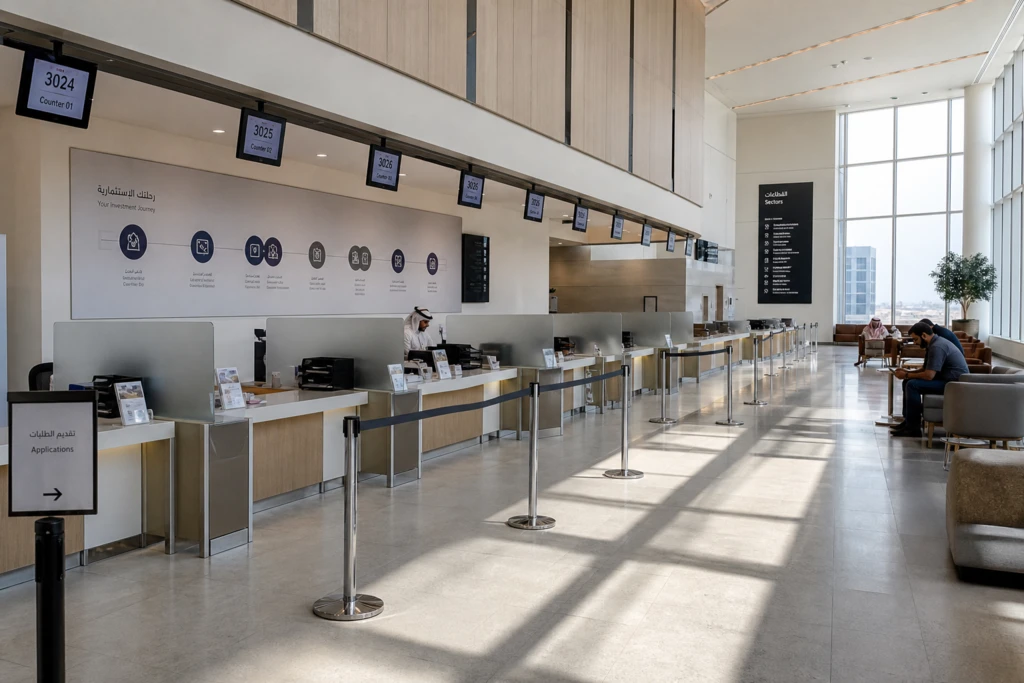
Just as important is the operational capacity behind the numbers. In Q2 2026, the Investment Ministry reported delivering more than 26,000 services through its One-Stop Shop Center, over 83,000 services through outreach centers, and more than 70,000 services via its website. That service volume matters because it points to a system built for throughput. The Ministry also stated it continued efforts to boost domestic investment and attract foreign capital by organizing and participating in specialized events and investment forums in Saudi Arabia and abroad. In practical terms, higher licensing totals paired with high service volumes can indicate fewer bottlenecks for firms attempting to establish a foothold.
Read alongside other Q2 2026 signals cited in investment commentary, the licensing jump sits inside a broader capital-and-infrastructure narrative. One report referencing the same Ministry monitor noted gross fixed capital formation at SAR 358 billion and foreign direct investment stock past SAR 1.1 trillion, while also citing four battery energy storage projects worth SAR 4.4 billion (USD 1.2 billion) awarded to build 2,000 MW of four-hour storage. Separately, business-setup commentary framed the licensing burst as evidence that getting licensed “is no longer the hard part,” while noting Saudi Arabia is targeting SR388 billion ($103.5 billion) in annual foreign direct investment by 2030. Put together, these figures help explain why Saudi Arabia investment licenses 2026 are clustering where execution capacity, supply chains, and demand creation can meet quickly.
How many investment licenses did Saudi Arabia issue in Q2 2026?
Which sectors captured most Q2 2026 investment licenses?
What did Q1 2026 licensing show compared with Q2?
What does the Q2 2026 service volume suggest about the licensing process?
What does the Saudi Arabia investment licenses 2026 surge reveal about where firms are entering?