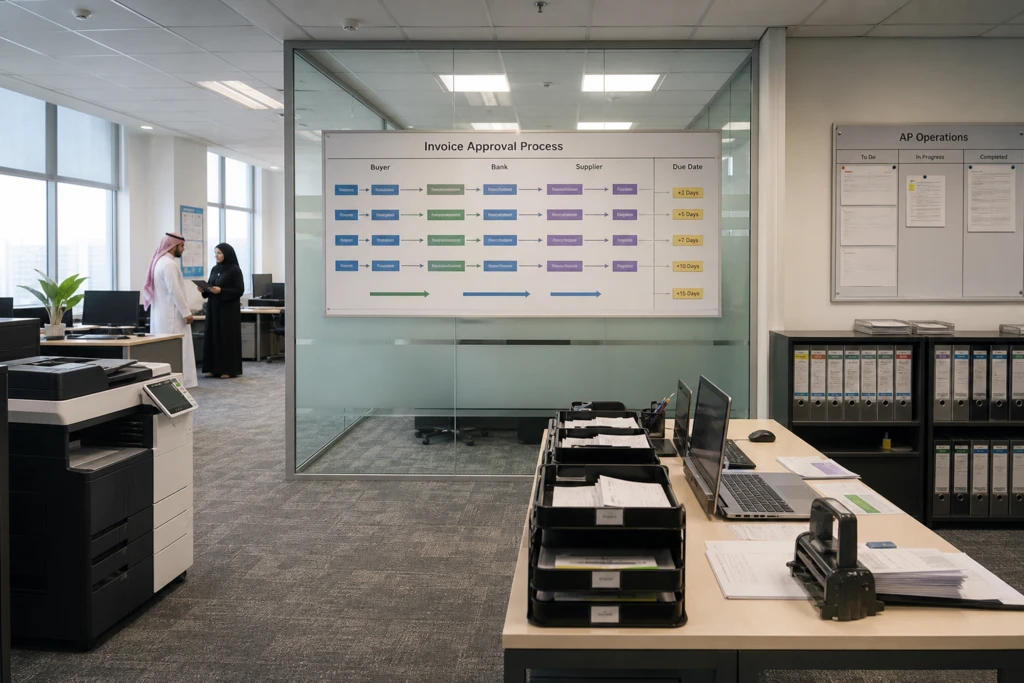
Tawrid is a new digital platform launched by Saudi Arabia’s Public Investment Fund (PIF) to provide supply-chain financing products to companies in the Saudi market. PIF announced the launch on 20 September 2026, describing Tawrid Company for Financing Solutions as a way to connect buyers, suppliers, and funders through a single digital offering. The platform’s product set includes early settlement options against approved invoices, a structure intended to help businesses improve working-capital efficiency and liquidity management. PIF has highlighted small and medium-sized enterprises as a particular beneficiary, positioning Tawrid as part of its broader push toward deeper, local, tech-enabled supply chains.
A key detail is the platform’s regulatory status. PIF said Tawrid has obtained a permit from the Saudi Central Bank (SAMA) to operate under the regulator’s sandbox environment. Separate reporting notes that SAMA had already permitted Tawrid for Financial Solutions to test supply-chain finance in its regulatory sandbox on 16 September 2025, and that PIF’s public launch came a year later on 20 September 2026. This matters for interpreting what the announcement does and does not prove. The launch signals an operating platform and partner participation, but it is not evidence that Tawrid holds a full-scale banking licence or that a material volume of invoices has already been financed.
Why the Backers and Agreements Matter for Contractors
PIF says Tawrid has signed binding agreements with Gulf International Bank (GIB), Saudi National Bank (SNB), and Banque Saudi Fransi (BSF), as well as with ROSHN and Nesma & Partners. This mix suggests a model that pairs funding capacity and regulated banking expertise with anchor corporate buyers that can validate invoices owed to vendors. For Saudi contractors and suppliers, the practical link is straightforward: smaller firms can deliver goods or services to large customers but wait weeks or months for payment, which can strain day-to-day cash needs. A platform that converts approved receivables into earlier cash can ease that working-capital stress if invoice approval is reliable and the offering is accessible.
Still, outcomes will depend on execution details that have not been quantified in the public announcement. Coverage of the launch explicitly notes that signed agreements demonstrate ecosystem participation, but transaction data will show whether the model works at scale. Important variables include buyer creditworthiness, the pricing offered to suppliers, and the platform’s regulatory permissions under the sandbox. The public announcement does not quantify financing volumes, average payment acceleration, supplier counts, pricing, or default performance. In other words, the promise of digital supply-chain finance is clear, but the measurable impact will only emerge as the platform publishes or demonstrates operating results.
Within PIF’s framing, Tawrid also sits inside a wider strategy effort. PIF has said the financial services industry is a strategic enabler of the six ecosystems it recently announced in its 2026–2030 strategy, and that Tawrid aligns with the objective of increasing the Saudi private sector’s contribution to PIF’s projects and portfolio companies. If the platform succeeds at connecting registered local banks with registered suppliers through early settlement against approved invoices, it could reduce working-capital friction across supply chains that serve large developments. But if financing is expensive, selective, or tied narrowly to one group of buyers, the benefit for the broader supplier base could be more limited.
What is Tawrid and who launched it?
How could Tawrid help Saudi contractors and suppliers manage working capital?
Which banks and companies have binding agreements with Tawrid?
What does it mean that Tawrid operates in SAMA’s regulatory sandbox?
How does PIF Tawrid supply chain finance avoid overpromising at launch?