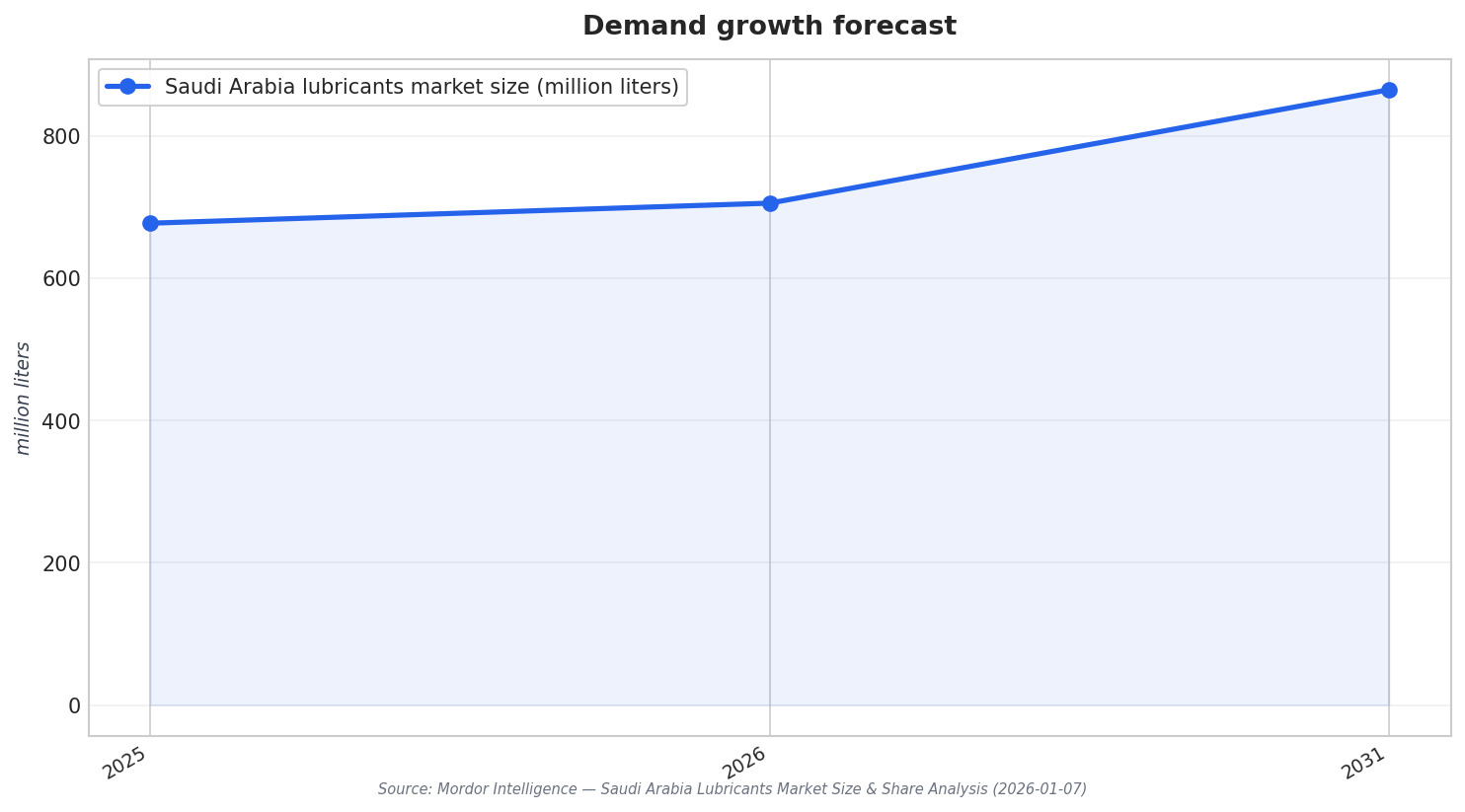
Saudi Arabia’s lubricants market is growing alongside Vision 2030’s industrial and infrastructure push. Mordor Intelligence values the Saudi Arabia lubricants market at 677.67 million liters in 2025 and estimates growth from 705.86 million liters in 2026 to 865.41 million liters by 2031, at a 4.16% CAGR for 2026–2031. In parallel, Eurogroup Consulting’s cited view says national consumption already exceeds 515 million liters annually, positioning Saudi Arabia as the largest lubricant market in the GCC. This scale matters because blending and packaging must keep pace with changing volumes, tighter lead-time expectations, and a broader mix of applications that extend well beyond traditional automotive oil changes.
Demand composition also explains why local blending capability is becoming more strategic. In 2025, engine oil led with 63.72% of Saudi Arabia’s lubricants market share, while automotive applications captured 58.64% share, according to Mordor Intelligence. Yet the same report highlights fast growth outside the classic engine-oil core. Greases are projected to record the fastest 4.55% CAGR through 2031, and power-generation demand is growing at a 4.52% CAGR over the forecast horizon. These shifts pull blenders into more varied formulations and performance targets, especially as customers ask for premium and synthetic lubricants designed for extended service intervals in high-temperature operating conditions.
From Imported Inputs to Local Value Chains Under Vision 2030
Vision 2030’s industrial diversification is a direct tailwind for localized production decisions. Mordor Intelligence notes that National Industrial Development and Logistics Programme (NIDLP) incentives are reshaping demand, with over USD 130 billion invested in new factories since 2016. That factory build-out supports steady orders for industrial fluids such as hydraulic fluids, metalworking fluids, and specialty greases used in precision equipment. On the supply side, localization initiatives are also cited as an enabler: Mordor Intelligence points to Luberef’s LubeHUB as a move that reduces import dependencies for base oils and additives. As producers connect base oil and additive availability to local blending and packaging, the focus turns to reliable plant utilization, faster replenishment cycles, and consistent specifications for industrial buyers.
Distribution dynamics reinforce the need to scale and modernize domestic blending operations. In 2025, distributor/retailers held 62.58% of the Saudi Arabia lubricants market size, while direct-channel sales are advancing at a 15.35% CAGR to 2031, according to Mordor Intelligence. Direct sales growth typically requires tighter coordination between blending schedules, packaging formats, and large end users that demand OEM-aligned formulations and monitoring services. Consolidation is also changing the operating landscape. Mordor Intelligence cites Saudi Aramco’s Valvoline acquisition and a potential Castrol bid as moves that add technological depth while deepening domestic value-chain integration, which can support more specialized blending portfolios.
Regional context shows why Saudi Arabia is a focal point for Gulf blending expansion. Mordor Intelligence values the Middle East lubricants market at 2.87 billion liters in 2025, with Saudi Arabia leading with 37.21% of the region’s lubricants market share that year. The same regional report notes that suppliers that localize blending and packaging under 70% iktva content rules can gain price and lead-time advantages over import-reliant rivals, encouraging capacity additions in locations such as Yanbu. At the same time, Eurogroup Consulting highlights that electrification is still nascent but gaining momentum, pushing innovation toward e-transmission lubricants and battery-cooling fluids. Together, these forces explain why Saudi Arabia lubricant blending plant capacity is scaling toward a broader, higher-performance product slate aligned with Vision 2030 demand.
What is driving lubricant demand growth in Saudi Arabia under Vision 2030?
How large is Saudi Arabia’s lubricant market today, according to the sources?
Which lubricant segments are changing fastest in Saudi Arabia?
How is Saudi Arabia lubricant blending plant capacity being positioned for the next demand cycle?
What does regional data say about Saudi Arabia’s importance in Middle East lubricants?