Saudi Arabia’s water system is shaped by extreme scarcity, high urban growth, seasonal demand peaks, and the reality of moving water across a vast geography. Desalination is not described as a supplemental source in this model; it is presented as the backbone of urban supply. Installed desalination capacity is stated as exceeding nine million cubic metres per day, meeting about sixty to sixty-five percent of the Kingdom’s potable water demand. But the country’s water security logic now extends beyond production capacity alone. Transmission portfolios, strategic reservoirs, peak planning tied to Hajj and Umrah, and wastewater infrastructure all influence national reliability.
In that broader infrastructure picture, wastewater treatment and reuse is framed as a practical, circular-economy lever. One investment guide states that total annual water demand in Saudi Arabia exceeds twenty billion cubic metres, with groundwater providing about forty percent, desalination about thirty-five percent, and treated wastewater about fifteen percent, with the balance from surface water and other sources. It also highlights groundwater depletion from agricultural irrigation as a structural challenge, pushing substitution toward desalinated water and treated wastewater. At the same time, demand is described as expanding at about three to four percent annually due to population growth, urbanisation, and industrial development, increasing the need for capacity across the entire water value chain.
Targets, Markets, and the Shift From Supply to Circularity
Vision 2030 policy targets reinforce why reuse is moving to the center. The National Water Strategy is described as aiming to increase wastewater treatment and reuse rates to ninety percent, reduce non-revenue water losses to a globally competitive fifteen percent, and maintain enough desalination capacity to meet rising demand. Separately, an OFW Intelligence model cites a 70% treated sewage effluent reuse target by 2030, linking that goal to reduced pressure on groundwater and a more diversified supply portfolio for agriculture, industry, landscaping, and resilience planning. A market report also notes a government target to achieve 100% reuse of treated urban wastewater by 2025, showing how reuse goals are being framed as urgent and comprehensive.
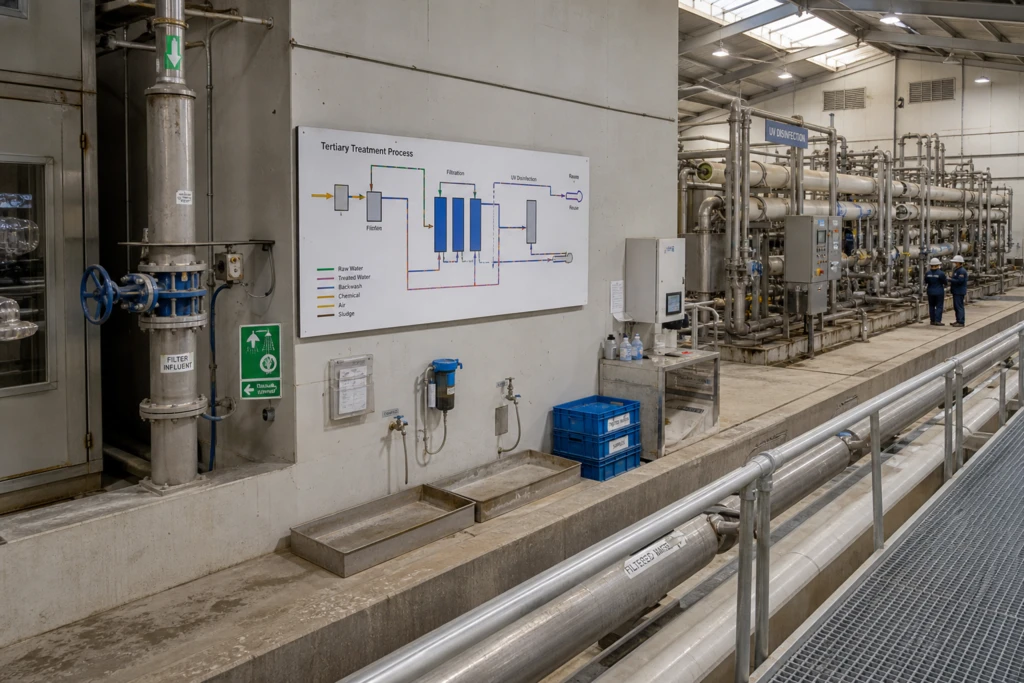
Those ambitions are matched by investment signals and project activity. One industry outlook, citing Renub Research, projects Saudi Arabia’s water and wastewater treatment market growing from USD 4.03 billion in 2024 to USD 7.43 billion by 2033, reflecting a 7.05% CAGR between 2025 and 2033. Another investment guide estimates cumulative water sector investment requirements through 2030 at SAR 80 to 100 billion. In the project pipeline, a February 2024 contract is described in which VA Tech Wabag secured USD 33.5 million for engineering and procurement of a 20 MLD industrial wastewater treatment plant at Saudi Aramco’s Ras Tanura refinery, using biological treatment, filtration, and reverse osmosis to enable partial reuse within the refinery.
Operationally, Saudi Arabia already has wastewater assets that make reuse scalable, even as expansion continues. A country overview states there are 33 wastewater treatment plants with a capacity of 748 million cubic meters per year, and 15 more under construction. It adds that much of the treated wastewater is reused to water green spaces in cities (landscaping), for irrigation in agriculture, and other uses. This practical deployment aligns with broader descriptions of reuse applications that include agricultural irrigation, industrial processes, toilet purposes, and groundwater recharge. In that context, Saudi Arabia treated wastewater reuse is not positioned as a niche sustainability measure, but as infrastructure that helps balance demand growth, protect groundwater, and strengthen system reliability alongside desalination.
Why is treated wastewater reuse becoming central to Saudi Arabia’s water security model?
What share of Saudi Arabia’s total annual water demand is attributed to treated wastewater?
What reuse targets are cited for treated sewage effluent and treated urban wastewater?
What wastewater treatment capacity and buildout is mentioned for Saudi Arabia?
What project example shows industrial reuse momentum in the Kingdom?