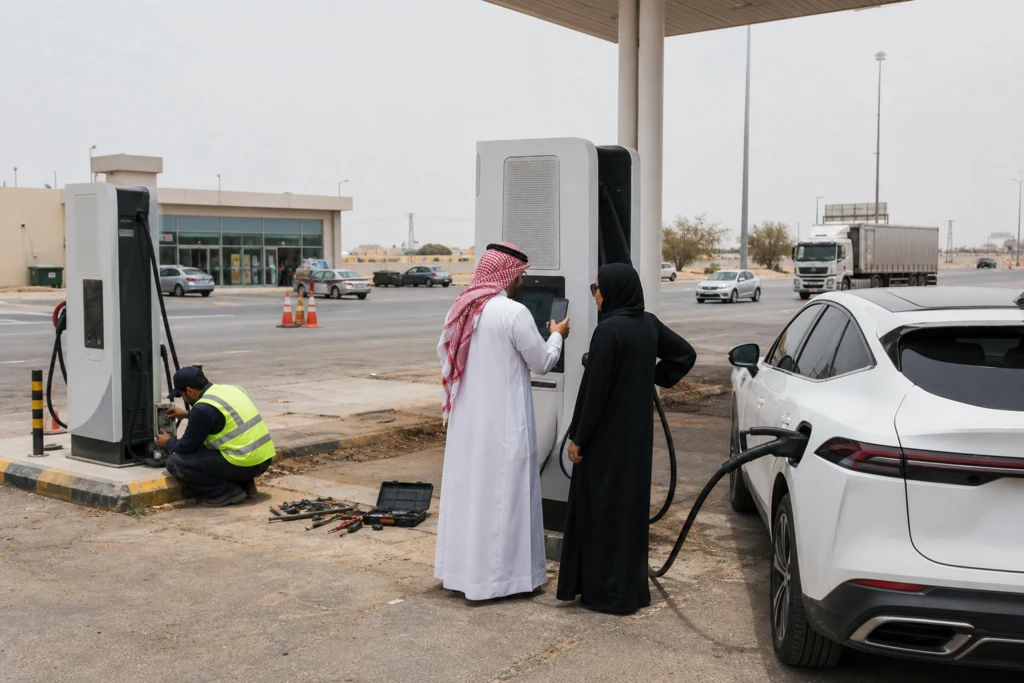
Saudi Arabia’s charging build-out is being pulled forward by real demand. Electric vehicle registrations rose by 425% between 2021 and 2023, increasing from 375 EVs in 2021 to over 12,000 by the end of 2023. That shift turns charging from a future discussion into an operational issue. Public charging station counts also point to fast change, but sources do not align. One source says public charging stations grew from 150 in 2022 to over 1,000 by early 2024, while another says Saudi Arabia had only 101 public chargers in 2024. Either way, rising EV registrations are moving faster than driver confidence.
The near-term narrative is about fast charging, location strategy, and visible delivery. EVIQ, a joint venture between the Public Investment Fund (PIF) and the Saudi Electricity Company (SEC), plans to install over 5,000 fast chargers across cities and highways. Its inter-city plan also sets a national scale goal: by 2030, 5,000 chargers and 1,000 hubs nationwide, linking Riyadh, Dammam, Mecca, and Madinah. SEC has also announced plans to install an additional 3,500 charging points across 1,000 locations by end-2025, described as an investment of SAR 500 million (USD 133 million). Together, these targets define where the Saudi Arabia EV charging infrastructure gap will be judged: speed, coverage, and consistency in the places people actually drive.
Where the 2026 Build-Out Focuses: Cities, Corridors, and Trust
Operators should watch the placement logic, not just the headline counts. EVIQ signed an MoU with Remat Al-Riyadh Development to deploy a city-wide charging network, placing chargers in high-traffic zones, residential hubs, and public parking to reduce range anxiety. The strategy also prioritizes “desert highways” such as the H-40 Riyadh–Jeddah corridor. Ultra-fast chargers rated between 150 and 350 kW are planned at key highway stops including Afif and Al Quwayiyah. By end-2025, EVIQ plans to complete 60 charging stations across major cities and highways such as Riyadh–Qassim and Jeddah–Madinah, signaling that highway reliability will be a core KPI for the next wave of adoption.
Competition and supporting capacity are forming, but the investment challenge remains practical. Lucid reported it has surpassed 100 EV chargers across Saudi Arabia, alongside studios in Riyadh, Jeddah, and Al Khobar. On the supply side, Foxconn Interconnect Technology (FIT), through its joint venture Smart Mobility, is expected to start production in 2026 at its first EV charger manufacturing facility in Saudi Arabia, which can shorten supply lines as networks scale. Funding signals are also large but described differently across sources: the Ministry of Investment data points to a USD 20 billion government investment package targeted at EV infrastructure development through 2030, while another source describes a government commitment of over USD 50 billion toward EV manufacturing and infrastructure through 2030, with PIF leading landmark investments.
For operators, the opportunity is to build where gaps are measurable and monetizable. In the GCC context, ultra-fast units above 150 kW are set to post the fastest 28.51% CAGR through 2031, showing why corridor-grade sites can become strategic assets. Cost and grid readiness shape who can execute. One report notes that turnkey installation of a 350 kW dispenser can exceed USD 500,000 once grid upgrades and civil works are included. It also highlights Saudi Arabia’s USD 5.33 billion HVDC program adding 7 GW of transfer capability and a USD 126 billion grid-modernization plan that includes 48,210 km of new transmission lines. For 2026, operators that pair site selection with uptime, clear pricing, and dependable power will be the ones that visibly narrow the charging gap.
What is driving the charging build-out in Saudi Arabia right now?
How many fast chargers is EVIQ planning to install?
Why do reports disagree on public charger counts in Saudi Arabia?
What does the Saudi Arabia EV charging infrastructure gap mean for operators in 2026?
What grid and cost factors matter for ultra-fast charger deployment?