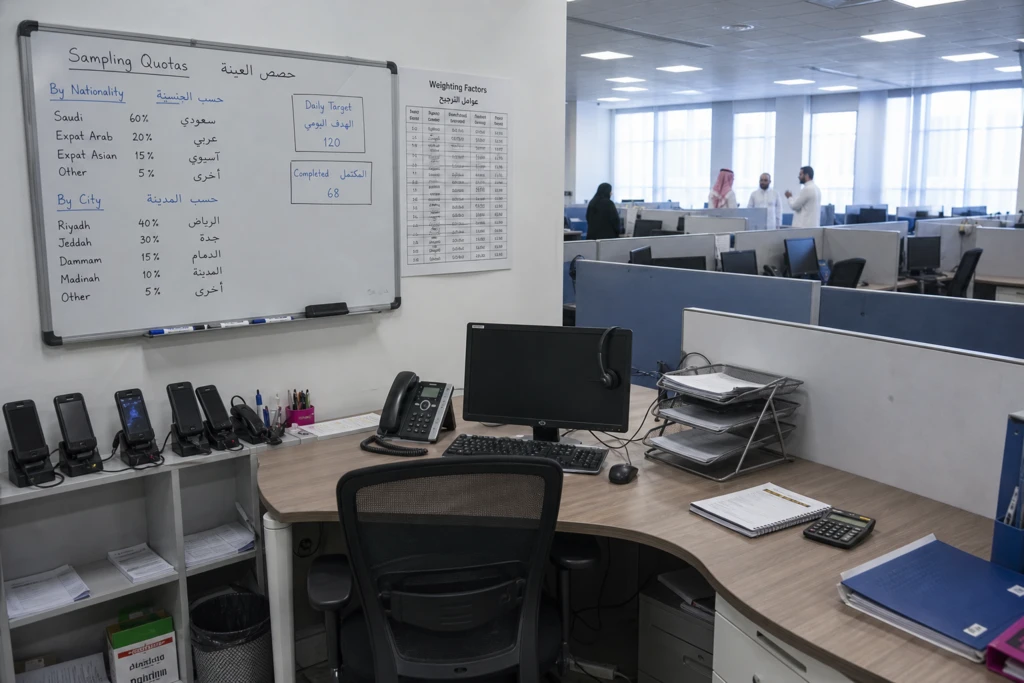
Designing research for an expat-heavy market in Saudi Arabia starts with acknowledging that “one national sample” can hide real demand patterns. Practical guidance for local studies stresses the need to distinguish between Saudi nationals and expatriate populations, and to recognize that the expatriate mix can vary by city. It also highlights segment differences by generation, including contrasts between older traditional consumers and younger millennial and Gen Z segments. Regional variation matters too, with cosmopolitan cities like Riyadh and Jeddah described differently from more conservative areas. For survey programs, this means planning quotas and weighting rules that reflect the market you are measuring, not only the channel that is easiest to reach.
Mobile-first fieldwork can be a strong foundation when you design properly for the market. One Saudi-focused guide notes a 98% smartphone usage rate and frames app-based surveys as a way to match local preferences for mobile interactions. However, consumer intelligence practitioners also caution that purely online approaches may struggle to reach certain traditional, rural, or less digitally-engaged segments. As a result, recruitment is often mixed: proprietary online panels are supplemented with targeted social media outreach, and, where appropriate, mall intercepts in major cities to broaden demographic coverage. This mixed-mode setup is especially useful when you need enough respondents in smaller nationality groups to support nationality-weighted reporting.
How to Build Nationality-Weighted Samples Without Losing Data Quality
Nationality-weighted design is not only about quotas. It is also about screening, data quality controls, and disciplined sample management. One provider operating an online panel in Saudi Arabia describes a proprietary, double opt-in panel and a multi-source recruitment approach intended to minimize sample bias, along with ongoing top-up recruitment and response-performance tracking. Another Saudi consumer intelligence workflow describes rigorous screening that includes geo-IP checks, digital fingerprinting, and attention checks within questionnaires, plus recent-participation flags to reduce “professional respondents.” These steps protect the quality of subgroup reads, which is critical when weighting by nationality, city, or other demographic variables can magnify any underlying sample bias.
Language and layout are not cosmetic details in Saudi surveys; they directly affect comprehension and completion. Local methodology guidance recommends bilingual research designs that offer Modern Standard Arabic, Saudi dialect options, and English for expatriates. It also calls out right-to-left survey layouts so visual elements flow correctly for Arabic readers. When surveys are intended to compare nationalities, consistency of meaning across languages becomes a core design requirement. Combined with culturally respectful approaches like in-home ethnography for deeper context, and operational tools like mystery shopping across retail and hospitality, you can triangulate what people say with what they do, without relying on a single instrument.
Finally, weighting decisions should be grounded in neutral reference points and executed within the legal framework for data handling. One Saudi market research advisory recommends triangulating assumptions against national statistics published by KSA National Statistics, then interpreting those datasets through primary research and sector-specific analysis. On compliance, consumer intelligence guidance notes that Saudi Arabia’s Federal Decree-Law No. 45 of 2021 (PDPL) sets the legal framework for personal data collection and processing, shaping consent and data handling in project design. Put together, a practical Saudi Arabia consumer survey methodology for expat-heavy audiences combines official-data grounding, careful recruitment and QC, and bilingual, mobile-first execution that still plans for hard-to-reach segments.
How do you design nationality-weighted consumer surveys in Saudi Arabia?
Why are bilingual and right-to-left layouts important in Saudi surveys?
What channels help reach respondents for consumer intelligence in Saudi Arabia?
How should studies in Saudi Arabia handle personal data and consent?
What should researchers use to ground weighting assumptions in Saudi Arabia?