
Saudi Arabia’s healthcare story in 2026 is less about headlines and more about delivery. In January 2026, the Kingdom announced the launch and implementation of its National Privatization Strategy, moving from a foundation-building phase into a more execution-focused stage. The stated direction is to expand private participation across priority sectors while the state retains legislative, supervisory, and regulatory authority. For healthcare investors, this matters because privatization is being positioned as part of a broader push to improve infrastructure quality, upgrade public services, and raise service efficiency, not simply to reduce the government footprint.
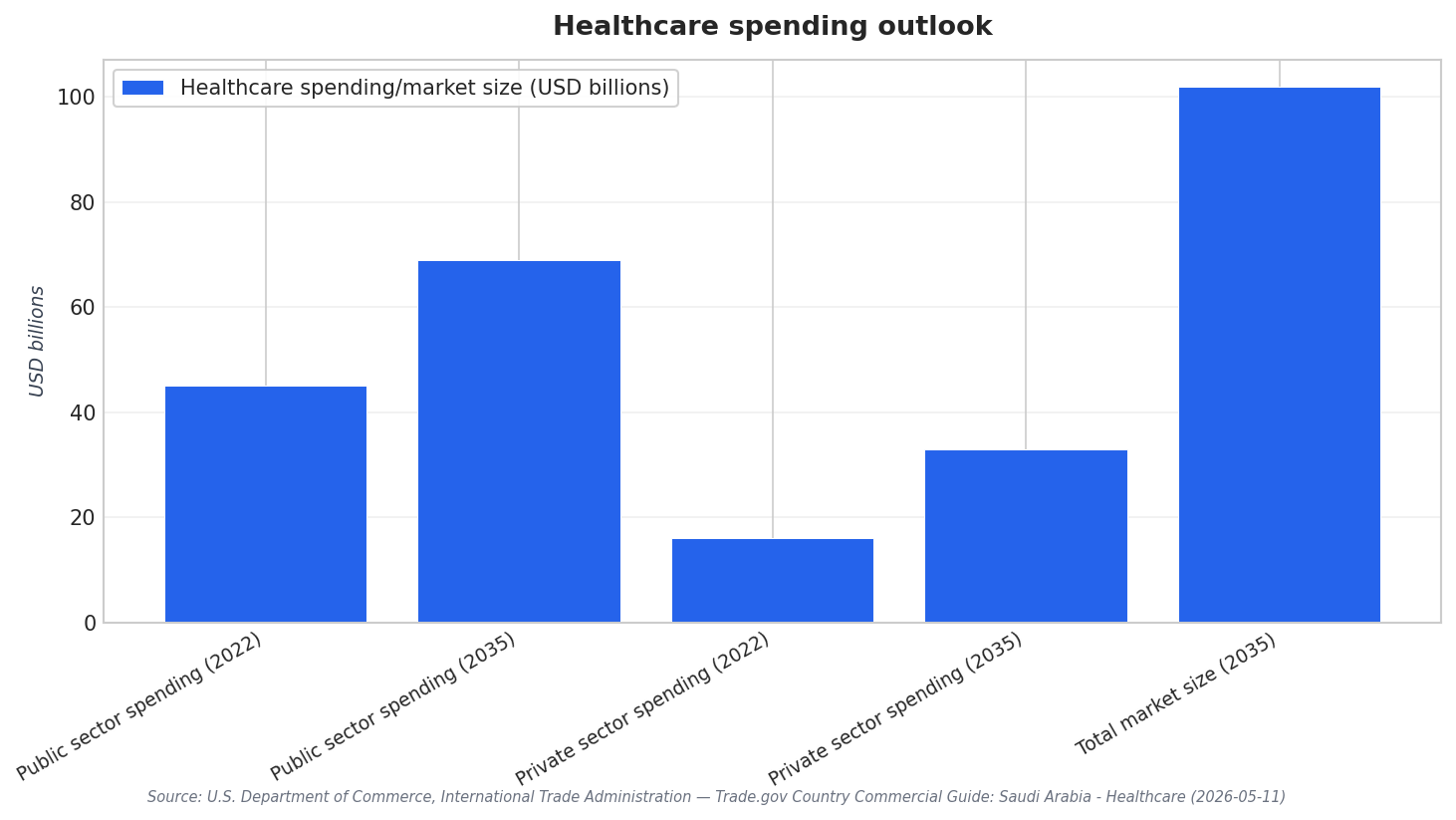
Market signals underline why healthcare remains a priority. Saudi Arabia accounts for 60% of Gulf Cooperation Council (GCC) countries’ healthcare expenditure, and the sector is a top priority for the Saudi government. In 2024, the Saudi government allocated SAR 214 billion (about US$57.1 billion) to healthcare, representing approximately 17% of its total budget. Separately, Saudi Arabia’s healthcare transformation agenda has been associated with approximately SAR 244 billion (about £47.7 billion) in planned healthcare investment, alongside reforms to service delivery, infrastructure, purchasing, and accountability. These figures frame the scale of activity investors may face as execution accelerates.
What “Execution” Means in Healthcare: Rules, Purchasers, and Providers
The most investable change may be governance, not asset sales. Analysts argue that framing healthcare privatization as a simple expansion in market participation is too simplistic for Saudi Arabia. The reform agenda is described instead as building a more coordinated system, where the government sets clearer rules, purchasers focus more closely on value, and providers—both public and private—are expected to improve performance across access, quality, outcomes, and patient experience. In practice, this is tied to Vision 2030 reforms that reorganize public provision through health clusters, clarify payer and provider roles, expand digital health infrastructure, and create greater space for private capital and operational capability.
Investors evaluating the Saudi Arabia National Privatization Strategy healthcare theme should track the contracting and partnership architecture as closely as the capital totals. The strategy targets 18 sectors and 220+ PPP contracts by 2030, and another investor-focused brief describes a framework that targets SAR 240 billion in private capital by 2030 through 220 PPP contracts across 18 sectors. In parallel, the National Center for Privatization & PPP had already developed over 200 projects worth $213 billion, reflecting a pipeline that extends beyond healthcare but can shape procurement norms, tender cadence, and delivery expectations. The government expects private operators to deliver infrastructure-first development, phased execution, and measurable outcomes.
Healthcare-specific roles are also being formalized in ways that can reduce ambiguity for operators. The Ministry of Health is described as the regulator for healthcare-related activities and services and has transitioned away from its previous role as healthcare provider. The Health Holding Company has taken over as provider of healthcare services, delivering day-to-day administration and primary healthcare development programs, including expanded digital health and virtual care. The Center for National Health Insurance will provide payment for health services given by the Health Holding Company and its subsidiaries, financed by the Ministry of Finance, and will strategically procure services and engage in contractual partnerships with health clusters. For investors, the opportunity sits at the intersection of capital, operational capability, and alignment with system objectives.
When did Saudi Arabia launch and begin implementing the National Privatization Strategy?
How large is the planned pipeline of PPP contracts under the strategy?
What healthcare spending signals does the government budget provide?
How does the Saudi Arabia National Privatization Strategy healthcare approach go beyond attracting investment?
Which entities are positioned as key payer and provider bodies in the reformed system?