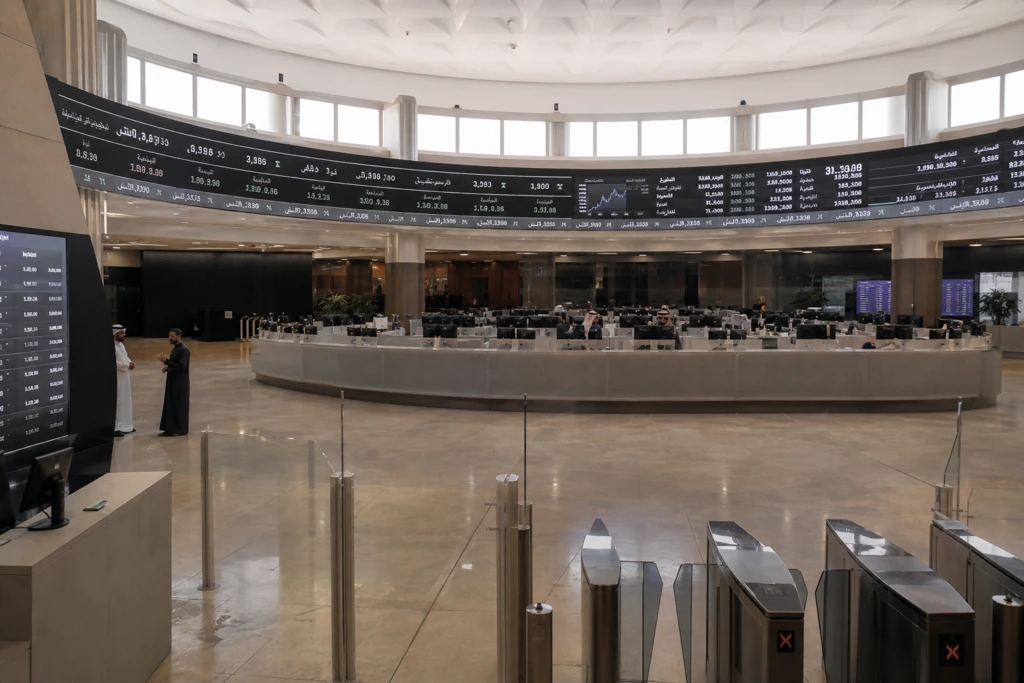
Saudi Arabia’s Capital Market Authority (CMA) has made a decisive shift in how international capital can reach Saudi equities. Effective Feb. 1, 2026, the CMA abolished the Qualified Foreign Investor (QFI) regime that had governed foreign access since 2015 and opened direct investment in shares listed on Tadawul’s Main Market to all categories of foreign investors. That includes both institutions and individuals, without prior CMA approval and without meeting qualification thresholds. The CMA also abolished the framework for equity swap arrangements, removing a legacy workaround that had provided synthetic exposure when direct ownership was restricted. In practical terms, the reform turns access from a regulatory process into a brokerage process, with foreign investors investing through licensed Saudi intermediaries and holding shares directly with shareholder rights.
Understanding why this matters for portfolio flows requires looking at what the QFI rules used to filter. At launch, minimum assets under management (AUM) thresholds were approximately USD 5 billion, designed to attract long-term institutional capital while limiting speculative inflows. Over time, the CMA relaxed requirements, and later versions required at least USD 500 million in AUM, while another reference point cited minimum AUM of nearly SAR 1.9 billion to access the main exchange. Even after simplification, the structure still imposed administrative barriers, especially for smaller institutions and individuals. By Q3 2025, foreign investors reportedly held over SAR 590 billion in Saudi equities, showing meaningful participation. But the QFI gate kept the market from being universally reachable in the same straightforward way global allocators expect.
Early Flow Signals: What Changed Once the Doors Opened
Positioning ahead of the new rules showed up in January activity. Foreign investors were net buyers of roughly SR 5 billion (about USD 1.33 billion), described as the strongest monthly foreign buying since 2022 outside a few special-event months. In that same month, foreign investors represented about 41.7% of total market purchases. Saudi equities also rallied into the move, with the market up roughly 10.6% from the Jan. 6 announcement through month-end, helped by strength in banks and gains in several index heavyweights. Ownership data also points to higher engagement: by late January, foreign-held shares had climbed to about USD 124.1 billion, with foreign investors holding nearly 13% of free-floating shares and 4.9% of total listed shares on the exchange, the highest proportion since Saudi Aramco’s IPO in 2019.
The first week after the rule change offered a cleaner view of post-opening behavior. For the week ended Feb. 5, foreign individual investors were net buyers of SR 39 million, with purchases of about SR 531 million, around 2.04% of total turnover. Foreign institutions were more prominent, with net purchases of roughly SR 1.22 billion. They accounted for about 41.93% of total buy transactions, compared with 37.24% of sells, suggesting a net-accumulation bias right after access broadened. This is a different flow architecture than the era when non-GCC foreign investors often relied on swaps, participation notes, or local funds for exposure. The move also supports the idea that Tadawul is becoming more structurally integrated into global index and capital flow dynamics, rather than relying on episodic bursts of interest.
Even with liberalized access, constraints still shape how much foreign capital can ultimately be absorbed. Multiple sources underscore that foreign ownership limits remain, including a 49% aggregate foreign ownership cap for listed companies and a 10% ceiling for a single foreign investor, subject to limited exceptions. Regulators have also indicated the cap framework is under review, and further liberalization has been signaled as a possibility, but caps are still the current guardrail. Against this backdrop, the market’s scale matters to allocators building long-term exposure: Tadawul ranks among the world’s top ten exchanges by market capitalization, with over 200 listed companies spanning USD 3 trillion in value. For issuers, broader access may also matter in primary markets. Analysts project 20 to 30 IPO executions on Tadawul in 2026, and expectations tie stronger IPO demand to a wider foreign investor base participating in book-building.
When did Saudi Arabia abolish QFI status and open Tadawul to all foreign investors?
How did foreign portfolio flows look right before and after the market opening?
What ownership limits still apply to foreign investors in Saudi-listed equities?
What does the post-QFI shift mean for Saudi Arabia foreign investment securities in practice?
What are analysts projecting for Tadawul IPO activity in 2026 after the access reforms?