
For multinationals, the discussion around Saudi Arabia transfer pricing 2026 is really about readiness for deeper scrutiny under rules that already apply broadly. Saudi Arabia’s transfer pricing regime applies to entities subject to the Income Tax Law or the Zakat Regulations, and it covers both cross-border and domestic controlled transactions. ZATCA administers the regime based on the arm’s length principle, meaning related-party dealings should look like open-market conditions. A controlled relationship can exist when one entity directly or indirectly owns 50% or more of another, or when control exists through financial, governance, or operational arrangements. That scope can bring more group entities into the compliance perimeter than governance charts suggest.
The compliance net also widened due to changes effective for fiscal years beginning on or after January 1, 2024. A 2023 amendment extended transfer pricing rules to zakat payers, not only income-tax payers, which means mixed-ownership and wholly Saudi-owned firms engaging in controlled transactions can be covered. ZATCA requires a set of baseline submissions and records, including disclosure forms, Master and Local Files, and compliance with arm’s length standards. Saudi Arabia recognizes all five OECD-endorsed transfer pricing methods: CUP, Cost Plus, Resale Price, TNMM, and Profit Split. ZATCA does not impose a strict hierarchy, so the burden shifts to the taxpayer to justify the “most appropriate” method with reliable, comparable support.
What the 2024–2026 Phase Means Before the 2027 Step-Down
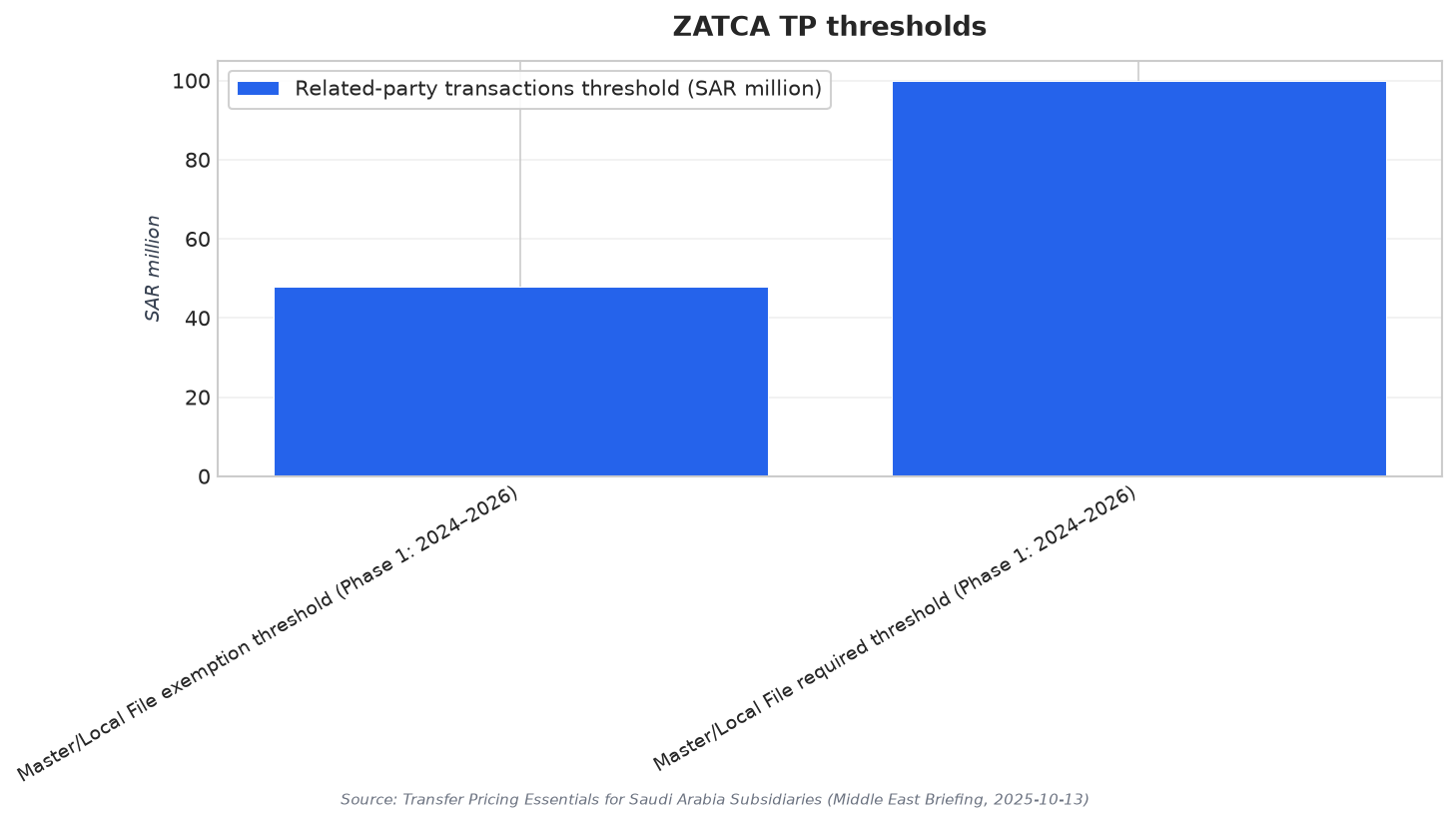
ZATCA’s phased implementation for zakat payers is central to planning. In Phase 1 (2024–2026), firms with related-party transactions below SAR 48 million (US$12.7 million) are exempt from preparing a Master File and Local File, while those with transactions above SAR 100 million (US$26.6 million) must maintain both. From 2027 onward, the exemption threshold is reduced to SAR 48 million. Regardless of transaction value, zakat payers should file a Transfer Pricing Disclosure Form (CTDF) and obtain an auditor’s affidavit as a baseline reporting standard. ZATCA’s third edition of its Transfer Pricing Guidelines, issued in June 2024, also added separate sections on Advance Pricing Agreements (APAs), guidance on transaction adjustments in accounting records, and clarification for entities filing single zakat returns.
Documentation timelines and group reporting triggers add pressure when enforcement intensity rises. One Saudi-focused summary notes that documentation must be maintained and provided to ZATCA within 30 days upon request, and it describes Master File expectations as a comprehensive global overview of the group. The same source highlights a Country-by-Country Report trigger tied to consolidated revenue: for MNE groups with consolidated revenue of SAR 3.2 billion or more, CbCR is applicable; if the parent jurisdiction’s threshold is not met or is less than SAR 3.2 billion, the Saudi entity will not be required to file CbCR. Separately, commentary on global audit trends emphasizes that authorities are moving from “documentation-as-compliance” to “data-as-proof,” using AI-driven analytics to cross-check narratives against ERP logs and intercompany flows. That raises the practical bar for proving that pricing aligns with how the business actually operates.
For 2026, the practical takeaway is to connect policies, filings, and underlying data before ZATCA asks. Saudi guidance points to disclosure forms plus Master and Local Files, while global practitioners warn that mismatches between functional stories and financial outcomes can trigger risk. In the US context, one 2026-focused piece describes increased automated analytics and notes that penalties for gross misstatements can reach 40% under IRS rules, which is not a Saudi statistic but illustrates why multinationals are tightening controls. In Saudi Arabia, the core is still arm’s length support, coherent functional analysis, and the ability to produce requested files within the required window. Treating transfer pricing as a standing operating capability—rather than an annual report—fits the direction of travel described across the sources.
What is changing for multinationals as Saudi Arabia’s transfer pricing focus intensifies in 2026?
Which related-party transactions are covered by Saudi Arabia’s transfer pricing rules?
What are the key thresholds for Master File and Local File in the 2024–2026 phase?
How fast must transfer pricing documentation be provided to ZATCA if requested?
When does Country-by-Country Reporting apply for MNE groups in Saudi Arabia?