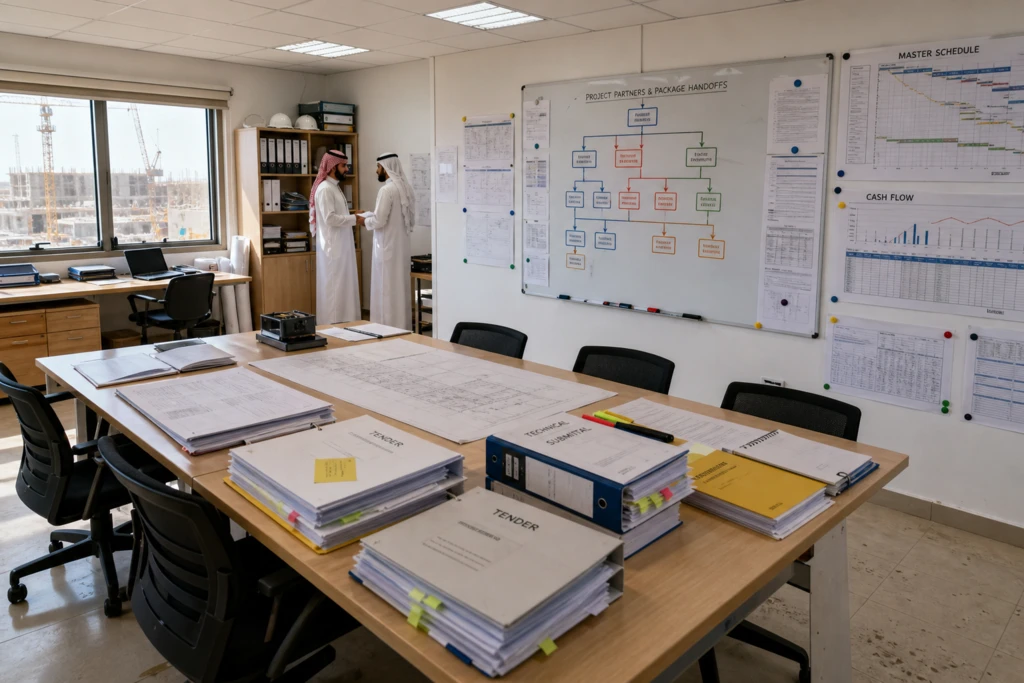
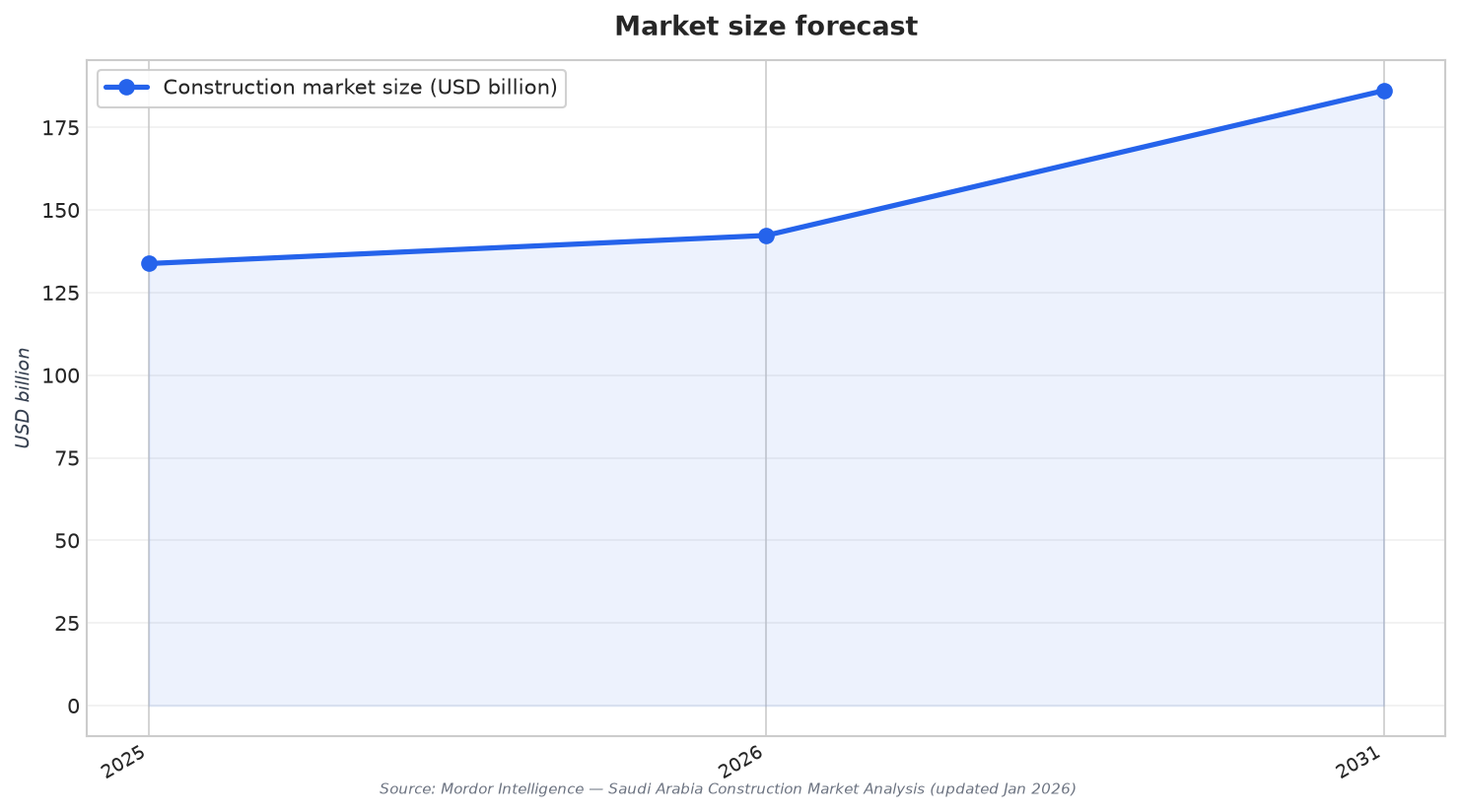
In 2026, Saudi construction is balancing two realities that shape consolidation. On one hand, Mordor Intelligence projects the Saudi Arabia construction market at USD 142.30 billion in 2026, with infrastructure leading at 36.6% of 2025 revenue and new construction accounting for 81.2% of 2025 value. On the other hand, Saudi Market Research Consulting describes rising cost pressure and a leaner-feeling pipeline in parts of the giga-project landscape, with longer payment waits for consultants and contractors and a slowdown where several developments are being reevaluated or extended. This combination rewards scale, stronger balance sheets, and tighter delivery controls, which is why M&A and structured partnerships become survival tools, not just growth options.
Consolidation is also a response to where money and procurement power sit. Mordor Intelligence estimates public spending represented 71.5% of 2025 activity, while private capital is expected to grow at a 7.10% CAGR during 2026–2031. MarkWide Research notes that government infrastructure agencies are displacing private residential developers as the dominant procurement channel as Vision 2030 megaprojects reshape priorities. In that environment, contractors that combine capabilities through acquisitions or mergers can meet higher qualification thresholds, carry working capital through longer payment cycles, and present integrated offers across civil works, project management, and specialized packages.
M&A, JVs, and Capability Bundling: What “Survival” Looks Like Now
Rivalry is intensifying as local champions form joint ventures with global majors to secure technology and balance-sheet strength for multi-billion-dollar awards, according to Mordor Intelligence. That is the practical logic behind contractor consolidation after the reset: buy or partner to add delivery capacity, compliance systems, and modern methods of construction. Mordor reports conventional on-site work was 89.6% of 2025 value, while modern methods are expanding at a 7.55% CAGR, supporting strategies that acquire modular or prefab competencies. MarkWide also highlights differentiation through technology-intensive delivery methods on complex developments, aligning with M&A that targets digital delivery strength and repeatable industrialized processes.
Sector selection matters as much as deal structure. Mordor Intelligence points to residential as the fastest-growing sector through 2031 at a 6.55% CAGR, while renovation is forecast to advance at a 6.91% CAGR over 2026–2031. Residential activity is also influenced by Sakani’s two-million-unit mandate, which Mordor links to private developers moving into prefab and modular solutions that shorten build times. Separately, Mordor’s residential research says the market is moderately consolidated at the top yet fragmented below mega-project tiers, and that apartment schemes held 70.54% of share in 2024. These dynamics create room for roll-ups of sub-scale specialists, as well as bolt-on acquisitions that add design-for-manufacture, BIM execution, and compliance readiness.
Cash discipline and risk clauses are the other half of consolidation success. Saudi Market Research Consulting ties 2026 conditions to financial recalibration, rising costs, and longer payment waits, while Mordor notes cost-inflation risk is being partly offset by escalation clauses that protect contractor margins. For Saudi Arabia construction contractors in 2026, the strongest consolidation strategies pair operational integration with contract governance: standardizing claims management, insisting on escalation mechanisms, and selecting clients and packages with clearer phased-payment triggers. The aim is not only to win work linked to pipelines like NEOM, Red Sea, Diriyah, and Qiddiya, but to remain solvent and bankable while timelines may lengthen and procurement becomes more demanding.
Why is contractor consolidation accelerating in Saudi Arabia in 2026?
How big is the Saudi Arabia construction market around 2026, according to Mordor Intelligence?
What segments and delivery methods influence M&A targets for contractors?
How can Saudi Arabia construction contractors in 2026 protect margins amid cost inflation?