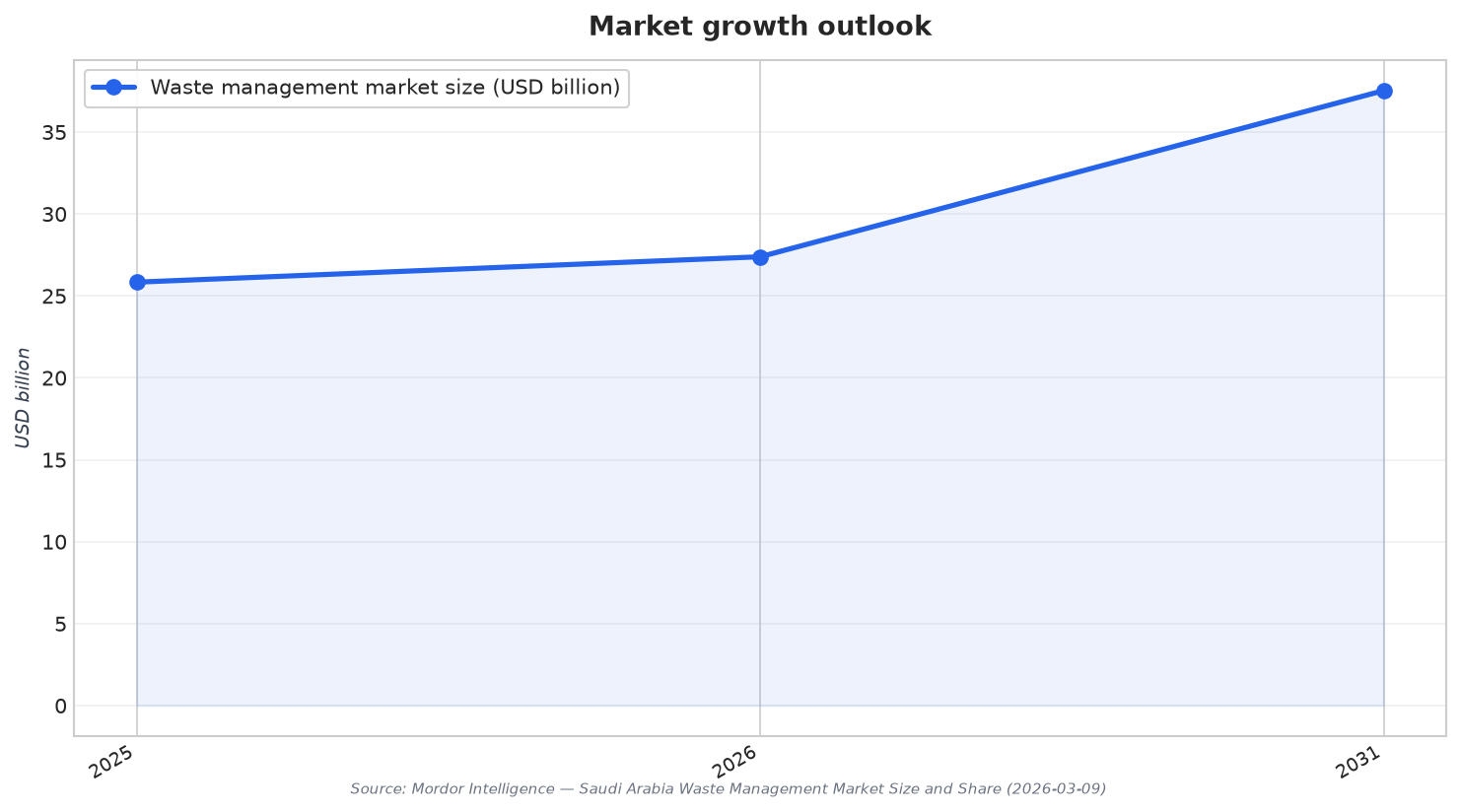
Saudi Arabia’s waste sector is moving from a landfill-first model toward a more circular system built on recovery and compliance. Mordor Intelligence values the Saudi Arabia waste management market at USD 25.84 billion in 2025 and estimates it will rise from USD 27.39 billion in 2026 to USD 37.53 billion by 2031, implying a 6.5% CAGR for 2026–2031. The same analysis links momentum to Vision 2030 policy pressure, stricter penalties under Royal Decree M/3, and a growing public-private-partnership pipeline. At the same time, national discussions still acknowledge a gap between ambition and day-to-day performance: a ScienceDirect review cites international assessments stating Saudi Arabia recycles less than 10% of municipal solid waste (MSW) and that many disposal sites remain unregulated.
Waste volumes and urban concentration are forcing decisions faster. GMI Research states Saudi Arabia produces approximately 53 million tons of waste every year and notes that Riyadh has a waste generation rate of more than 1.5 kg/day per person. It also cites the National Center for Waste Management that the majority of solid waste is generated by three cities: Riyadh (21%), Jeddah (14%), and Dammam (8%). Mordor Intelligence adds a forward-looking view, estimating population growth above 36 million by 2030 and an increase in per-capita MSW generation from 1.4 kg per day in 2024 to 1.6 kg by 2030. Large construction programs such as NEOM and the Red Sea Project are also described as drivers of higher construction-and-demolition (C&D) waste, which in turn supports demand for mobile crushers, material recovery facilities, and refuse-derived-fuel plants.
Targets Tighten, While the Market Tilts Toward Recycling
Saudi Arabia’s policy direction is increasingly explicit on diversion and circularity, even as baseline recycling remains low in parts of the system. Makreo Research highlights targets under Vision 2030 and the National Environment Strategy, including up to 90% landfill diversion by 2040 and a 40% national recycling rate by 2030, plus a longer-term aim of recycling up to 95% of total waste. GMI Research adds another stated goal: the government plans to recycle 35% of all types of waste by 2035. Mordor Intelligence frames a “90% diversion goal for 2040” and reports that Royal Decree M/3 introduced fines up to USD 8 million and prison terms for non-compliance. This shift is visible in service mix forecasts too: disposal and treatment represented 53.45% of the market in 2025, while recycling is projected to grow at a 9.7% CAGR through 2031.
Companies and infrastructure are scaling alongside regulation, but constraints remain. Mordor Intelligence reports that SIRC, Veolia, SUEZ, Averda, and BEEAH collectively managed more than 50% of treated volumes in 2025, and that SIRC alone recycled 16 million tons of C&D waste that year. It also notes operational technology steps such as blockchain-enabled traceability for extended producer responsibility credits and solar-powered electric collection fleets. On the infrastructure side, GMI Research states that around 840 treatment and recovery facilities will be operational across the Kingdom by 2040 to meet government objectives, and it cites a plan to send only 18% of solid waste to landfills by 2035 and reduce this to 10% by 2040. Still, the ScienceDirect review points to barriers including weak consumer awareness, weak regulatory enforcement, and limited cost-recovery mechanisms for MSW services, which can restrict investment in sorting, composting, and recycling capacity—key issues the Saudi Arabia waste management recycling push must solve to meet its stated milestones.
Several fast-growing waste streams show why circular solutions are becoming a business priority, not just a policy theme. Mordor Intelligence finds MSW held 45.85% of market share in 2025, while e-waste is expected to grow at an 8.49% CAGR over 2026–2031. GMI Research estimates 620 million kgs of e-waste are generated annually in the Kingdom, and says around 85% ends up in landfills. In parallel, the ScienceDirect review notes that metals, glass, batteries, and electronic waste are rarely recycled at scale and often end up in landfills or informal markets. With Riyadh alone accounting for 38.5% of market size in 2025 (Mordor Intelligence), the near-term opportunity is clear: concentrate collection, sorting, and recovery where waste is densest, then replicate models into faster-growing clusters as capacity expands.
How large is Saudi Arabia’s waste management market, and what is the outlook?
What landfill diversion and recycling targets are shaping the shift to a circular economy?
Which cities generate the largest share of Saudi Arabia’s solid waste?
How is e-waste influencing Saudi Arabia’s waste and recycling priorities?
What is holding back Saudi Arabia waste management recycling progress today?