Saudi Arabia’s push toward sovereign digital infrastructure is changing what “secure by design” means across government and enterprise. One forecast projects the Saudi Arabia cybersecurity market will grow from USD 4.98 billion in 2026 to USD 7.81 billion by 2031, at a CAGR of 9.4%. Another market study values the market at nearly USD 4.19 billion in 2025 and projects around 11.73% CAGR to reach USD 9.11 billion by 2032. These projections are not just about more tools. They reflect new operating realities as cloud adoption accelerates and data-residency requirements intensify, particularly for public-sector workloads.
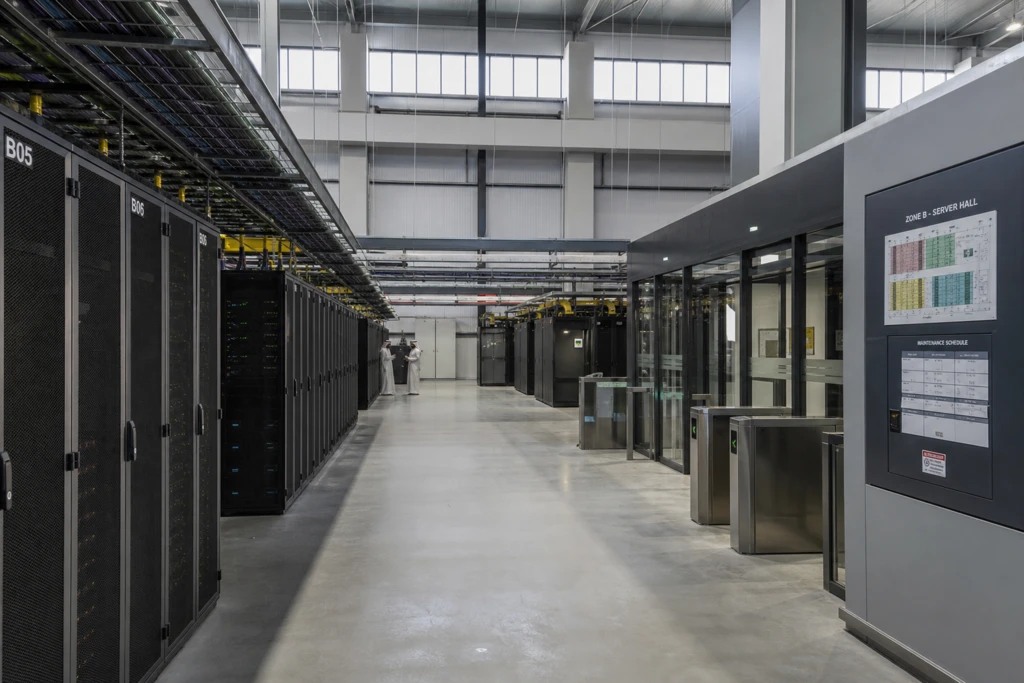
Data centres and hyperscale cloud regions are a major part of the story because they pull sensitive workloads into shared platforms that demand continuous assurance. Saudi Arabia has mandatory cloud-first directives that require all ministries and public agencies to offload legacy workloads into sovereign infrastructure by 2027. Hyperscalers are also committing capital, including AWS’s USD 5.3 billion commitment to launch its first local cloud region by 2026. As more systems move to SaaS and IaaS, cloud deployment is expected to grow at the highest CAGR in the Kingdom’s cybersecurity landscape, while buyers look for scalable controls that can keep pace with multi-cloud complexity.
Where Sovereign AI Meets Security Operations
Sovereign AI ambitions and hyperscale builds raise the security bar for availability, monitoring, and incident response. The Saudi Data and Artificial Intelligence Authority’s Million Saudis for AI program aims to graduate 20,000 local experts by 2030, while HUMAIN is described as having USD 100 billion backing in the data center market context. At the same time, NEOM’s DataVolt partnership lines up USD 5 billion for 1.5 GW of AI-optimized capacity by 2028. These moves concentrate critical compute and data, making managed detection and response, cloud security posture controls, and resilient operations more central to procurement decisions.
Market segmentation signals how buyers are prioritizing this shift. One study states the defense and government vertical held a leading 33% revenue share, and that public sectors and defense systems accounted for 33% of overall demand in 2025, citing data sovereignty requirements and modernization. The same source says the Central region controlled about 54% of total cybersecurity spending in 2025. It also reports that the security solutions segment captured an estimated 57% market share in 2025, linked to identity management and firewall installations. Separately, managed services are described as holding the largest market share as organizations outsource security operations for 24/7 monitoring and response.
As infrastructure scales, the enabling conditions create both tailwinds and constraints. Saudi Arabia’s data center economics are supported by electricity prices as low as USD 0.05 per kWh for business customers, which is positioned as attractive for hyperscale and AI-focused facilities. But expansion also depends on skills and standards. The Saudi Technical and Vocational Training Corporation (TVTC) reported a 25% shortage of skilled engineers and technicians in early 2024, especially in data center operations, cloud computing, and AI infrastructure. Industry initiatives are also emerging, such as Mastercard launching its first Middle East Cyber Resilience Center in Saudi Arabia in May 2025, partnering initially with Riyad Bank to focus on training, risk assessments, and adoption of global cybersecurity standards.
How fast is Saudi Arabia’s cybersecurity market expected to grow?
What is pushing demand for cloud security in the Kingdom?
Which sectors and regions lead cybersecurity spending in Saudi Arabia?
What role do managed security services play in Saudi Arabia’s security spending?
What challenges could slow progress despite strong infrastructure momentum?