Saudi Arabia’s solar story is no longer only about building power plants. It is also about building an industrial base that can supply them. IMARC Group values the Saudi Arabia solar energy market at USD 8.3 Billion in 2025 and expects it to reach USD 145.4 Billion by 2034, with a CAGR of 37.39% during 2026–2034. That kind of expansion creates a clear question for developers and policymakers: how much of the equipment value chain can be localized. Government initiatives are explicitly framed around diversification, standards, and incentives, while keeping project development moving under Vision 2030.
Localization is being formalized through new institutional moves. On July 16, 2024, the Public Investment Fund (PIF) announced signing three agreements to localize the manufacturing and assembly of solar and wind generating equipment and components in Saudi Arabia. The Renewable Energy Localization subsidiary (RELC), wholly owned by PIF, entered into these agreements, aligned with the Saudi Ministry of Energy’s efforts to localize renewable component production. At the same time, market demand for PV hardware is visible in downstream indicators: Grand View Research reports Saudi Arabia’s solar PV panels market generated USD 1,023.5 million in revenue in 2023 and is expected to reach USD 1,123.1 million by 2030.
From Targets to Tender Terms: Why Domestic Supply Matters
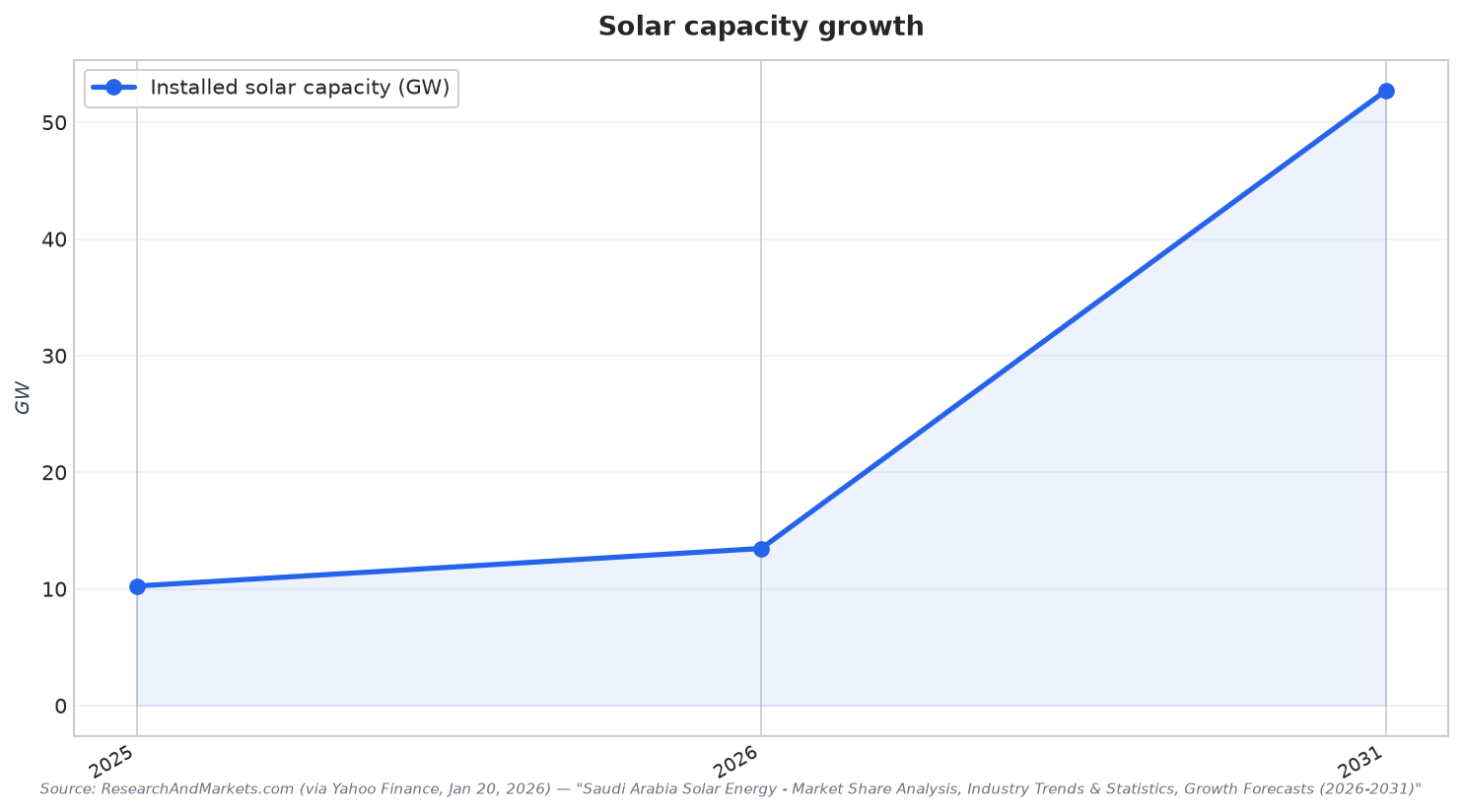
The manufacturing push sits inside a broader capacity ramp. A ResearchAndMarkets.com report cited by Yahoo Finance projects installed solar market size reaching 13.47 GW in 2026, up from 10.25 GW in 2025, and rising to 52.72 GW by 2031. It also states solar photovoltaic installations commanded a 98.55% market share in 2025, highlighting how central PV is to near-term deployment. The same report describes tenders that integrate battery storage capabilities and include local-content thresholds within utility procurements, explicitly linking project awards to industrial policy and domestic manufacturing outcomes.
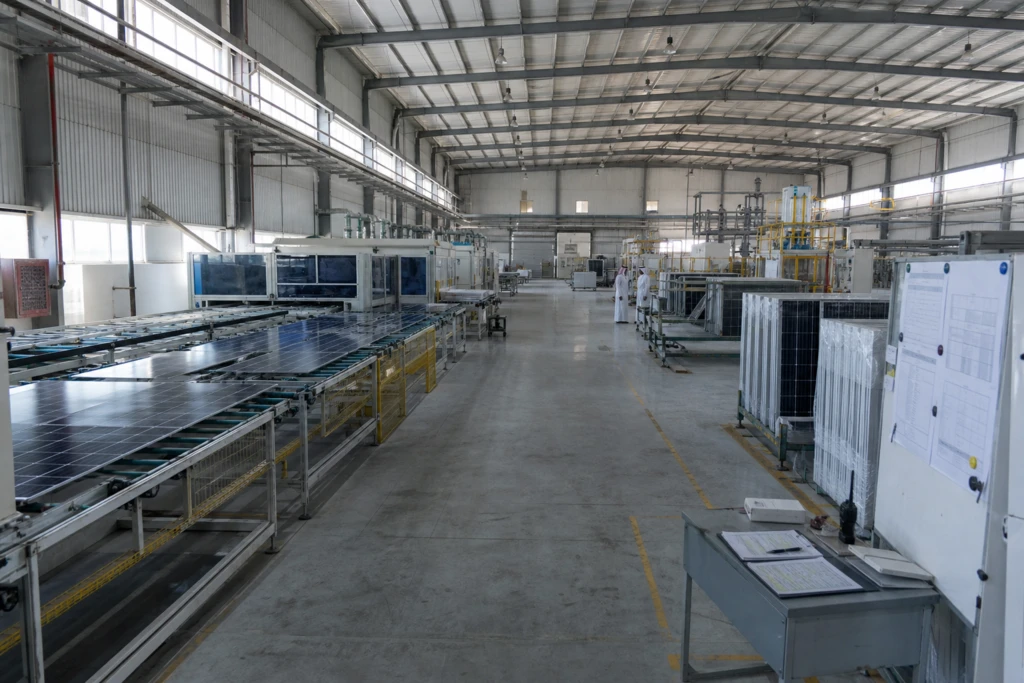
Industry supply signals are already showing up in equipment-side commentary. IndexBox describes local content requirements as a driver for international suppliers to establish manufacturing and assembly operations in Saudi Arabia. It notes that several module assembly lines with 1–3 GW capacity each have been announced by companies such as LONGi, JinkoSolar, and local joint ventures. It also reports inverter and tracker assembly facilities being developed by Sungrow and NEXTracker in partnership with Saudi entities. In the same framing, IndexBox lists major module suppliers to the Kingdom and says they collectively supply 60–70% of modules through direct sales or distributor partnerships, underscoring why localization is a strategic lever rather than a niche add-on.
All of this points to a practical logic: Saudi Arabia is trying to match its project pipeline with domestic capability so the value of equipment procurement does not sit entirely offshore. Vision 2030 is repeatedly cited across sources as the policy backbone, while procurement design, standards, and localization agreements are the mechanisms. The result is a clearer runway for Saudi Arabia solar panel manufacturing efforts, especially around assembly and adjacent equipment, as capacity projections climb and PV remains the dominant technology. The next test will be how consistently localization commitments translate into operating factories that can deliver to utility-scale schedules.
What signals show Saudi Arabia is serious about localising solar equipment production?
How large is Saudi Arabia’s solar energy market according to IMARC Group?
What do forecasts say about installed solar capacity growth in Saudi Arabia?
What kinds of factories are being discussed for Saudi Arabia solar panel manufacturing?
How big is the Saudi solar PV panels market in revenue terms?