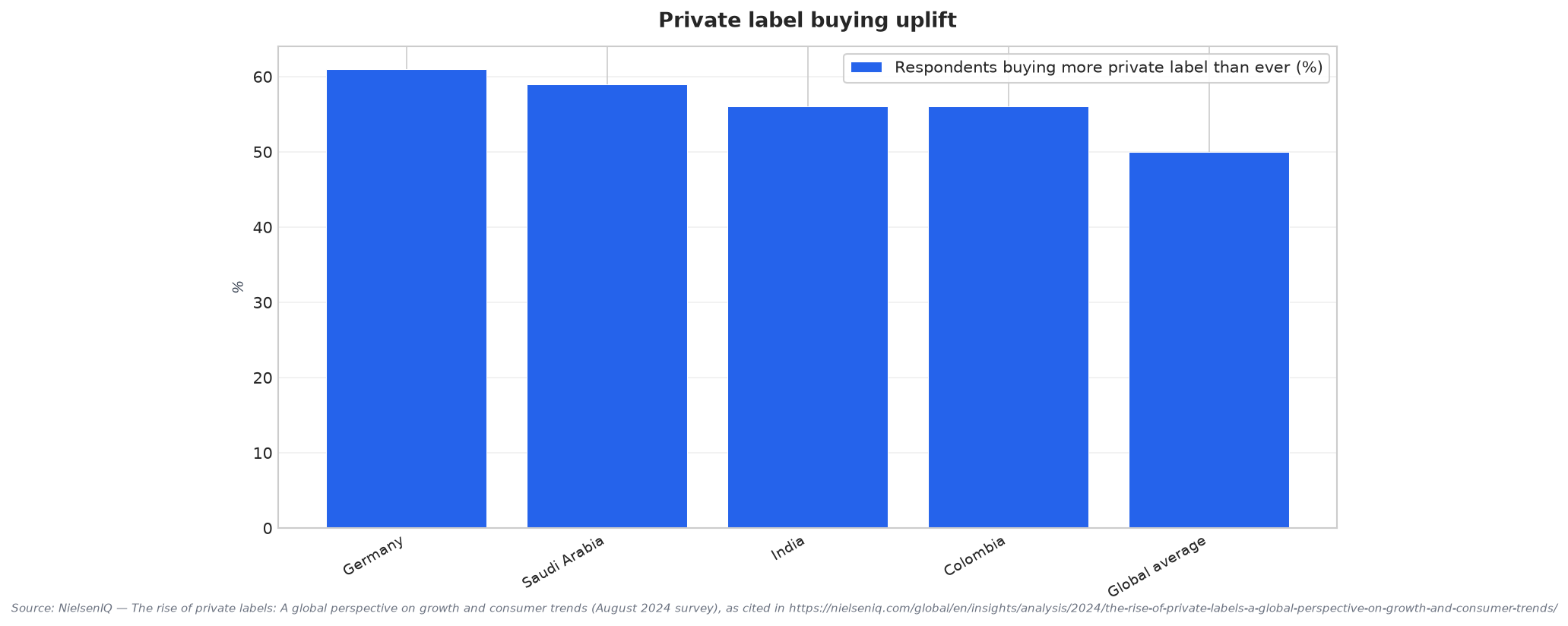
Premium private label is rising because shoppers are rethinking what “value” means. NIQ’s August 2024 survey found that 59% of respondents in Saudi Arabia said they were buying more private label products than ever, above the global average of 50%. That shift matters in grocery, where inflation pressure has made consumers more intentional about what they buy. NIQ also reported that in Q2 2024, private labels delivered +5.6% value sales growth over a 12-month period globally, with Middle East/Africa posting the fastest regional value growth at +34.3%. For Saudi retailers, this creates a clear playbook: compete on price where shoppers need relief, while also using premium tiers to keep baskets from trading down too far.
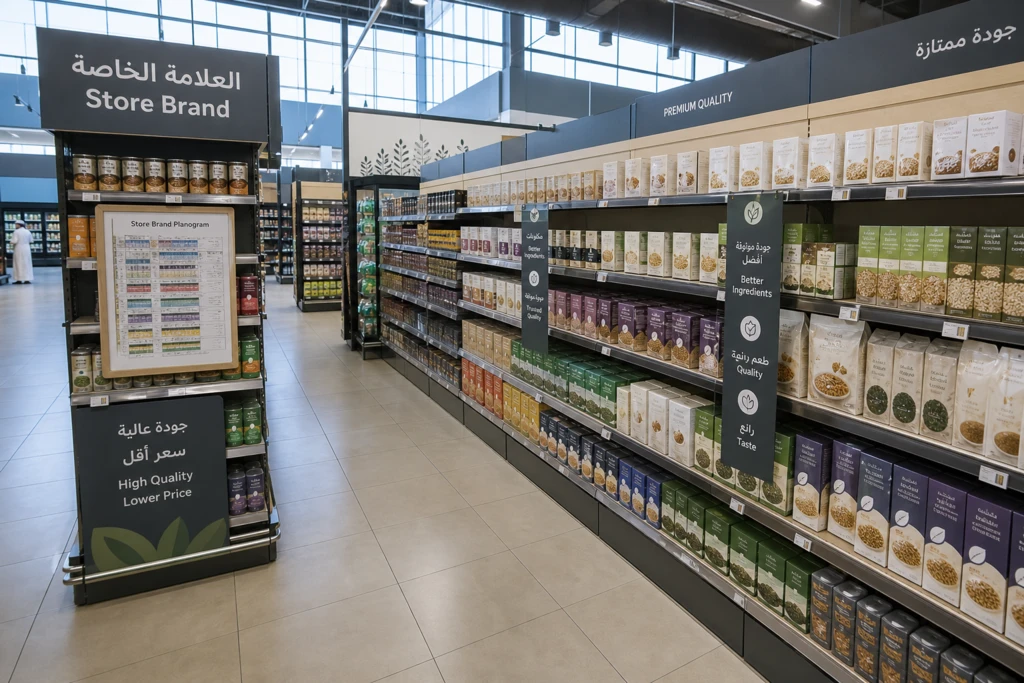
Own-brand strategies work best when they stop acting like “generic” and start behaving like brands. Industry commentary describes premium private label as a way to bridge a price gap: shoppers “go up a bit” in price, but not as far as a national brand. This is reinforced by the idea that private-label premium ranges often have distinct identities, not just a supermarket name, which can improve familiarity and perceived value. The same logic helps retailers defend shelf space and profitability as private label becomes a more central choice, not a last resort. In practice, this means creating clear good-better-best ladders, where entry lines signal savings and upper tiers signal quality, taste, and occasion.
Premiumization Is Not Just a Western Playbook
Global benchmarks show how far private label can scale when retailers invest in range design and trust. Circana data cited in 2026 notes that private label is nearly a quarter of all unit sales in the US, described as a $300 billion business, while Europe is at roughly half of all unit sales and Australia at about 40%. Numerator similarly reported that private label products accounted for 26% of unit volume across ten major product sectors in the past 12 months. These figures are not Saudi-specific, but they show what happens when retailers treat own brand as a managed portfolio: tiered architectures, deeper penetration in everyday categories, and sustained investment in quality, innovation, and experience.
The next phase is making private label feel “worth it,” even when it is not the cheapest option on the shelf. NIQ’s survey points to a willingness among younger consumers to pay more for private label products they enjoy: 46% of Millennials and 46% of Gen Z respondents said they are willing to spend more, compared with 23% of Boomer respondents. That matters for Saudi retailers building a long-term franchise, because premium private label depends on repeat purchase and loyalty, not just one-time trade-down. It also supports a strategy where premium lines can coexist with value staples, letting shoppers choose by occasion while still staying within the retailer’s ecosystem.
Product development and health cues also help retailers justify premium tiers while still serving budget needs. US examples show how grocers are expanding store-brand assortments with claims like protein and fiber: Meijer referenced more than 700 SKUs that include more than 10 grams of protein per serving, and Kroger’s 24-SKU expansion of its Simple Truth portfolio offers between 9 grams and 21 grams of protein per serving. These examples are from the US market, but they illustrate a transferable tactic for the Saudi Arabia private label market: add visible, easy-to-compare benefits that translate to perceived quality. Combined with clear pricing ladders, retailers can capture value shoppers without racing to the bottom.
What is changing in Saudi Arabia’s private label market right now?
Are shoppers willing to pay more for premium private label?
How fast is private label growing globally and in Middle East/Africa?
What do other regions suggest about the scale private label can reach?