Base oil is a core input for automotive lubricants, industrial oils, hydraulic fluids, gear oils, and greases. In Q2 2026, base oil pricing shifted fast as crude availability concerns, transportation pressure, and refinery conditions tightened. Sources linking the move to disruptions around the Strait of Hormuz and the wider USA-Israel-Iran conflict describe a market where higher feedstock and energy costs reached lubricant supply chains in overlapping waves. Across monitored markets, average base oil prices increased by around 100% during the quarter, an unusually large movement for a three-month period. For lubricant players, that kind of change compresses planning windows and increases the risk of selling finished products priced off older inventory assumptions.
For Saudi Arabia, the same Q2 2026 tracking shows the local increase at around 80%, highlighting how the global shock translated into regional realities rather than a uniform outcome everywhere. In the same dataset, the USA rose by around 167%, South Korea by about 100%, and Taiwan by approximately 97%, while the UAE rose by about 74%. These spreads matter for procurement and competitive positioning, because they suggest that inventories, refinery operations, shipping costs, and local buying activity can amplify or dampen the same global trigger. For decision-makers watching Saudi Arabia base oil prices, the key point is not only that costs jumped, but that global benchmarks moved at different speeds, changing the economics of imports, exports, and substitutions across grades.
What the Q2 2026 Benchmarks Mean for Pricing in Saudi Arabia
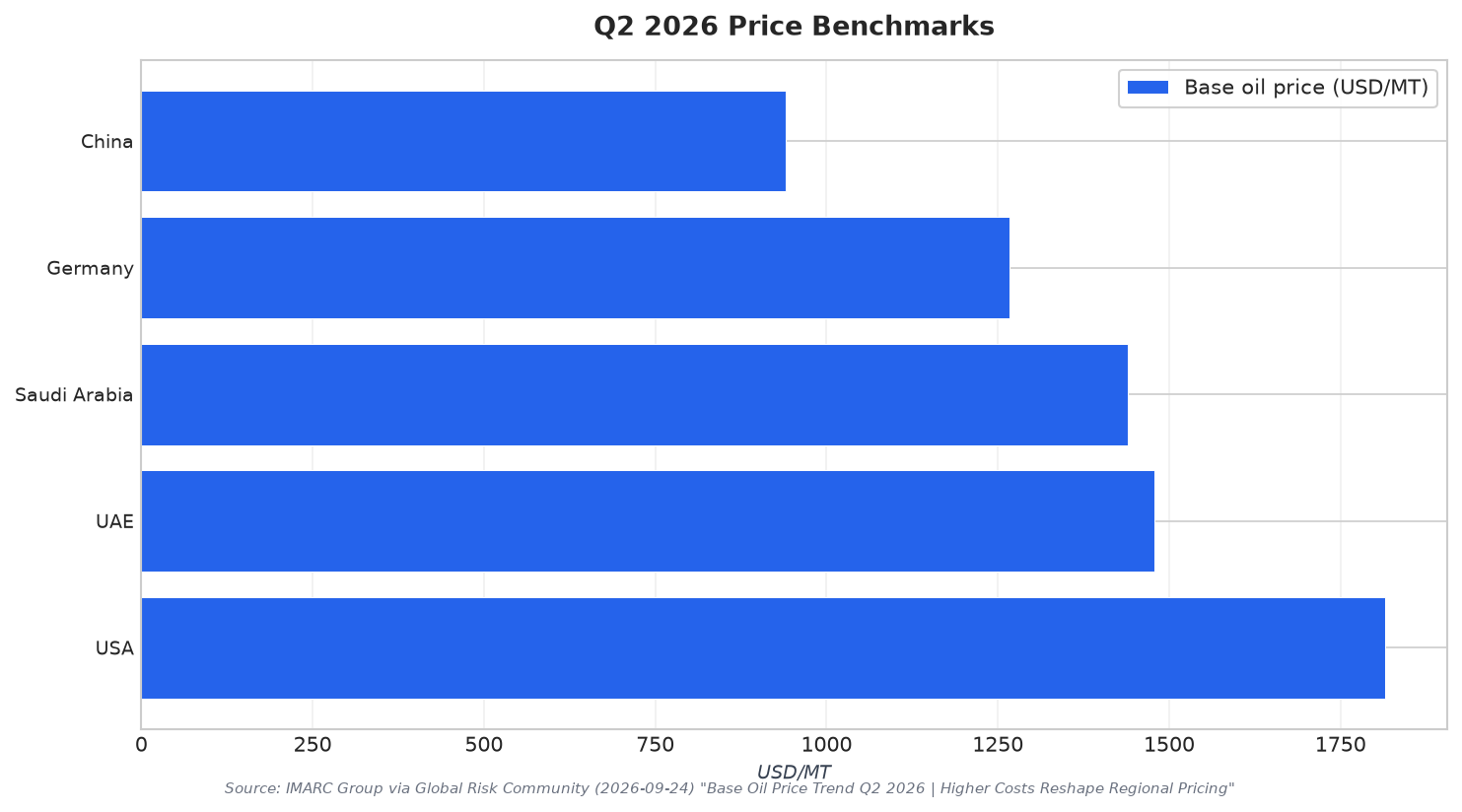
Benchmark pricing snapshots add clarity to what “higher” meant in absolute terms during Q2 2026. IMARC Group tracking listed China at USD 940/MT, Germany at USD 1267/MT, Saudi Arabia at USD 1440/MT, the UAE at USD 1479/MT, and the USA at USD 1815/MT. This range underscores why regional procurement strategy became more important under cost pressure. Middle Eastern benchmarks sat above China but below the USA, and that positioning can influence export economics and local pricing discipline when freight and availability become uncertain. At the same time, a separate January 2026 outlook noted that in Saudi Arabia, modest seasonal industrial restocking was expected to partially offset oversupply, while Red Sea freight dynamics were described as the main cost wildcard for buyers taking delivery via longer routing.
Margins tightened further because base oil was not the only moving part. One industry analysis reported that Group II base oil prices increased by more than 35% in 2026, while Group III prices climbed above USD 1,800 per metric ton. That same source also tracked at least 17 to 22 separate finished-lubricant price increase announcements between March and May 2026, with individual increases ranging from 12% up to 35%, and some flat-rate jumps of USD 5.00 per gallon or more on synthetics. Another input-cost review described early posted increases for Group I and II base stocks in the USD 0.24 to USD 0.50 per gallon range, and noted that strong margins in diesel and jet fuel encouraged refiners to prioritize higher-margin output over base oil, tightening supply. It also warned that meaningful relief on the synthetic base oil side may not occur until late 2026 or into 2027.
For Saudi blenders and distributors, the practical consequence is a faster, more defensive approach to pricing and customer communication. When base oil costs rise sharply and logistics variables such as Red Sea routing remain a wildcard, holding list prices steady can quickly translate into margin erosion. The Q2 2026 pattern also suggests that relying on global averages can mislead: Saudi Arabia’s rise of around 80% did not match the USA’s roughly 167%, and Q2 benchmarks placed Saudi Arabia at USD 1440/MT versus USD 1815/MT in the USA. As supply constraints and grade-specific disruptions persist, many companies will treat pricing as a sequence of adjustments rather than a single event, aligning contracts and purchasing plans to the reality that cost relief may lag and arrive unevenly by region and product group.
How did Saudi Arabia’s base oil market move in Q2 2026 compared with other regions?
What Q2 2026 benchmark price was reported for Saudi Arabia?
Why did lubricant prices see repeated increases in 2026?
What did sources report about Group II and Group III pricing pressure in 2026?