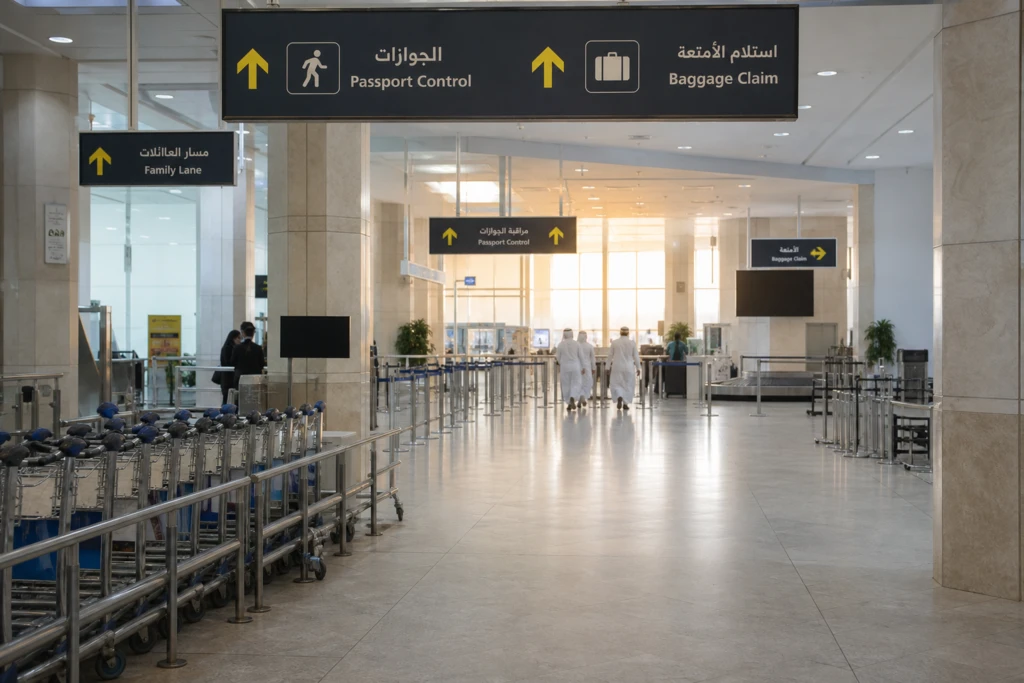
Saudi Arabia’s pilgrim economy is increasingly defined by one structural shift: Umrah can be performed almost any time of the year, and it scales with capacity rather than a fixed international quota. That design difference matters because it converts religious travel into repeatable, year-round demand for airlines, hotels, ground transport, food, retail, telecoms, and ritual services. In 2024, Saudi Arabia logged 18.5 million pilgrims, including 16.92 million Umrah arrivals and roughly 1.61 million Hajj pilgrims. Vision 2030 framed Umrah growth as a core objective, targeting a rise from a 2016 baseline of 6.2 million to 30 million annually by 2030.
The Umrah runway is already visible in the gap between targets and performance. The 16.92 million foreign Umrah arrivals in 2024 exceeded the interim 2024 target of 11.3 million, placing religious tourism among the commitments described as ahead of plan. Another analysis characterizes Umrah volumes as exceeding 17 million annually and says Saudi Arabia receives approximately 30 million religious tourists each year when combined with other visitors to Mecca, Medina, and Islamic heritage sites. This scale is why analysts describe the sector as generating billions of dollars annually across direct and indirect activity, with concentrated spillovers into the regional economies of Makkah and Madinah.
Hajj’s Fixed Window, Umrah’s Flexible Capacity
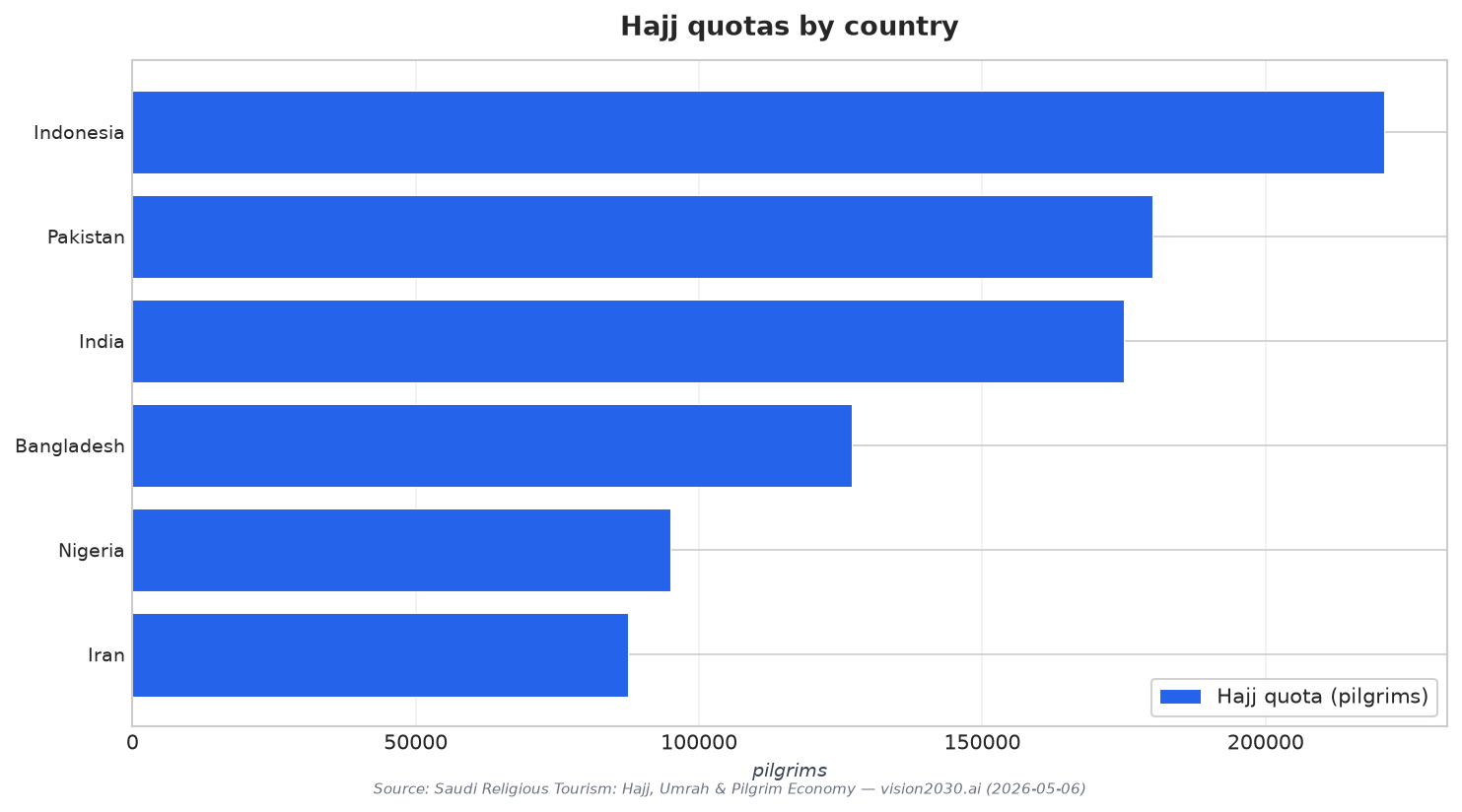
Hajj remains a tightly compressed, five-day mass gathering with fixed geography and a quota system established in 1987 at roughly one visa per 1,000 Muslims per country. For Hajj 1446 AH (2025), one source cites a global ceiling of 1,372,482 international pilgrims and a season ending with 1,673,230 total when 166,654 domestic participants were added, alongside a reported 1,506,576 international arrivals via air, land, and sea. For Hajj 1445 AH (2024), the total cited is 1,833,164. Market research also reports that in 2024 there were 1,833,164 total Hajj pilgrims, including 1,611,310 from abroad and 221,854 domestically, and estimates 87.9% international participation.
Operational intensity raises both costs and risks, and recent events have pushed safety to the center of planning. A June 2024 heat episode is reported to have killed at least 1,301 Hajj pilgrims as Mecca temperatures peaked at 51.8 degrees Celsius. Saudi authorities reported that 83% of the dead were unauthorised pilgrims who bypassed the quota system, lacked air-conditioned accommodation, and walked long distances under direct sun. This context helps explain why multiple sources emphasize crowd control, health services, smart monitoring, and digital booking and visa systems as strategic levers. It also reinforces why Umrah’s year-round model—less constrained by a single fixed ritual window—has become the long-run economic story.
On the business side, forecasts and market sizing attempts vary by publisher, but they point in the same direction: investors and policymakers are treating pilgrimage services as a large, formalized industry. One report projects the Saudi Arabia Hajj tourism market rising from USD 172.5 billion in 2024 to USD 358.8 billion by 2034 at a 7.6% CAGR. Another projects expansion from USD 183.8 billion in 2025 to USD 368.3 billion by 2035 at a 7.2% CAGR, and anticipates international pilgrims holding a 58.9% share and men accounting for 52.3% of demand orientation in 2025. Together, these projections frame how the sector’s growth expectations are being priced into the broader Saudi Arabia religious tourism market narrative.
How many pilgrims did Saudi Arabia record in 2024, and how many were Umrah?
What is Vision 2030’s Umrah arrival target, and what was the baseline?
How does Hajj capacity differ from Umrah in practice?
What do the sources say about the Saudi Arabia religious tourism market outlook for Hajj services?
What happened during Hajj 2024 regarding extreme heat, according to the sources?