Consumer goods brands in Saudi Arabia are entering a compliance squeeze where packaging choices are no longer just commercial decisions. They are regulatory, operational, and cost decisions. The stakes are rising because packaged categories are expanding. Mordor Intelligence values the Saudi Arabia food and beverages market at USD 36.35 billion in 2025, with estimates moving to USD 38.38 billion in 2026 and USD 50.38 billion by 2031 (a 5.59% CAGR for 2026–2031). It also reports supermarkets and hypermarkets held 57.10% share in 2025, while online retail is projected to grow at a 7.82% CAGR through 2031. That mix increases the volume of labeled packs moving through both physical and digital channels, which magnifies the impact of any packaging non-compliance.
The compliance baseline starts with who controls what. SASO is the only Saudi organization responsible for setting national standards for commodities and products, including safety and environmental testing, and it maintains significant authority in developing and enforcing standards in Saudi Arabia. SFDA is responsible for regulating and controlling food, drugs, and medical devices, including mandatory standard specifications, for imports and local manufacturing. For imports, SASO’s Saber system (Saleem Saber) is an electronic certification and conformity assessment platform that became mandatory for all imported goods entering Saudi Arabia as of July 2018. Saber connects importers, SASO-approved certification bodies, and Saudi customs in one system, with stated goals that include accelerating clearance, reducing counterfeit products, tracking products more easily, and raising the number of SASO-conforming products in-market.
What Changes in 2026 Means in Practice: Materials, Labels, and Proof
In 2026 planning, compliance pressure shows up in both materials strategy and label architecture. Trade.gov states that all imported and locally produced prepackaged food products must meet labeling requirements indicated in GSO 9:2022 (SFDA.FD GSO 9:2022), and labels should be in Arabic or include an Arabic translation. The same source adds that plastic food containers must be labeled with the type of plastic material used, and include details such as weight or capacity, a statement of food grade, purpose, directions for use, and applicable warning statements. In parallel, Mordor Intelligence’s flexible packaging coverage notes that SFDA rules require traceable Arabic labeling, accelerating adoption of digital printing for variable data compliance. It also points to municipal mandates in Riyadh that require certified recycled content, and it frames a 2026 levy as adding compliance costs while accelerating demand for recyclable and compostable alternatives.
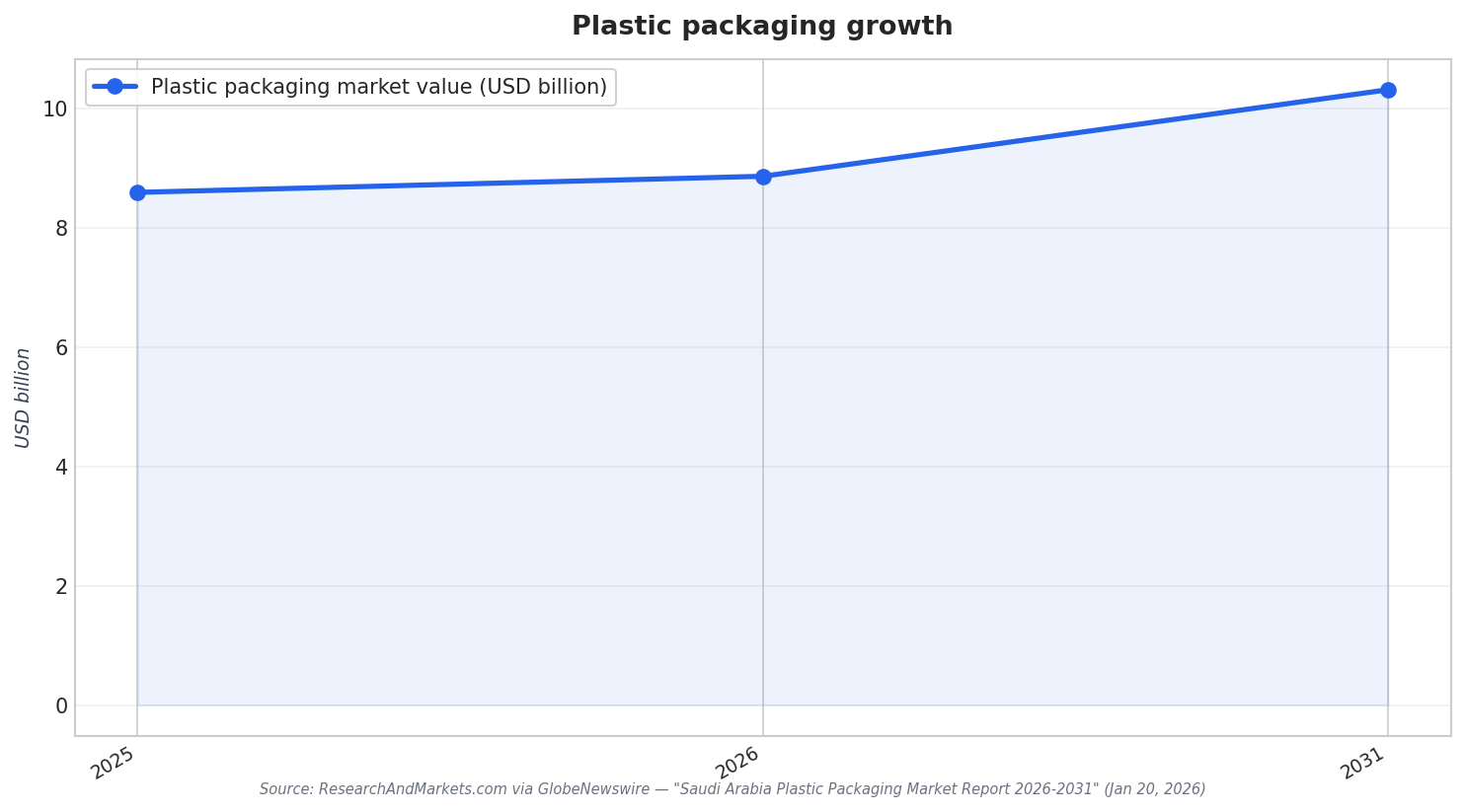
Material choices are also being pulled by market growth and standards tightening. One packaging market outlook projects Saudi Arabia’s plastic packaging market growing from USD 15.85 billion in 2026 to USD 25.99 billion by 2035 (a 5.65% CAGR for 2026–2035). Another report snapshot projects the plastic packaging market moving from USD 8.59 billion in 2025 to USD 8.86 billion in 2026 and reaching USD 10.31 billion by 2031 (a 3.15% CAGR for 2026–2031). That same snapshot states that NEOM and Ras Al Khair are early adoption zones experimenting with ISCC+-certified resins from SABIC under the TRUCIRCLE program, and that with SASO standards tightening, brand owners are securing long-term contracts for certified polymers that sustain price premiums. It also notes PVC is seeing a slow phase-out in consumer goods following updated SASO hazard guidelines.
For brands, Saudi Arabia sustainable packaging regulation compliance becomes a workflow, not a one-off project. Start with product classification and certification sequencing in Saber for import readiness. Build labels to satisfy GSO 9:2022 requirements, including Arabic text and plastic container disclosures where relevant, and incorporate traceability requirements where SFDA rules apply. Then stress-test packaging formats against the direction of travel described in the sources: lightweighting is highlighted as a design approach that reduces material use without changing functionality, while Riyadh’s certified recycled-content mandates and the 2026 levy are positioned as forces that increase compliance costs but boost demand for recyclable and compostable options. The practical outcome is clear. Packaging teams must coordinate procurement, printing, and regulatory sign-off earlier, because proof of conformity and traceable labeling are becoming core market-access requirements.
Who enforces packaging-related standards in Saudi Arabia: SASO or SFDA?
What is Saber and why does it matter for imported consumer goods packaging?
What does GSO 9:2022 require for prepackaged food labels?
How is traceable Arabic labeling affecting packaging execution?
What does Saudi Arabia sustainable packaging regulation compliance look like for 2026 planning?