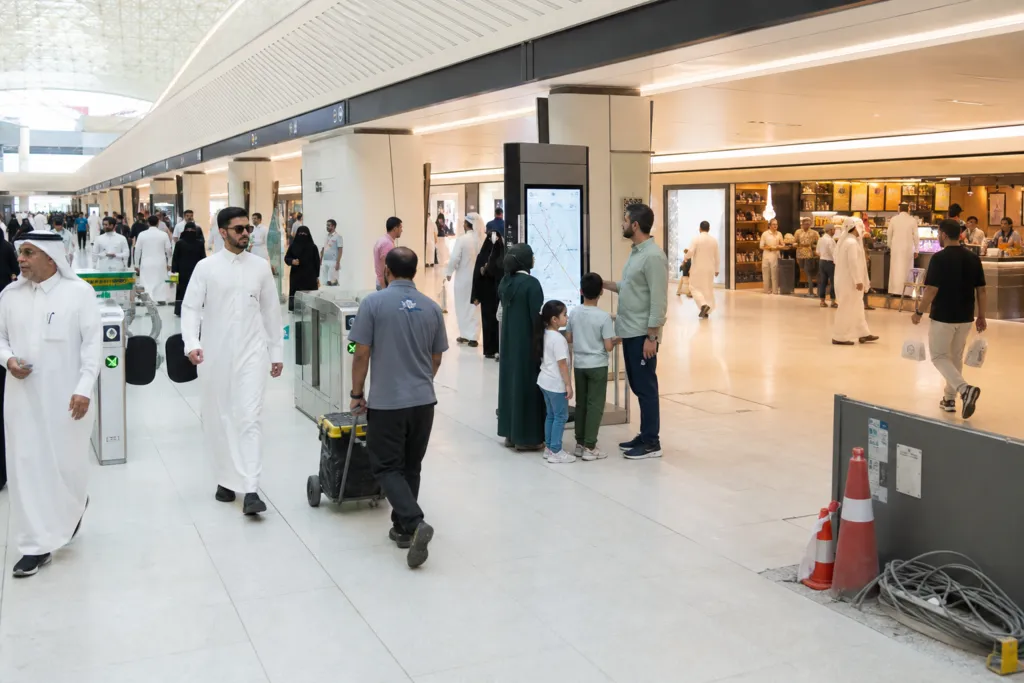
The Riyadh Metro is not being positioned as a routine way to get from A to B. A CNN report describes it as an experience, built around standout architecture and large station footprints that can feel overwhelming at first. Yet, the same report notes there are usually plenty of station staff to help people navigate. This matters for urban mobility because onboarding and comfort can influence repeat use. It also matters for retail footfall because stations that feel like destinations can lengthen dwell time and encourage spending near interchanges, concourses, and station-adjacent districts.
In hard network terms, the system launched in December 2024 as an automated rapid transit network spanning over 176 kilometers across six lines. CNN also calls it the world’s longest driverless metro system, linking key points across the capital, including King Khalid International Airport and the King Abdullah Financial District (KAFD). For the Riyadh Metro economic impact discussion, this footprint sets the conditions for broader access to jobs, services, and shopping districts. It also creates new “edges” for retail catchments, because a single network can connect airport arrivals with business zones and civic centers.
Ridership momentum is one of the clearest early signals. Within six months of opening, the network was already outperforming expectations, according to the Royal Commission for Riyadh City. The commission reported more than 18 million passengers in the first 11 weeks. CNN then reports that, “last month,” the Riyadh Metro welcomed its 100 millionth passenger. These are mobility outcomes, but they also hint at footfall outcomes. A transport system that accumulates riders at this pace concentrates people in predictable nodes, which is exactly what retail and mixed-use operators typically seek when planning leasing, tenant mix, and activation.
From Stations to Destinations: Interchanges, Design, and TOD
Not every impact is immediate or uniform. CNN says traffic remains heavy and that the metro has not eased car dependency yet; some trips are quicker by metro, while others can take twice as long because of Riyadh’s urban layout. That mixed performance suggests the Riyadh Metro economic impact will vary by corridor and use case. Still, when stations are “huge,” like KAFD and Qasr Al-Hokm, and when KAFD functions as a central interchange, the built environment itself can support non-transport activity. Large, well-staffed hubs can act as magnets for meetings, errands, and time spent nearby, which is a practical bridge between mobility and retail footfall.
The clearest retail-adjacent signal in the sources is the rise of transit-oriented development. The Fintech Times reports a Riyad Capital fund valued at c. $400 million (SAR 1.5 billion) tied to a 32,000-square-meter plot on Al-Takhassusi Road. The plan is a mix of hospitality, office, residential, and retail assets, and it is classified as a TOD. A key detail is proximity: the project is located just 250 meters from the Al-Takhassusi Metro Station. This is a direct bet that high-frequency, high-volume passenger movement can translate into viable, high-density places where retail is supported by daily activity, not only occasional visits.
Put together, the Riyadh Metro effect is best understood as a pipeline: network scale brings access, ridership concentrates people, and TOD converts that concentration into investable places. Official messaging also frames the metro as a milestone aligned with economic, social, environmental, and urban development objectives, according to a statement cited by CNN from Ibrahim bin Mohammed Al Sultan, CEO of the Royal Commission for Riyadh City. The near-term picture includes tradeoffs—traffic is still heavy—but the early ridership milestones and the $400 million TOD fund show how mobility and retail footfall can start to reinforce each other around stations.
What does “Riyadh Metro economic impact” mean in practical terms?
How big is the Riyadh Metro network, according to the sources?
What ridership figures are reported for Riyadh Metro?
Has the metro already reduced traffic and car dependency in Riyadh?
What is an example of TOD linked to the Riyadh Metro in the sources?