Saudi Arabia’s shift toward zero routine gas flaring is best understood as a long arc of policy and operations catching up with resource reality. After the discovery of Ghawar in 1948, oil production increased, more associated gas was produced, and more gas was flared. A Saudi Arabia case study published by SPE notes that Saudi Aramco initially had no interest in capturing the gas from oil operations. It also states that no local or regional market existed and that exporting would have required substantial infrastructure investments. That historical constraint matters because today’s compliance programs and technical roadmaps increasingly focus on building the enabling systems—commercial, infrastructural, and operational—that make routine flaring avoidable rather than inevitable.
Globally, routine flaring is widely framed as the routine disposal of associated petroleum gas during crude oil extraction, where the unwanted gas is mostly natural gas dominated by methane. Wikipedia’s summary estimates that over 145 billion cubic metres of natural gas was flared worldwide during 2018, and an MDPI review cites a World Bank/GGFR estimate of 143 billion cubic meters flared in 2020. Wikipedia also reports global data spanning 1996–2018 indicating flared gas volumes fell 10% while oil production rose 40%. For Saudi Arabia methane emissions flaring reduction efforts, these global figures are not local performance metrics. But they underscore why “zero routine flaring” has become a widely used operational target and why stakeholders now expect systems that prove reductions with credible measurement and reporting.
What “Compliance” Looks Like: Measurement, Reporting, and Execution
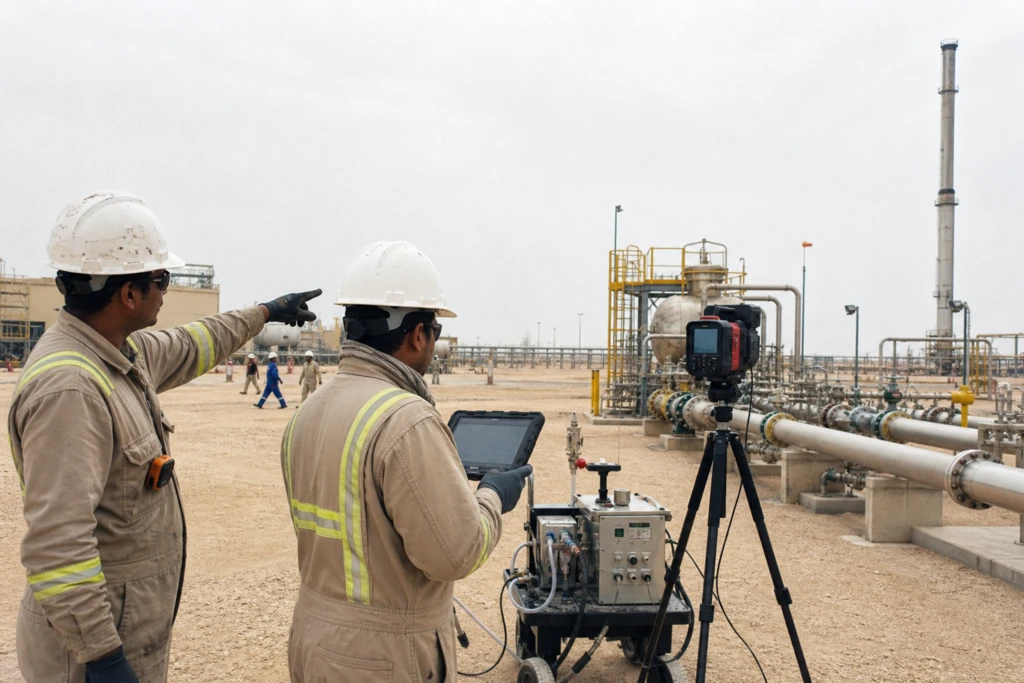
Several sources stress that the hardest work is often not choosing a target, but building enforceable governance and transparent disclosure. The MDPI review argues that flaring reduction efforts can be hampered by failures in policy design and implementation, incoherent legislative frameworks, and a lack of transparent reporting and statistical disclosure. It also notes that outdated legal provisions can limit regulatory enforcement and that penalties are often ineffective in deterring violations. For energy service providers, that gap is a commercial opening: helping operators standardize measurement, reporting, and verification workflows that stand up to audits, internal assurance, and stakeholder scrutiny. The same MDPI review describes the Global Gas Flaring Reduction Partnership (GGFR) as a voluntary program that provides technical support and guidance to measure, report, and verify flaring emissions and facilitate cooperation.
Operator-led ambitions are also sharpening expectations. OGCI states its member companies share an ambition to achieve near zero methane emissions from operated oil and gas assets and zero upstream routine flaring by 2030, and that enhanced monitoring and measurement of methane could support further reduction opportunities while improving data quality and transparency. In its progress reporting, OGCI says member companies’ aggregate total routine gas flared volumes upstream was 1,568 million cubic metres (Mm3), which it describes as 72% lower than in 2018 (the first year of published data for that metric). OGCI also reports an aggregate average upstream methane intensity ambition for operated assets of well below 0.20% by 2025. Service providers can map offerings to these needs: continuous monitoring, site diagnostics, flare system optimization, and the digital evidence chain that makes progress defensible.
Saudi Arabia’s broader transition context reinforces why this becomes a sustained services market rather than a one-off retrofit cycle. Britannica Money reports that Saudi Arabia has pledged to reduce its net greenhouse gas emissions to zero by 2060, and that Saudi Aramco has taken steps to reduce emissions from its facilities, including efforts to limit methane flaring, while not including scope 3 emissions in its climate disclosures or reduction targets. OGCI also highlights a Saudi project example: Aramco and TotalEnergies’ joint venture reached a deal to develop a cogeneration plant for the Amiral petrochemical complex in Jubail, due to start operating in 2027, generating up to 475 megawatts of power and approximately 452 tonnes per hour of steam using advanced cogeneration gas-fired technology. For providers, the compliance opportunity is to connect field-level methane and flaring work with facility-level efficiency projects, and to document both with consistent, report-ready data.
What does “routine flaring” mean in oil and gas operations?
How large is routine flaring globally, based on the sources?
Why is measurement and reporting central to Saudi Arabia’s methane and flaring reduction efforts?
What targets do OGCI members cite for methane and routine flaring?
What is the compliance opportunity in Saudi Arabia methane emissions flaring reduction for energy service providers?