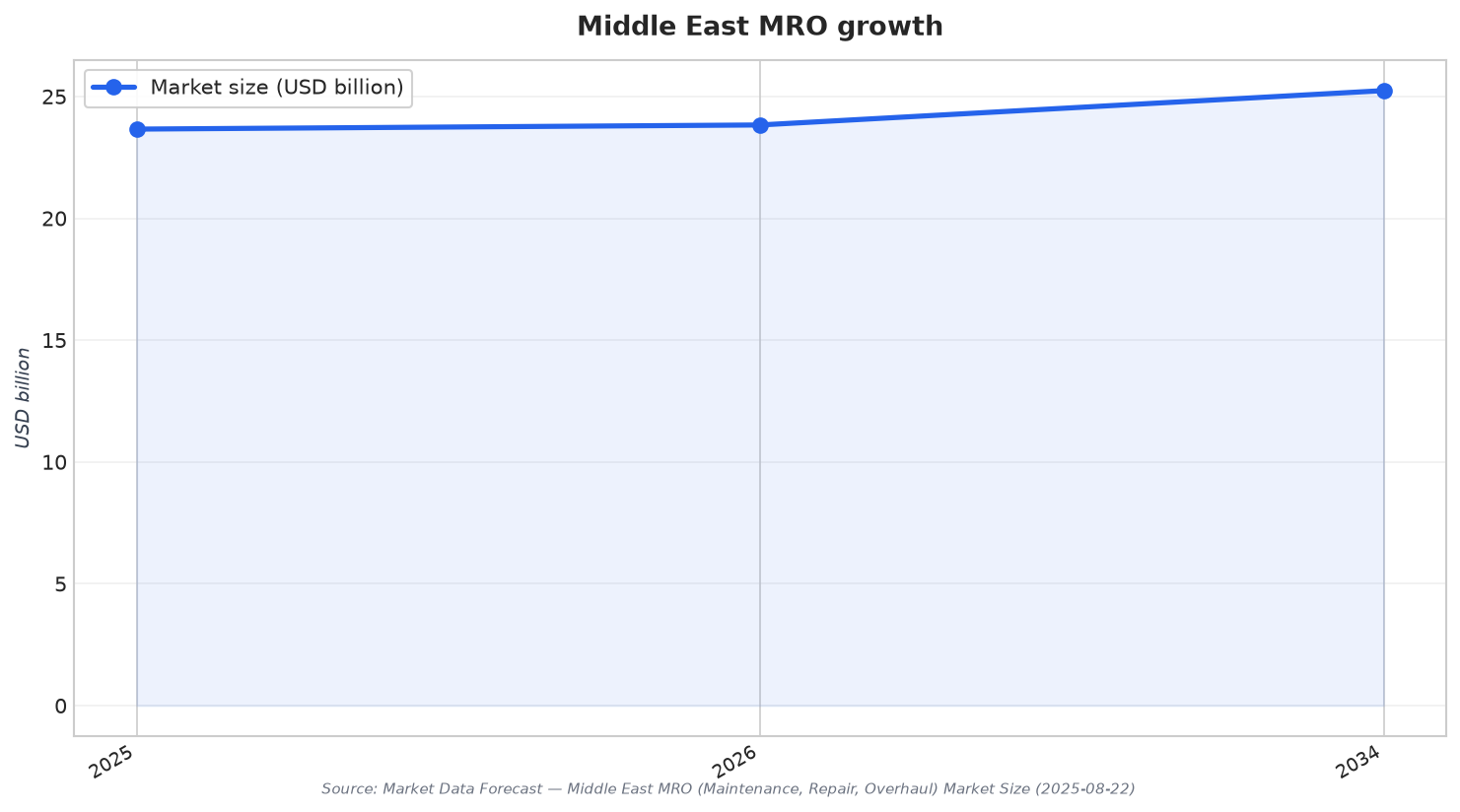
Saudi Arabia is working to build a regional maintenance, repair, and overhaul (MRO) hub at the same time that the wider Middle East market continues to scale. The Middle East MRO market was valued at USD 23.66 billion in 2025, estimated at USD 23.83 billion in 2026, and projected to reach USD 25.24 billion by 2034, with a 0.72% CAGR from 2026 to 2034. The same source notes that the sector is highly competitive and shaped by predictive maintenance, OEM partnerships, and localization of capabilities within national frameworks, including Saudi Vision 2030.
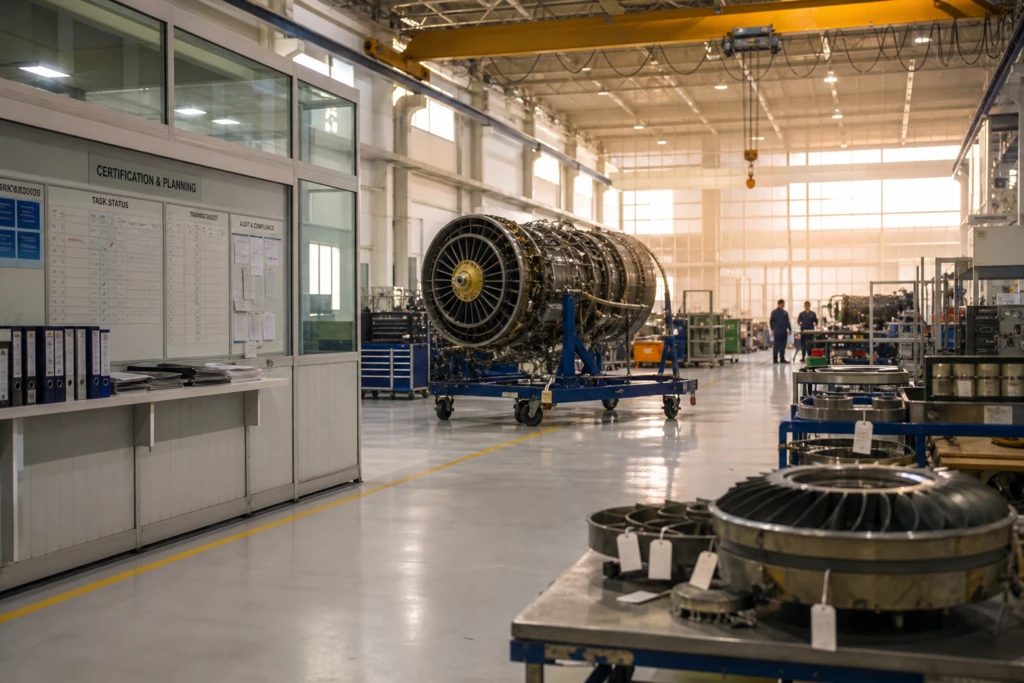
Within that regional backdrop, the engine maintenance segment is becoming a focal point for where complex work and investment concentrate. In the Middle East & Africa aircraft MRO market, engine work led with a 37.02% share in 2025. In the GCC engine MRO outlook, the market size is estimated at approximately USD 3.95 billion in 2026 and forecast to reach nearly USD 7.59 billion by 2034, at around 8.5% CAGR. The same outlook states Saudi Arabia represents an estimated 36.7% share of regional aircraft engine MRO revenue in 2026, supported by airport expansion, fleet modernization, defense aviation investments, and industrial development initiatives.
What Localization Really Means: Targets, Capability, and Compliance
Saudi Arabia’s localization push is also explicit in defense sustainment policy. In Middle East & Africa aircraft MRO analysis, Saudi Arabia’s GAMI targets 50% in-country sustainment by 2030. That same analysis describes military workstreams that were historically sent overseas now localizing at a rapid pace, and it cites Saudi Arabia’s GE90 module program as an example of spending being redirected from Europe to the Gulf. For Saudi Arabia aircraft MRO localization, the practical effect is a shift toward domestic engine and component capability, plus the tooling, testing infrastructure, and certified processes required to keep work onshore.
Building a hub is not only about hangars and test cells. It also depends on regulatory alignment and documentation maturity. MarkWide Research notes that GACA in Saudi Arabia, GCAA in the UAE, and EASA via bilateral agreements shape airworthiness certification, technician licensing, and component release standards across the Middle East. It also highlights escalating documentation requirements that filter access toward facilities with integrated quality management systems and digital record keeping. At the same time, technician shortages across the GCC are unwinding capacity expansion timelines, reinforcing why workforce development and throughput planning have become central to hub ambitions.
Regional competition adds urgency and defines the benchmark Saudi Arabia aims to match or exceed. Emirates Engineering operates a USD 950 million facility that handles wide-body checks on A380 and 777 aircraft, positioning Dubai as a major third-party center. In Saudi Arabia, Saudia Aerospace Engineering Industries is described as sustaining component repair depth through in-house production of structural parts and landing gear sub-assemblies. Meanwhile, line maintenance is forecast to post the fastest 6.05% CAGR through 2031 in the Middle East & Africa market analysis, showing how on-wing service adoption can scale quickly while heavier work and engine overhaul remain higher-barrier capabilities.
How fast is the Middle East MRO market expected to grow?
Why does engine MRO matter so much to hub-building in the region?
What is Saudi Arabia’s in-country sustainment target tied to localization?
What does Saudi Arabia aircraft MRO localization require beyond new facilities?
Which growth area is expected to expand fastest in regional MRO services?