The Saudi Arabia electric vehicle market is moving fast, even though adoption is still early. Electric vehicles account for just over 1% of overall car sales in Saudi Arabia, according to PwC’s “eMobility Outlook 2024: KSA Edition” published in September 2024. That gap is visible when compared with the global picture, where about 18% of all cars sold in 2023 were electric, according to the International Energy Agency. The shift is now being pushed by new choices in showrooms, pricing pressure from new entrants, and an explicit national target for electrification in Riyadh.
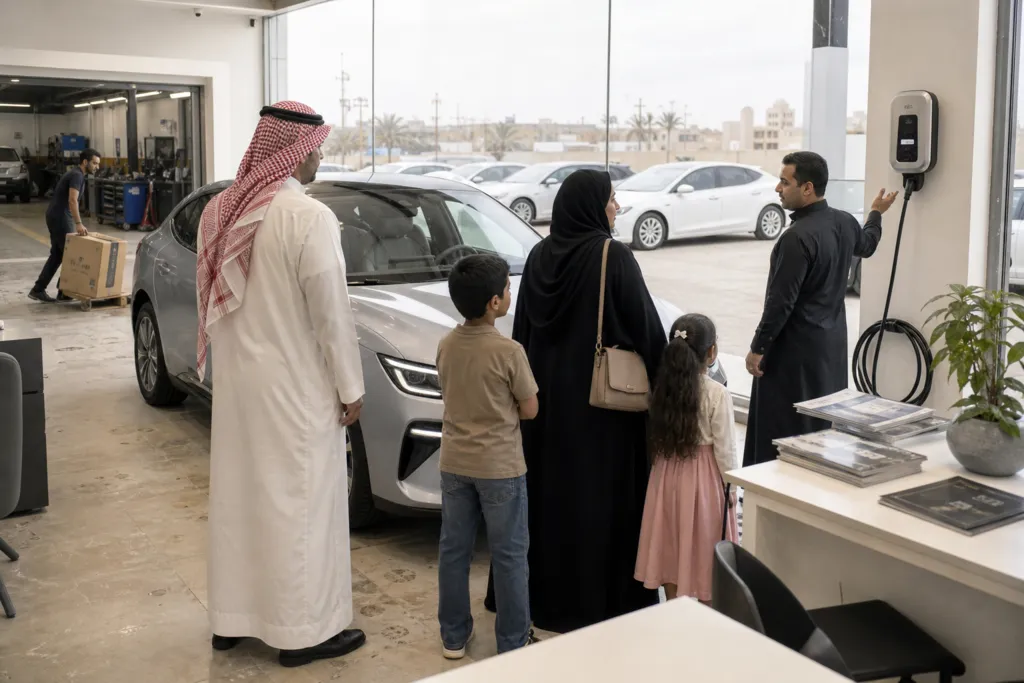
Demand signals are strengthening. PwC found that more than 40% of Saudi consumers are considering purchasing an EV in the next three years. That intent is being met with broader availability: China’s BYD opened its first showroom in Saudi Arabia in May 2024, and Tesla launched in Saudi Arabia in April, according to CNN. Pricing is also part of the story. CNN reported that the introduction of Chinese models is likely to help drive prices down, and BYD’s Saudi website lists the Atto 3 with a starting price of approximately $27,000.
Policy direction is a major adoption driver. Saudi Arabia wants 30% of the cars in its capital Riyadh to be electric by 2030, according to CNN. That goal links consumer adoption to infrastructure planning and to a wider industrial push. As CNN described it, Saudi Arabia is not only adopting EVs, it is “building an entire industrial ecosystem” around them, using eMobility as a lever to decarbonize, diversify its economy, and localize manufacturing at scale. These priorities help explain why investment is flowing toward both factories and supply chains, not just vehicle imports.
Local Production Is Becoming Part of the EV Strategy
Local assembly and future manufacturing depth are central to the plan. Saudi Arabia’s PIF is the largest shareholder in Lucid, which opened the first car manufacturing facility in the country in 2023, according to CNN. CleanTechnica noted that Saudi policymakers want a local EV ecosystem that includes assembly operations, supply chains, and eventually battery production, and that the Lucid plant near Jeddah currently focuses largely on assembling vehicles shipped from the United States in semi-knocked-down form. CleanTechinca also reported a government commitment to purchase tens of thousands of Lucid vehicles over a ten-year period for official fleets, designed to encourage EV adoption and support local manufacturing.
New local programs add momentum. CEER, a joint venture between PIF and Foxconn, plans to launch its first Saudi-produced EV by 2026, and a joint venture between PIF and Hyundai has broken ground on a manufacturing plant in the country, according to CNN. Gizmodo reported that Rimac will supply the electric drive powertrain for the CEER EV, and that CEER also did a deal with Hyundai Transys for other drive systems. A press release cited by Gizmodo said the still-unnamed EV is on track for production starting in the fourth quarter of “this year,” aligning with near-term industrial execution rather than distant ambition.
Saudi Arabia’s EV push also intersects with broader industrial and resource strategy. Consultancy-me.com reported that Saudi Arabia is investing $39 billion to establish a domestic EV manufacturing ecosystem (citing PwC). Separately, Oil & Gas 360 described critical minerals partnerships framed around copper, lithium, and nickel for EVs and noted that Manara Minerals, a JV between PIF and Ma’aden established in 2023, is mandated to buy into copper, nickel, lithium, and rare-earth assets abroad to secure long-term offtake, with main clients inside the Kingdom including electric vehicles and batteries. Together, these moves support the Saudi Arabia electric vehicle market by pairing adoption targets and showroom growth with manufacturing capacity and upstream inputs.
Globally, the direction of travel remains clear, and that context matters for Saudi planning. Consultancy-me.com (citing PwC) reported that global electric car sales surpassed seventeen million units in 2024 and are projected to exceed twenty million in 2025. Saudi Arabia’s current EV share is still just over 1% of car sales, but the mix of consumer consideration, competitive pricing, and a Riyadh electrification target creates near-term demand signals. Meanwhile, Lucid’s assembly footprint, CEER’s planned first Saudi-produced EV by 2026, and the PIF-Hyundai plant ground-breaking show that supply is being localized alongside adoption.
What is the current state of the Saudi Arabia electric vehicle market?
How many Saudi consumers are considering buying an EV soon?
What EV adoption target has Saudi Arabia set for Riyadh?
Which companies are driving local EV production in Saudi Arabia?
What price signal is emerging from new EV entrants?