Saudi Arabia is pushing port modernisation in 2026 through long-term concessions and targeted upgrades. Saudi Arabia ports privatization is visible in new operating agreements tied to Mawani, the Saudi Ports Authority, and in investment commitments from private operators. These moves are also unfolding as shipping lines explore new routings that link Red Sea gateways to the Gulf by land. The result is a more competitive contest for Red Sea trade, where terminal capacity, inland connectivity, and operational readiness matter as much as geography.
On the Gulf side, Mawani said operations started at the container terminal in Jubail Commercial Port following a concession agreement with Saudi Global Ports Company (SGP). Seatrade Maritime reported the terminal start as part of a $53 million project under the National Transport and Logistics Strategy under Vision 2030. In a separate announcement, SGP said it began operations at the Jubail Container Terminal under a long-term privatization agreement spanning 30 years. SGP also said it would invest SAR 2 billion over the concession period to upgrade infrastructure and deploy advanced equipment.
Privatisation is also wider than one terminal. In 2025, SGP was awarded four 20-year concession agreements by Mawani to operate multipurpose terminals on the Eastern Coast at King Abdulaziz Port Dammam, Jubail Commercial Port, King Fahad Industrial Port Jubail, and Ras Al-Khair Port. Under those four concession agreements, SGP said it planned to invest more than 700 million Saudi Riyals to upgrade the terminals and buy new equipment. The intent described in the source is integration with its existing operations across Dammam and Riyadh to improve efficiency and resilience.
Jeddah Capacity Upgrades Meet a Shifting Red Sea Map
On the Red Sea, Jeddah Islamic Port is drawing both capacity work and new capital structures. Maritime Executive described Jeddah Islamic Port as having four terminals and 62 berths, with about 4,000 vessels docking last year. APM Terminals agreed with DP World to acquire a 37.5% stake in the Southern Container Terminal (SCT). The same source said SCT expanded reefer capacity from 1,200 to 2,340, has a total quay length of 2,150 meters, includes an 18-metre deep-water quay, and can accommodate up to five ultra-large container vessels simultaneously.
Another Red Sea investment signal came in 2025, when Seatrade Maritime reported a planned $450 million Terminal 4 investment at Jeddah Islamic Port through a partnership with RSGT and CMA CGM. The article stated that this would deliver new infrastructure, advanced handling equipment, and digital and sustainability capabilities. It also said RSGT aimed to scale annual handling capacity up to 8.8 million teu. Taken together with the SCT figures, the sources point to parallel efforts: expand physical capability and attract operators with a stake in performance and throughput.
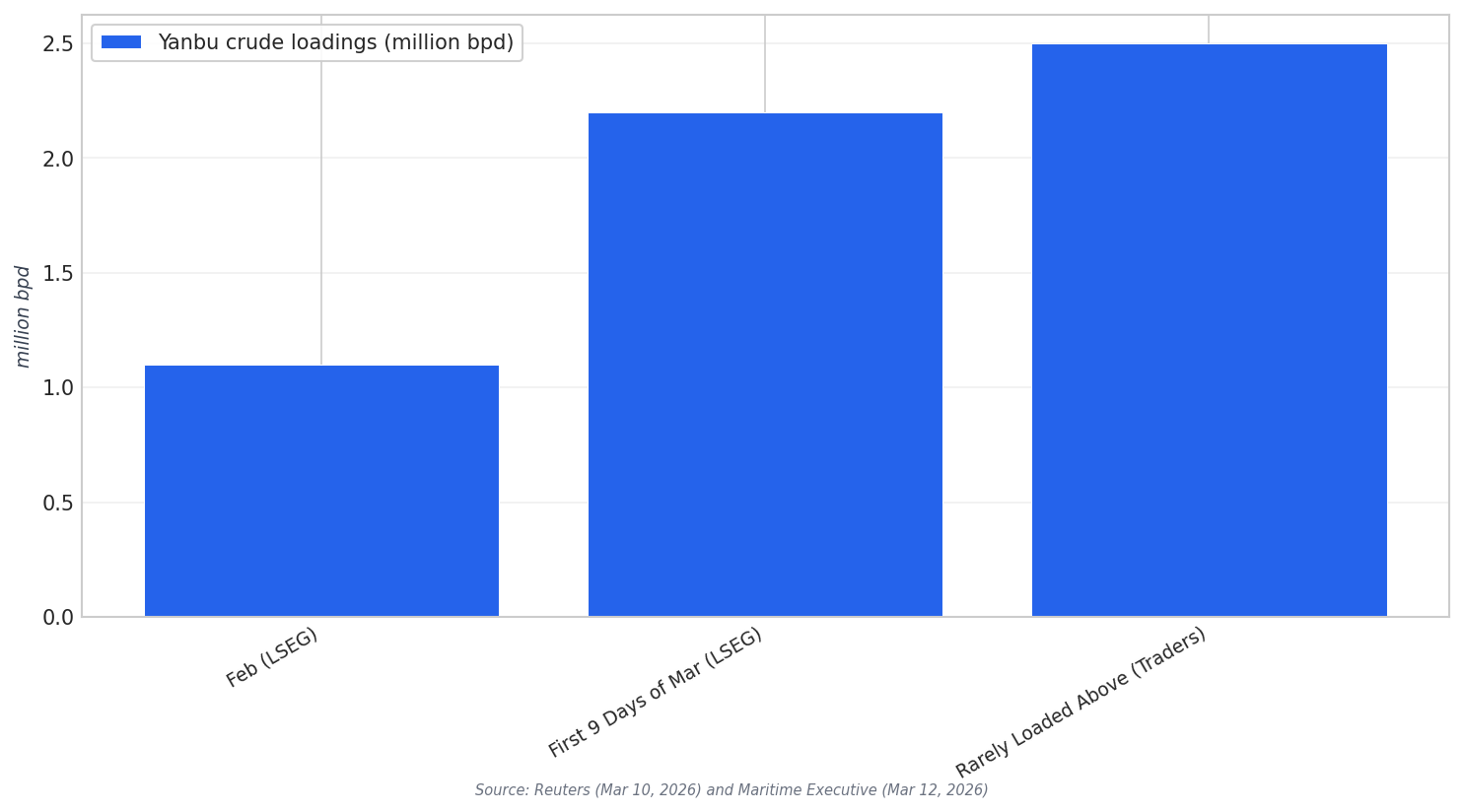
These capacity and ownership shifts are happening while carriers and energy flows test the Red Sea’s role. Maritime Executive reported MSC launching a new May 2026 service from Antwerp to Jeddah and King Abdullah Port, then transferring containers to trucks to Dammam, and using feeder services onward to Jebel Ali and Khalifa Industrial Zone and other Gulf ports. The same report noted a shortage of trucks and drivers as a challenge, plus throughput constraints at some ports. Meanwhile, Reuters reported Yanbu loadings averaged 2.2 million bpd in the first nine days of March, up from 1.1 million bpd in February, while traders said Yanbu has capacity to handle more than 4.5 million bpd, though it has rarely loaded more than 2.5 million bpd.
What does Saudi Arabia ports privatization look like in 2026?
What new capacity upgrades are highlighted at Jeddah Islamic Port?
How are shipping lines using Saudi ports to bypass chokepoints?
What do the sources say about Yanbu export volumes in 2026?