The Saudi national biotech strategy sets a clear localisation goal: raise local drug manufacturing from 20% to 40% by 2032. That target sits inside a wider shift away from import dependence and toward domestic capability. In pharmaceuticals, this direction shows up in the rise of contract development and manufacturing (CDMO) activity and a deliberate push to strengthen local manufacturing skills. Vision 2030-linked initiatives also matter because they help channel capital into industrial infrastructure that supports advanced manufacturing, quality systems, and faster scaling.
Saudi Arabia is already building a larger base for pharma production and services. The Kingdom has 206 pharmaceutical and medical device companies with total investments above SR10 billion, and 56 are pharmaceutical facilities licensed by the Saudi Food and Drug Authority (SFDA). In addition, investments in the pharmaceutical sector alone have exceeded SR7 billion. Together, these figures indicate that localisation is not just a policy statement. It is being backed by money, licensing, and a growing number of operating entities that can manufacture, partner, and expand capacity inside the country.
How Manufacturing Economics Support Localisation
Market signals also support the strategy’s manufacturing-first direction, especially through CDMO and API-related activity. Reports cited in industry coverage say the active pharmaceutical ingredient (API) CDMO market earned over USD $2.8 billion in 2024 and is expected to surpass USD $4.5 billion by 2033. Separately, the Saudi pharmaceutical CDMO market is expected to increase from USD $1.62 billion in 2024 to USD $2.24 billion by 2030, at a CAGR of 5.45%. These projections are not the localisation rate itself, but they do show growing demand for development and manufacturing services tied to domestic capability.
Localisation is also reinforced by industrial zones and procurement incentives that reward in-country production. A recent example is the Co-Diagnostics joint venture CoMira, which received approval for a manufacturing facility in Sudair Industrial City. The allocated site is intended to support development of a state-of-the-art facility dedicated to molecular diagnostic instruments and assays, designed to meet specific production and regulatory requirements. The company also highlighted that local manufacturing can support participation in government procurement programs, where in-country manufacturing may be a key differentiator. This dynamic can accelerate localisation by pulling demand toward domestically made products.
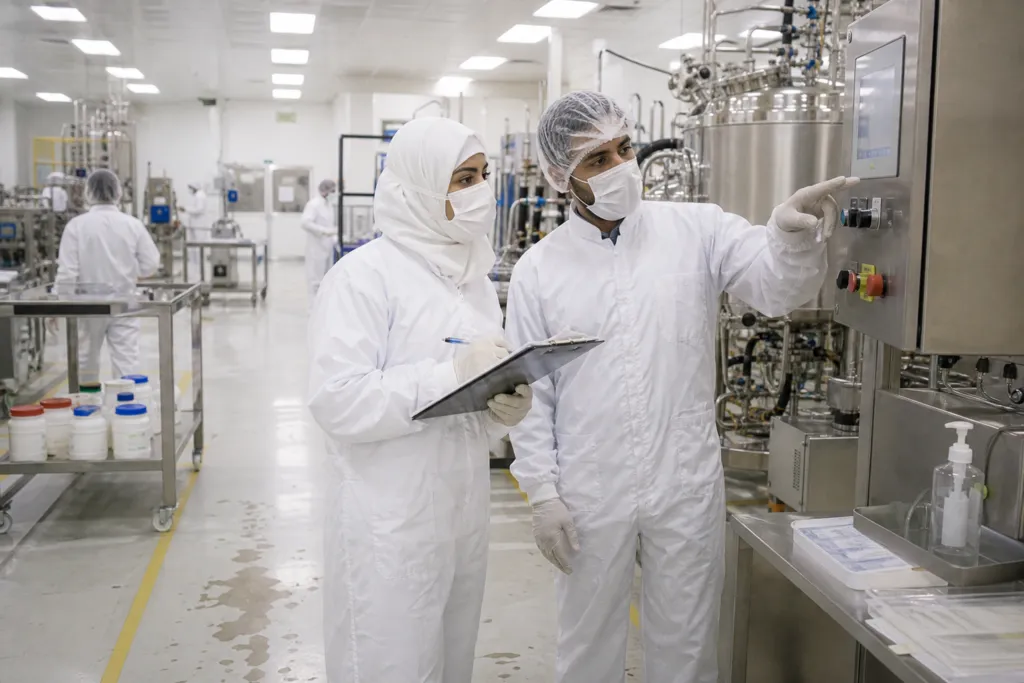
Biotech ambitions are also visible in advanced therapy manufacturing. King Faisal Specialist Hospital and Research Centre said it will open Saudi Arabia’s first facility for manufacturing genetic and cellular therapies by late 2025. The plant spans more than 5,000 square meters and is designed around 16 modular clean-room clusters. Once fully operational, it is expected to manufacture about 2,400 treatment doses each year, and meet roughly 9% of the nation’s demand for such therapies. The project is also designed to reduce the cost of care by an estimated eight billion riyals by 2030, linking local manufacturing to patient access and system efficiency.
Reaching 40% by 2032 will require more than factories. It requires a pipeline of products that can be made locally, a workforce that can run regulated operations, and systems that connect R&D, manufacturing, and procurement. Saudi Arabia’s broader industrial shift is moving toward more complex manufacturing, with the range of manufactured goods expanding to 612 in 2024 and complex, knowledge-intensive products rising from 100 in 2020 to 123 in 2024. Those indicators are economy-wide, but they align with what biotech localisation needs: scaling complexity, building know-how, and turning capability into consistent output.
What is the main goal of the Saudi national biotech strategy mentioned here?
What signs show Saudi Arabia is expanding its pharma manufacturing base?
How do CDMO projections relate to localisation efforts?
What is happening in Sudair Industrial City that supports localisation?
What is notable about Saudi Arabia’s gene and cell therapy manufacturing project?