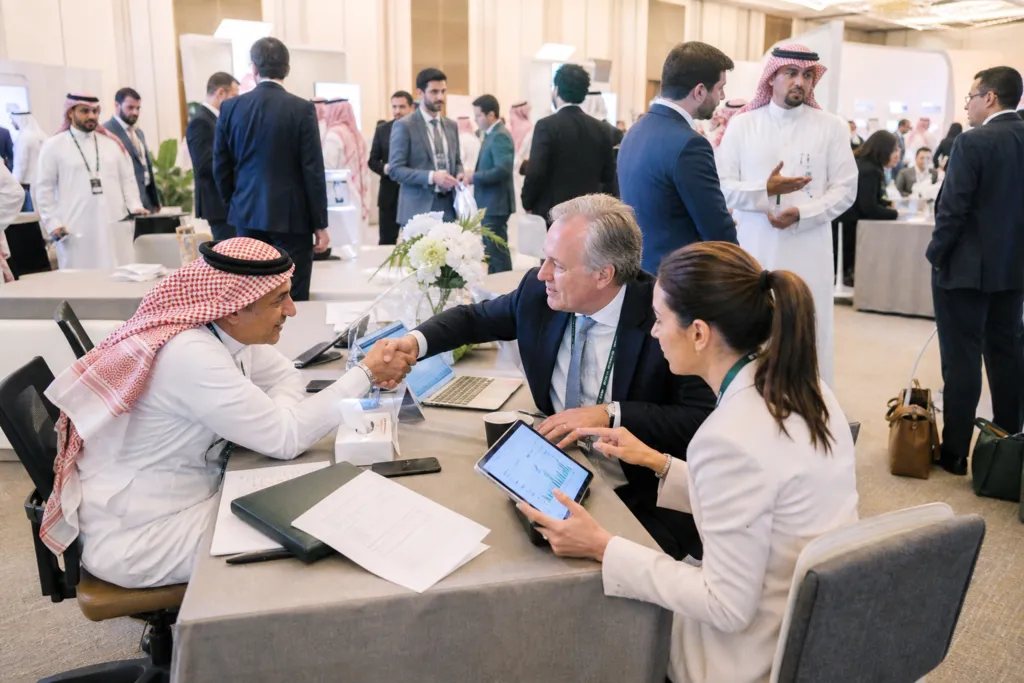
Saudi PIF private sector hub activity is becoming easier to spot in how the Public Investment Fund is opening its pipeline to co-investors, operators, and suppliers. As the PIF Private Sector Forum opens in Riyadh, the fund and its 120 portfolio companies are pitching opportunities to investors and suppliers. Organisers said the forum is expected to yield more than 100 memoranda of understanding. This structure matters for domestic and foreign operators because it turns a broad national development agenda into a repeatable matching process: portfolio companies define needs, counterparties respond, and MoUs start to convert interest into executable workstreams.
The hub logic is also linked to a strategic reset. PIF governor Yasir Al Rumayyan said in October that the fund was in the final stages of approving a revised investment strategy for 2026-2030. Sources familiar with the process said the plan is still a test draft that could be reshaped after investor feedback, with a fuller version expected in the spring. That feedback loop is an important signal for co-investment models. It implies that operator participation can influence how opportunities are structured, including risk allocation, timelines, and procurement pathways connected to projects in the pipeline.
What the New Co-Investment Push Means for Operators
For operators evaluating entry or expansion, the immediate context is capital discipline combined with capital attraction. The roughly $1 trillion sovereign wealth fund is likely to cut capital spending by up to 15 percent, according to a person familiar with its finances. At the same time, the fund is seeking billions from the private sector to keep its giga-project pipeline moving, people familiar with the plans told AGBI. For domestic operators, this can translate into more structured supplier and joint delivery roles. For foreign operators, it can translate into clearer co-investment pathways tied to portfolio-company needs rather than one-off market entry efforts.
PIF’s positioning also relies on scale and sector breadth that can underpin multiple operating models. One report said PIF had assets exceeding US$1tn by 2025, making it the fourth-largest sovereign wealth fund worldwide. The same source said PIF had US$19.4bn committed to green projects as of mid-2024 and that it maintains a comprehensive Green Finance Framework. For operators in energy, infrastructure, and adjacent services, that combination of scale and green finance tooling can support co-investment structures where financing readiness and delivery capability are aligned early through hub-style engagement.
Sector examples reinforce why PIF is motivated to bring in partners that can operate, not just finance. Reuters reported a $55 billion deal backed by PIF that would make PIF a majority shareholder in EA, while Affinity Partners would own 5%, and it linked that move to bringing game-developing capabilities to the kingdom. Separately, Reuters said Qiddiya aims to attract 10 million visitors per year to its esports and gaming district by 2030, with a goal of incubating 30 leading video game development companies. These targets show where domestic and foreign operators can fit: operations, capability transfer, and ecosystem build-out that goes beyond capital deployment.
The Saudi PIF private sector hub approach is therefore best read as a coordinated market-making effort. It convenes deal flow through a forum expected to generate more than 100 MoUs, links opportunities to a large portfolio-company base, and tests a 2026-2030 strategy draft using investor feedback. It also operates alongside signals of a potential up to 15 percent capital spending cut, which can increase the importance of co-investment and co-delivery structures. For operators, the practical takeaway is to engage where the pipeline is presented, structure proposals around execution, and align with sectors where PIF is explicitly building long-term capabilities.
What is the Saudi PIF private sector hub approach in practice?
How does PIF’s 2026-2030 strategy relate to co-investment models?
Why might co-investment become more important for operators now?
What facts show PIF’s scale for potential domestic and foreign operators?
Which operator-style opportunities are highlighted by gaming and destination plans?