Saudi Arabia’s Fatoora program, led by the Zakat, Tax and Customs Authority (ZATCA), is designed to standardize how businesses issue, verify, and store invoices electronically. The intent is clear across guidance: replace paper-based invoicing with a secure digital process that improves transparency, supports VAT compliance, and reduces fraud and tax evasion. For VAT-registered businesses, the change is not only about generating an electronic invoice. It is also about producing invoices in the required structure, including mandatory data fields and a QR code that supports authenticity checks.
The biggest operational shift arrives with Phase 2, the Integration Phase. Phase 1, implemented in December 2021, focused on generating and storing compliant invoices without direct system-to-system communication with ZATCA servers. Phase 2 moves the process into real-time linkage. Businesses must connect their invoicing systems to the Fatoora platform through APIs so invoices can be validated, time-stamped, and returned with a digital signature. This is where workflow and governance change for mid-market firms: invoice issuance becomes part of an automated validation process, not a back-office recordkeeping step.
Waves 23-24: The 2026 Thresholds, Dates, and What “Integration” Really Means
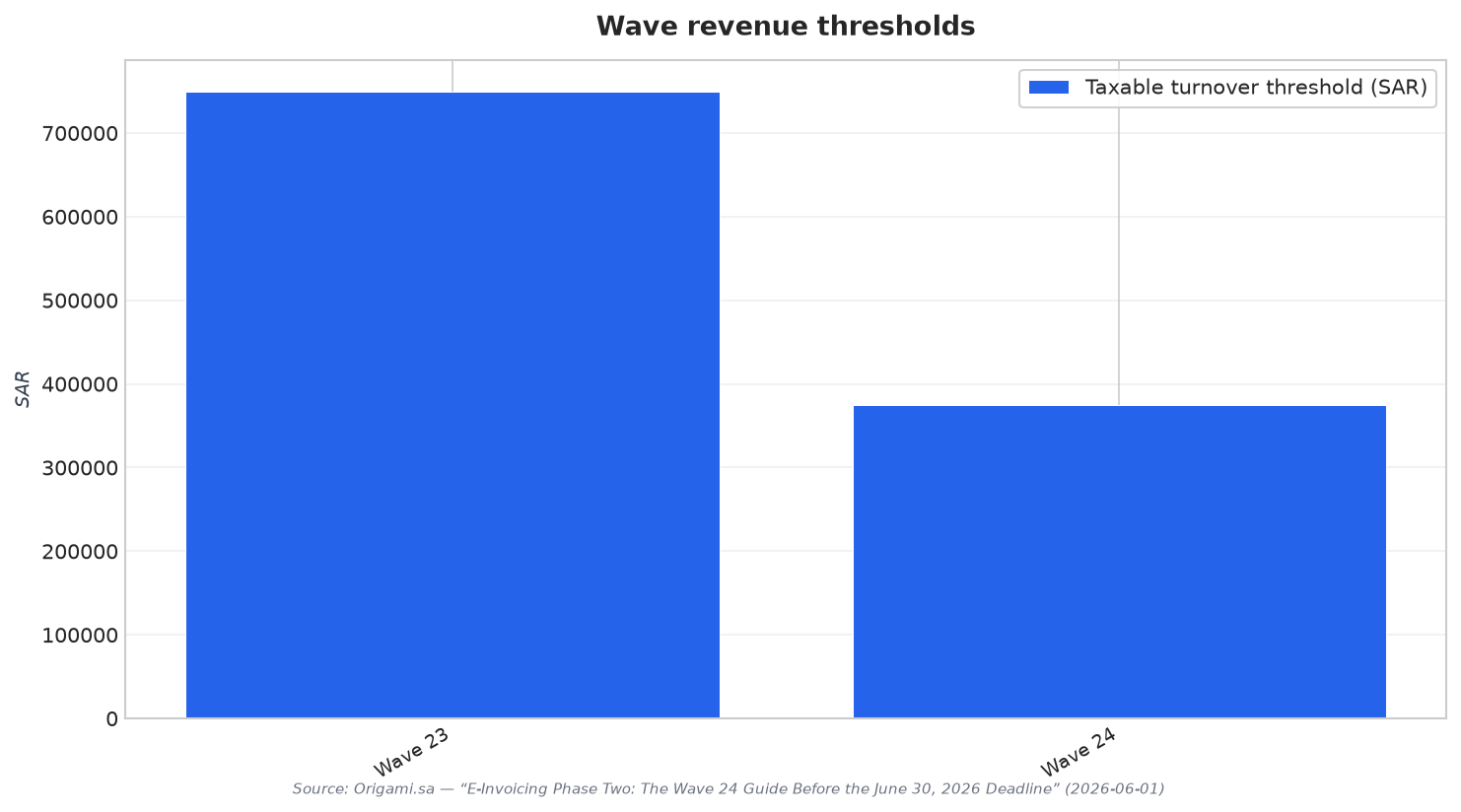
In 2026, the late-stage rollout is defined by Waves 23 and 24. Wave 23 covers businesses whose revenue exceeded SAR 750,000 during 2022, 2023, or 2024, with a compliance deadline of March 31, 2026. Wave 24 expands the net further: businesses whose taxable turnover exceeded SAR 375,000 in 2022, 2023, or 2024 must comply between 1 April and 30 June 2026, with June 30, 2026 marked as the deadline in multiple guides. Some timelines also list Wave 23 as scheduled for March 1, 2026 and Wave 24 for June 1, 2026, but the consistent operational message is to prepare early and validate your dates using ZATCA notices and your Fatoora account.
For mid-market finance teams, “integration” has specific technical meaning. Invoices must be issued as XML in UBL 2.1, or as PDF/A-3 with embedded XML, while unstructured formats like plain PDFs or images do not qualify. Each invoice must include a UUID and a QR code, and standard invoices require a cryptographic stamp and digital signature. The transmission model also differs by transaction type: for B2B standard tax invoices, the Clearance model applies, meaning the invoice is sent to ZATCA before the customer receives it. For B2C simplified invoices, the Reporting model applies, meaning submission occurs within 24 hours.
Execution risk in ZATCA e-invoicing 2026 is often organizational, not theoretical. Several sources stress that teams must align Finance and IT, integrate and test in ZATCA’s environment, and train staff on the new processes. ERP teams also face capacity pressure: one guide notes a spike in demand for SAP talent experienced in ZATCA integrations, while organizations attempting to hire mid-wave can encounter a “dry market,” longer project lead times, and rising costs. For mid-market firms, the practical endgame is to treat Fatoora as a real-time compliance system: choose a ZATCA-compliant solution, validate document types and API calls, and complete testing well before Wave 23 or Wave 24 enforcement windows close.
What changes in Saudi e-invoicing in 2026 for Waves 23 and 24?
Who is included in Wave 24 and what is the deadline?
What invoice formats are accepted under Phase 2 integration?
What is the difference between Clearance and Reporting in Phase 2?
What should mid-market firms do first to get ready for Phase 2?