Shipping constraints in the Gulf are rewriting the competitiveness equation for exporters, including lubricant producers that depend on reliable outbound logistics. Before the war, around 130 vessels a day passed through the Strait of Hormuz, but in September the average fell to 19 ships a day, according to ship-tracking data cited by The New York Times, and Kpler recorded only nine ships on a Thursday. In parallel, crude exports from Gulf countries excluding Iran were about two-thirds of their prewar level in August, according to Windward analyst Michelle Wiese Bockmann. These figures are oil-focused, but the same chokepoint dynamics can influence shipping availability, insurance, and scheduling for other liquid cargoes and packaged exports. That context matters when buyers compare sourcing options across the region.
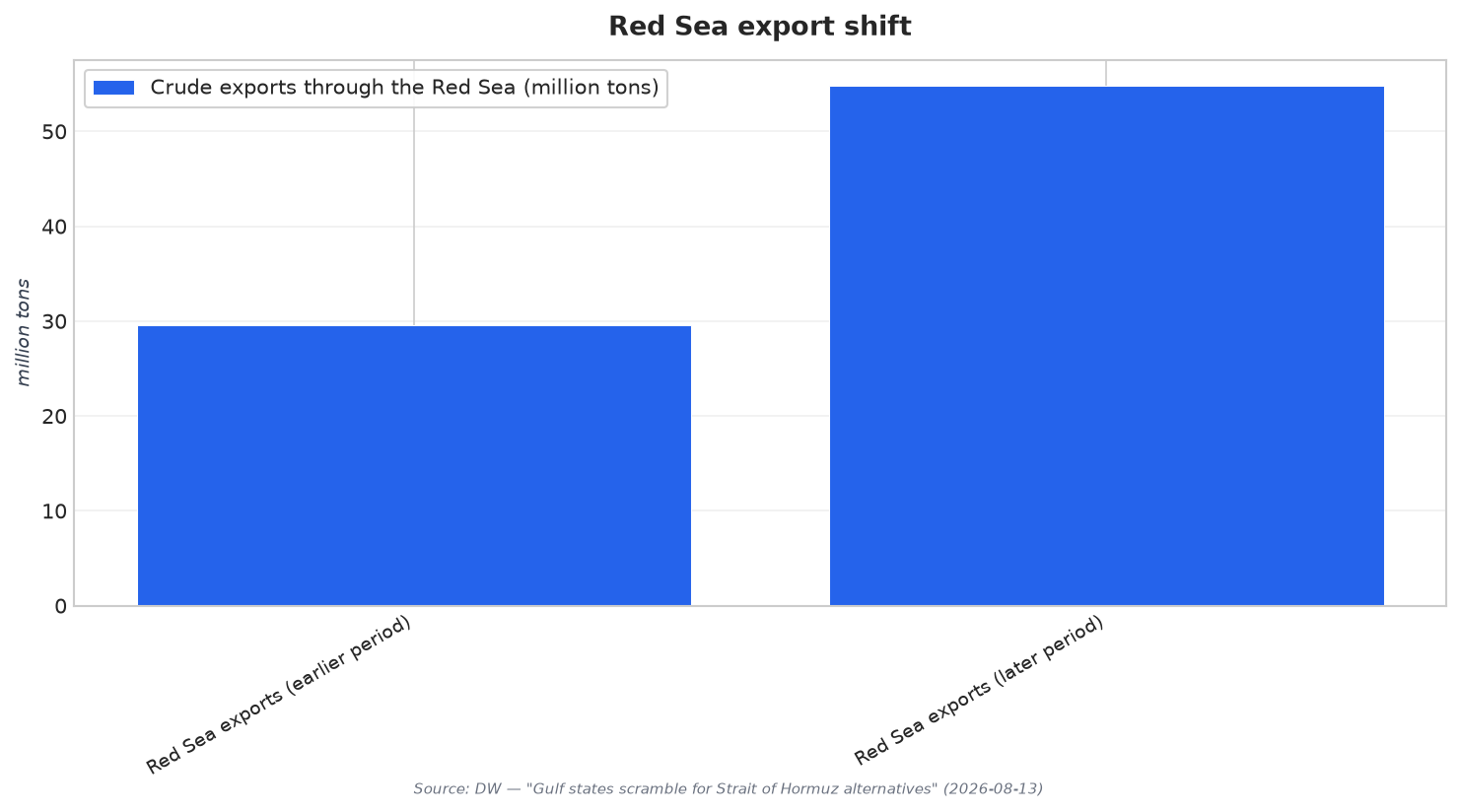
Saudi Arabia has long had a structural routing advantage versus some Gulf peers because it can move volumes westward across the kingdom and load on the Red Sea, reducing reliance on Hormuz. Deutsche Welle reports that over a defined period, exports through the Red Sea rose from 29.6 million to 54.8 million tons, an increase of 25.2 million tons that replaced roughly 61% of the volume lost on the Persian Gulf side. The same report notes that Saudi Arabia is sending crude via the East-West Pipeline from eastern oil fields to Yanbu, enabling shipments to global markets by circumventing Hormuz entirely. For Saudi lubricant blenders trying to grow Saudi Arabia lubricant exports, proximity to Red Sea logistics can look like a differentiator—especially when customers are anxious about Gulf-side disruptions.
The Export “Advantage” Is Real, but It Has a Red Sea Price Tag
That advantage is not absolute, because Red Sea access carries its own chokepoints. OilPrice.com argues that once crude reaches Yanbu, it still has to leave the Red Sea, and the Bab el-Mandab has become inaccessible due to a sustained Houthi blockade. Modern Diplomacy similarly says the Houthis hold Yemen’s Red Sea coast and have declared the strait closed to Saudi shipping, and it notes that barrels reaching Yanbu for Asian buyers still have to sail south through Bab el-Mandeb. Gulf News reports that Iran-backed Houthis captured Mocha and, citing Yemeni government sources reported by CNN, seized Perim Island in the Bab Al Mandab Strait. For lubricants, this means a Saudi Red Sea option can still face risk on southbound routes, even if Hormuz is bypassed.
For Saudi blenders, export readiness also depends on local supply depth and manufacturing economics, not only sea lanes. Ken Research reports that Luberef operates 1.3 million MT of annual base-oil capacity across Yanbu and Jeddah, and it adds that supply is concentrated around the Western and Central regions for blending and distribution, with major blending capacity reported by Petromin in Jeddah and Riyadh. It also states that local feedstock access lowers import exposure for core formulations and supports export-capable manufacturing economics. On the demand side, Ken Research notes Saudi Arabia had more than 15.8 million registered vehicles in operation at end-2024, up 6.9% year on year, supporting recurring lubricant consumption that can help stabilize plant utilization. For exporters, steady domestic pull can support continuity while external routes remain volatile.
Still, the Red Sea “advantage” is best viewed as conditional flexibility rather than a guarantee of uninterrupted access. OilPrice.com states the East-West Pipeline has a nameplate capacity of around seven million barrels per day, but it warns that if Bab el-Mandab is closed or threatened, the advantage disappears, and it describes complications for Asian-bound volumes that must route north via Suez and then face a longer voyage. Gulf News adds that Saudi authorities said the East-West Pipeline was targeted multiple times and shut as a precaution. For lubricant exporters, the practical takeaway is that Saudi routing options can be compelling when Hormuz is constrained, yet sales strategies should reflect the possibility that Red Sea-linked threats can tighten schedules, raise costs, or redirect cargo planning.
How do Hormuz constraints affect export planning for lubricants in the Gulf?
What evidence shows Saudi Arabia can shift volumes toward the Red Sea?
Why can Bab Al Mandab still limit Red Sea-based exports?
What on-the-ground capacities support Saudi blending and export capability?
Can Saudi Arabia’s lubricant exports gain share while rivals face Hormuz limits?