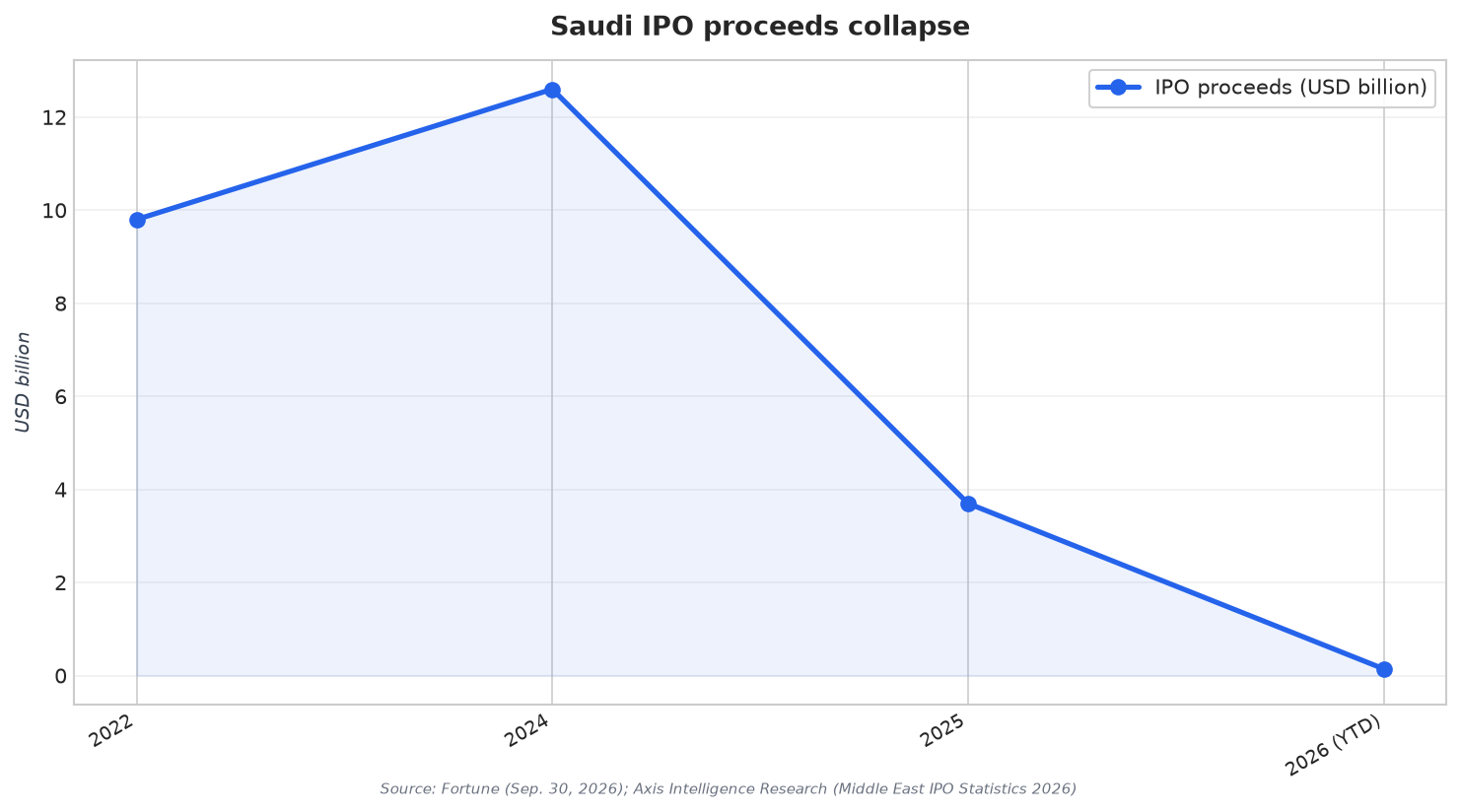
Saudi Arabia’s IPO window shifted from momentum to hesitation in 2026. Only three companies—Dar Al Balad, Saleh Abdulaziz Al Rashed, and MSGA—listed across Tadawul and Nomu so far this year, raising a combined $144 million. That is a sharp contrast with last year, when Saudi companies raised $3.7 billion through share sales, and with 2022, when $9.8 billion was raised across 17 listings. The scale of the change is also visible in the Saudi Exchange 2025 Annual Report comparison: the $144 million raised so far this year equals 4% of the $3.53 billion raised during the same eight-month period in 2025, when 25 companies went public.
At the center of the stall is a pricing standoff. Company owners have been reluctant to list at valuations the market is prepared to accept, while investors have been unwilling to pay higher prices after a year of losses on most new listings. Bloomberg data adds context to the sentiment: of the 17 companies that have gone public since 2025 on the main market, only four are trading above their issue price. Deal execution has also been affected. Planned listings from Mutlaq Al Ghowairi, Arabian Dyar, and Kesay Clinics were postponed this year, while six-month extensions granted to Alandalus Educational and Alromansiah have expired.
Why the Market Stayed Tight Even Before Geopolitics
Geopolitics added uncertainty, but several sources stress the pressure was already building. Fortune and Yahoo note that, beyond valuation compression, liquidity weakened and investors became more selective as the cost of capital and risk premiums increased. Semafor also points to falling valuations compounded by the war and compares performance since Feb. 28: Saudi’s index is down 3% since that date, while the MSCI Emerging Markets Index rose 6% over the same period. Axis Intelligence, citing EY, frames the regional picture: in the first half of 2026, EY recorded MENA declines of nearly 80% in IPO count and over 90% in proceeds.
Deal flow weakness shows up in early-year figures. Axis Intelligence reports the Saudi Exchange’s main market hosted one IPO in Q1 2026, raising $67 million, versus $1.8 billion from five listings in Q1 2025—a 96.3% fall. The same source cites an April 2026 assessment dating the start of the conflict involving the US, Israel and Iran to 28 Feb. 2026, noting that before that date EY counted 18 companies and funds signaling intent to list in early 2026, 16 of them in Saudi Arabia. This backdrop helps explain why the Saudi IPO market slowdown 2026 became a practical issue for owners trying to time valuation, demand, and execution risk.
Regulatory reform is the other moving variable owners must plan around. Fortune and Yahoo report the Capital Market Authority (CMA) proposed reforms to rejuvenate Tadawul, including a notable change: underwriting commitments would take effect when book-building begins, meaning underwriters would be required to purchase any shares investors fail to subscribe for, potentially leaving them responsible for the entire offering. Semafor warns critics think requirements such as hard underwriting could delay deals already in the pipeline, and that smaller banks may not be able to participate. For owners, the practical alternative planning is clear in WDC TV NEWS: the IPO slowdown is pushing firms to turn more to debt and M&A work; Bloomberg data cited there says the value of such deals involving Gulf entities rose almost 200% in the first half of the year to around $300 billion.
How severe was the 2026 slowdown in Saudi IPO fundraising?
What is driving the standoff between owners and investors?
Which Saudi IPOs were postponed or saw extensions expire in 2026?
What CMA reform could most affect IPO execution risk?
What should owners consider instead during the Saudi IPO market slowdown in 2026?