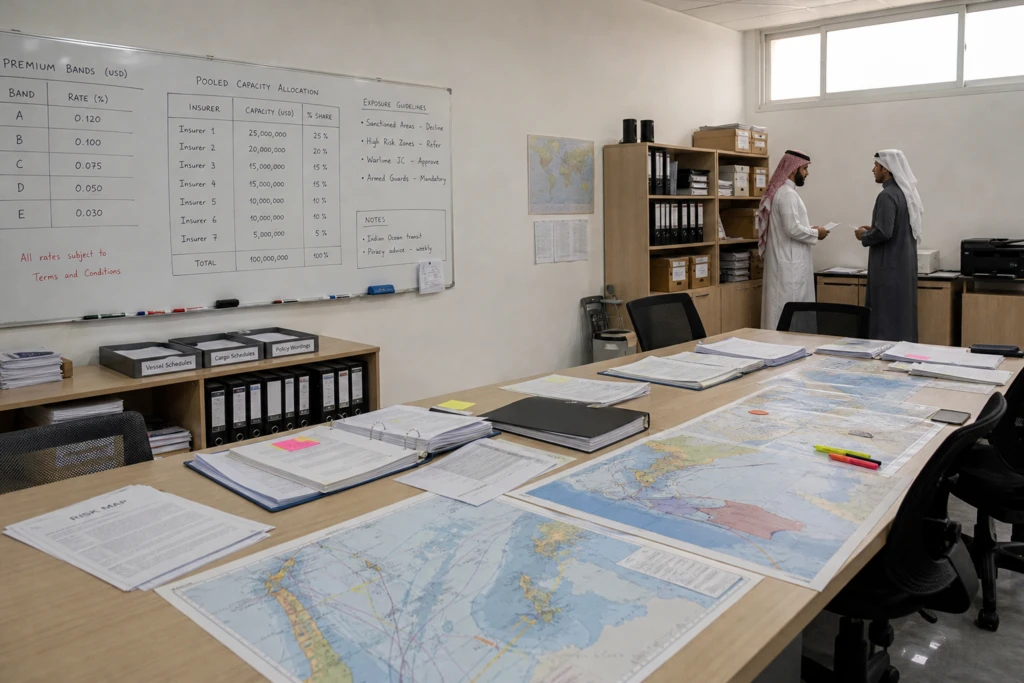
In marine trade, disruptions often start before a port closes. They can begin when insurers raise war-risk rates, narrow terms, or reduce capacity for ships entering exposed regions. Saudi Arabia has faced this dynamic as tensions around maritime traffic have increased, with underwriters becoming more cautious and, in some cases, restricting coverage for ships, infrastructure, and cargoes including oil and chemicals. Even when routes remain physically open, insurance that is prohibitively expensive—or unavailable—can make voyages commercially unworkable and slow trade well before any physical blockage appears.
Against that backdrop, Saudi Arabia’s Ministry of Finance explored a public-private structure that could combine private-sector coverage with government-backed financial support. Proposals discussed with industry participants included commercial insurance capacity of up to SAR700 million ($186 million) for each covered incident for ships and marine cargo. The policy logic is straightforward: insurance can make dangerous trade commercially possible, but it cannot make missile attacks, vessel seizures, or disruption disappear. A state-backed mechanism instead aims to transfer part of the most severe potential losses away from private insurers, keeping market participation viable when risk perceptions spike.
How the National War-Risks Pool Is Designed to Work
Saudi Arabia has now approved a national war-risk insurance pool for cargo and vessels, formally creating domestic capacity for periods when geopolitical tension drives up marine premiums or restricts available cover. The “Saudi Marine War Risks Insurance Pool for Cargo and Hull” will operate as a public-private mechanism under the supervision of the Insurance Authority. Saudi Reinsurance Company (Saudi Re) will lead and manage the pool with participation from insurers in the domestic market, while the Insurance Authority sets the regulatory framework and participating insurers distribute coverage to eligible customers.
The pool is positioned as a tool for continuity and planning. Saudi Arabia’s Ministry of Energy has cited higher insurance costs and a decline in the number of tankers willing to operate in the region among the factors raising oil transportation costs. The Insurance Authority has described objectives that include enhancing preparedness and capacity to absorb marine insurance risks, supporting trade and supply-chain continuity, limiting the effects of sharp volatility and higher reinsurance costs in global markets, and strengthening competitiveness as a logistics hub. Coverage is described as broad, including cargo transported by land, sea, and air, alongside marine hull insurance against covered damage and risks.
For buyers comparing options for Saudi Arabia marine war risk insurance, the key promise is predictability during severe market disruption, especially when international reinsurance markets tighten, pricing rises, or exposure to specific routes is restricted. Several sources also describe additional lines associated with transport operations, including charterers’ liability and protection and indemnity coverage for participants in trade and logistics. As a reference point from outside Saudi Arabia, India launched a marine insurance pool with total capacity of $1.5 billion, including a $1.4 billion sovereign guarantee; the scheme issued more than 1,600 policies within weeks, and war-risk premiums fell by about 35% to 40% from earlier peaks during a regional escalation.
Why can trade slow even if shipping lanes stay open?
What is the Saudi War Risks Insurance Pool for Cargo and Vessels?
How much cover was discussed for incidents under earlier proposals?
What does the pool cover beyond marine hull risks?
How does Saudi Arabia’s approach compare with another country’s pool experience?