
Saudi Arabia’s Insurance Authority has announced a transition to a mandatory Risk-Based Capital (RBC) framework starting Jan. 1, 2027. It will become the approved framework for measuring the financial solvency of insurance and reinsurance companies and will replace the current system. The Authority has framed the change as broadly aligned with global best practices for capital requirements, referencing Europe’s Solvency II regime, while adapting the approach to the characteristics of the Saudi insurance market. For insurers, this is a solvency reset that ties required capital more directly to the risks they underwrite, invest in, and operationally manage.
Implementation is being engineered to reduce disruption. The Insurance Authority has conducted four quantitative impact studies in recent years to test the standard formula for calculating required capital, then followed with a fifth study based on 2025 data to assess the expected impact on sector solvency. A parallel run phase begins in 2026, where insurers and reinsurers will assess solvency under both the RBC framework and the existing regime. The broader international context supports why this takes time: a BIS executive summary on risk-based solvency regimes notes that jurisdictional experiences show implementation generally takes five to 10 years or more and requires sustained political support, training, and continuous engagement with stakeholders.
What Changes Under RBC—and Why Corporate Buyers Should Care
Under the RBC approach described by Saudi-focused reporting, insurers and reinsurers will be required to maintain capital levels proportionate to the risks they undertake. That introduces flexibility in capital allocation, but it also increases the premium placed on measured risk selection, portfolio mix, and governance. Companies can use the standard formula or develop internal models, subject to regulatory approval, and actuaries and senior management teams are expected to play key roles in evaluating the financial and operational impact. For corporate insurance buyers, this matters because it can influence how carriers price volatility, how they set limits, and how they decide which industries or exposures they are willing to support over multi-year programs.
The RBC transition also opens specific capital-management levers. Saudi reporting notes insurers will gain access to tools to strengthen their capital base, including issuing subordinated debt instruments, and anticipates this can enhance liquidity and attract greater investor participation. The shift is positioned within Saudi Vision 2030 and the National Insurance Sector Strategy, including a stated plan to double available risk-bearing capital in the sector from SR25 billion to SR50 billion by 2030. In practice, stronger capital planning can affect the stability of insurers’ underwriting appetite. Buyers can expect more scrutiny of loss drivers, clearer articulation of risk controls, and potentially more structured conversations around retentions and program design.
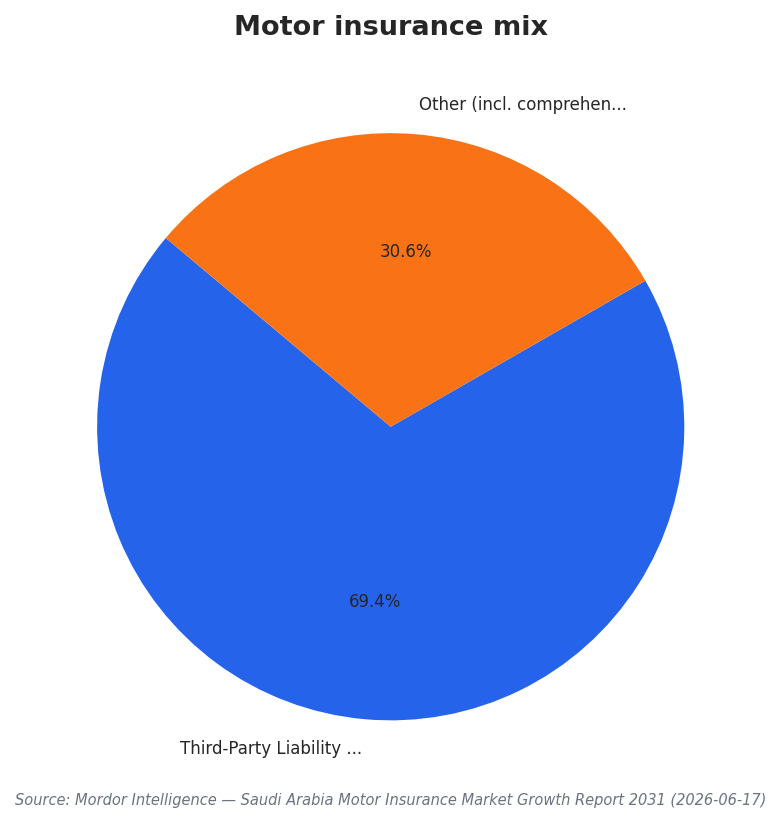
Market signals already point to firms preparing for a capital-efficiency mindset. In motor insurance, Third-Party Liability held 69.4% of Saudi Arabia’s motor insurance market share in 2025, while comprehensive coverage is forecast to expand at a 9.7% CAGR through 2031, alongside product shifts and operating model upgrades linked to readiness for risk-based capital rules expected in 2027. The same source also describes a 30% local cession requirement improving capital resilience and making treaty optimization a key lever, and notes consolidation activity such as Arabian Shield’s merger with Alinma Tokio Marine in late 2023. In health, Mordor Intelligence reports the Saudi health and medical insurance market at USD 11.41 billion in 2026 with a CAGR of 7.16% to USD 16.12 billion by 2031, while citing restructuring and merger integration aimed at optimizing capital allocation and solvency metrics. For corporate buyers, the takeaway is to track counterparty strength, reinsurance structures, and how insurers align product design and pricing with the Saudi Arabia risk-based capital insurance framework rollout.
When does Saudi Arabia’s RBC solvency framework become mandatory?
How is the new Saudi RBC approach positioned versus international standards?
What tools can insurers use to strengthen capital under the new framework?
How could the Saudi Arabia risk-based capital insurance framework affect corporate insurance buyers?
What market indicators suggest insurers are preparing for RBC in Saudi Arabia?