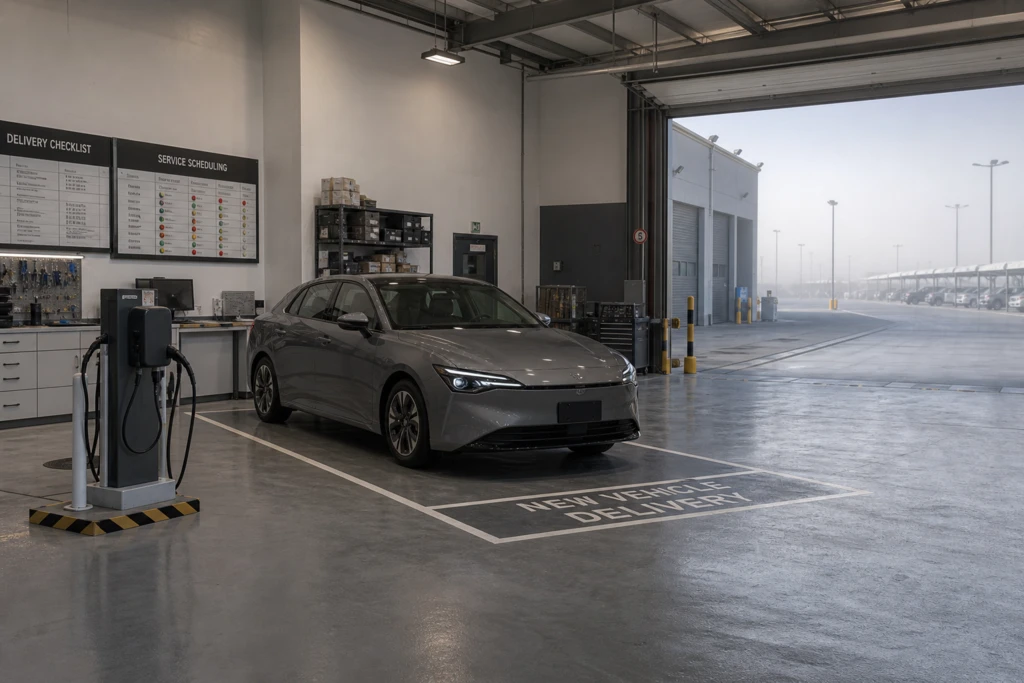
Ceer has moved from national ambition to showroom reality after unveiling its first models, the Exobot sedan and SUV, on Sept. 21. Crown Prince Mohammed bin Salman, chairman of the Public Investment Fund (PIF), launched the reveal, positioning the company as the Kingdom’s first domestic car brand rather than another importer. For the Ceer electric car story in Saudi Arabia, the immediate commercial question is simple: can early curiosity convert into purchases? Analysts cited by Arab News said adoption is still early, and that sales will hinge on charging availability, pricing, and consumer trust.
For dealers, the appeal of a locally anchored OEM is less about novelty and more about operating basics. NielsenIQ’s Vivek Sharma argued that local production can improve parts availability and service times, while also enabling vehicles designed for Saudi Arabia’s climate, roads, family needs, and digital expectations. That matters in a market where SUVs take a major share of family car sales, and Ceer has led with both a sedan and an SUV. Ars Technica added that the Vision 2030 push includes a “Saudi Made” branding initiative, which could become a retail advantage if the vehicles stand out beyond their badge.
What the Factory Plan Signals to Fleets and After-Sales Networks
Fleet buyers will watch delivery timing and the factory ramp as closely as they watch vehicle specs. Vision2030.ai reports commercial production is scheduled to start in the fourth quarter of 2026 at the $1.3 billion Ceer Manufacturing Complex in King Abdullah Economic City, with first-vehicle deliveries scheduled before year-end 2026. Rest of World, however, reports deliveries promised for March 2027, underscoring how rollout milestones will be scrutinized. The same Vision2030.ai source describes a 1-million-square-metre facility with 530,000 square metres under roof, a full-capacity cadence of 38 vehicles per hour, and an annual production ceiling of 240,000 vehicles.
Localisation targets also change the conversation for fleet maintenance and dealer profitability. Ceer has said it aims for 45% local content by 2034 and expects to contribute more than SR30 billion (about $8 billion) to GDP by then, according to Arab News. Vision2030.ai also cites agreements tied to supply-chain localisation, including 16 commercial agreements worth more than SAR 3.7 billion by February 2026, building on SAR 5.5 billion in partnerships from the previous year’s forum. For dealers and service operators, those numbers matter because they imply broader local parts and supplier activity, which can reduce downtime and improve throughput.
Infrastructure readiness is the constraint that dealers and fleets cannot solve alone. Streamlinefeed cites an Arthur D. Little 2026 Global Electric Mobility Readiness Index ranking Saudi Arabia 30th out of 31 assessed markets, characterising the EV sector as nascent despite heavy state-backed investment. The same source warns that without ubiquitous, rapid charging, mass demand for any EV will remain constrained. Competitive pressure is also real: Rest of World notes Ceer must match Chinese rivals on price and needs a dealer and service network as wide as BYD’s from the outset, while also navigating an “awkward” overlap with Lucid, where PIF holds a majority stake.
What did Ceer unveil, and when?
When does Ceer production start, and what scale is planned?
How does the Ceer electric car story in Saudi Arabia affect dealers?
What localisation and economic targets has Ceer stated?
What do the sources say about EV readiness and charging constraints in Saudi Arabia?