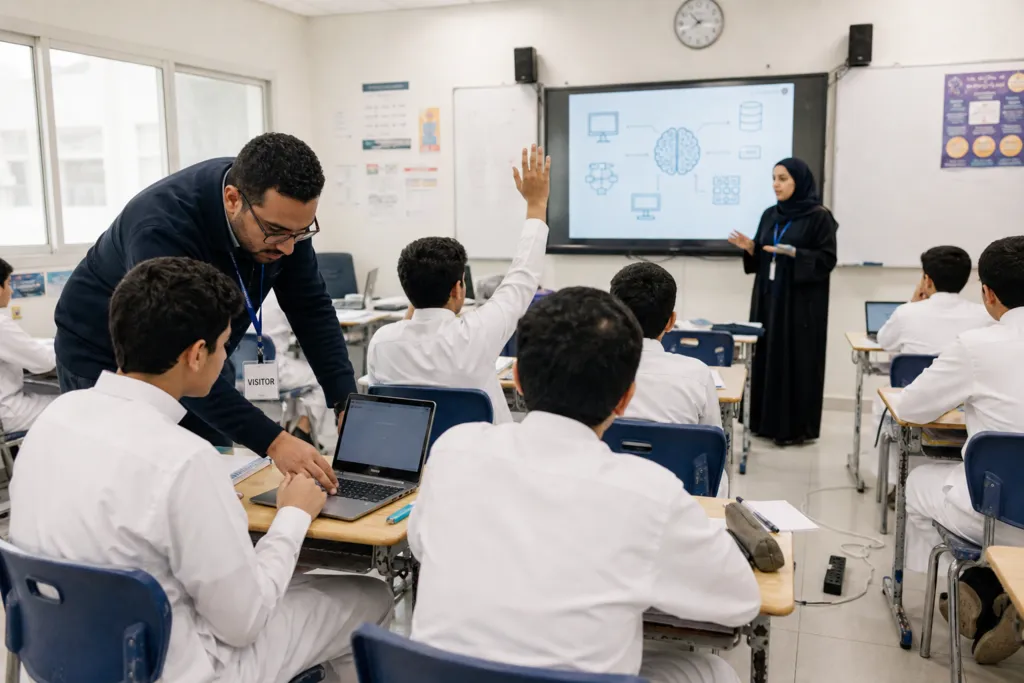
Saudi Arabia is set to teach artificial intelligence in public schools from 2025, aiming to build a future-ready workforce. Reported coverage says the curriculum integrates AI ethics, policy, innovation, and community impact, alongside technical concepts like data analysis and algorithms. It is designed by NCCD with the Ministry of Education, the Ministry of Communications & IT, and SDAIA. The approach is meant to ensure continuity through the national student performance evaluation framework without adding teaching hours. An earlier “Introduction to Artificial Intelligence” elective targeted over 50,000 grade-12 students.
For employers, the immediate implication is not just new graduates with AI vocabulary, but a workforce that increasingly expects AI in day-to-day work. A Saudi Gazette report states four out of ten Saudi workers use AI daily. It also links tool access to experience: among Saudis who report a healthy work relationship, 34% use AI tools provided by their employer every day. This creates a practical benchmark for HR and IT teams. If employees see AI as a productivity tool, employers may face pressure to standardize approved tools, set usage norms, and support everyday adoption.
Workforce Implications: Training, Mobility, and Leadership
Multiple sources point to a training and leadership gap that employers will need to close. A Nature paper cites a 19-country poll of 25,000 employees where 68% of KSA respondents reported weekly Gen-AI use, yet 61% said their employers provide insufficient training. At the same time, Arab News reporting highlights demand for new roles such as AI specialists and data analysts, and describes AI-driven tools used for reskilling, internal progression, and internal marketplaces to support career transitions. Another Arab News piece, citing Korn Ferry research, outlines six traits for AI-ready leadership: sustaining vision, decisive action, scaling for impact, continuous learning, addressing fear, and pushing beyond early success.
EdTech vendors should read the national curriculum as a procurement signal. The school curriculum reportedly includes ethics and policy, not only technical skills, which favors platforms that combine content, practice, and assessment. Because the rollout is designed to fit within existing teaching hours and connect to national evaluation, vendors that can map learning outcomes to assessment systems may be advantaged. TIME also notes that the proliferation of AI is pushing companies to invest in edtech to upskill employees, while schools use platforms to customize learning and expand access. That demand spans K–12 and workforce development, which aligns with Saudi Arabia’s school-to-work pipeline logic.
Governance and ethics features will matter to both buyers and suppliers. Consultancy-me reports that 90% of business leaders in the GCC expect AI to enhance business processes and workflows, while 81% anticipate its use in new product and service development over the next three years, underscoring the need for strong governance frameworks. For vendors, that favors auditable systems, transparent reporting, and controls that support ethical and responsible use. It also helps address the “bring your own” risk seen elsewhere. An EdTech Innovation Hub story describes a “bring your own AI” crisis in UK higher education where affordability can drive unequal access, a cautionary parallel for institutions aiming for consistent, equitable tooling.
The clearest near-term play for employers is alignment. Hiring teams can translate the school curriculum’s topics into entry-level competency frameworks, then connect those to internal reskilling pathways and mobility programs. Vendors can package age-appropriate modules that progress from foundational literacy to applied practice, while supporting ethics, policy, and evaluation needs. Across sources, the direction is consistent: AI usage is already high, expectations are rising, and training capacity is a differentiator. The Saudi Arabia AI curriculum workforce shift is therefore both a talent pipeline story and an operational readiness test for organizations.
What is the Saudi Arabia AI curriculum workforce impact for employers?
What topics are included in Saudi Arabia’s national AI curriculum rollout?
What should EdTech vendors build for this curriculum and market?
Which leadership traits are linked to being AI-ready in Saudi-focused reporting?
What signs show Saudi workplaces are already using AI tools?