Saudi Arabia is repositioning itself for a world where minerals sit alongside oil as a strategic lever. At Riyadh’s Future Minerals Forum, the kingdom’s energy minister, Prince Abdulaziz bin Salman, said that “oil is no longer the energy security challenge – it’s going to be gas, electricity and predominantly minerals.” That shift is tied to Vision 2030, launched in April 2016, and to targets that increase the need for secure mineral inputs. Riyadh has set a target of 30% of new car sales being electric by 2030, alongside a plan to boost production to 500,000 electric vehicles by that year. It also aims for 50% of its electricity generation to be from renewable sources, with more than $186bn invested in sustainable projects under the Saudi Green Initiative.
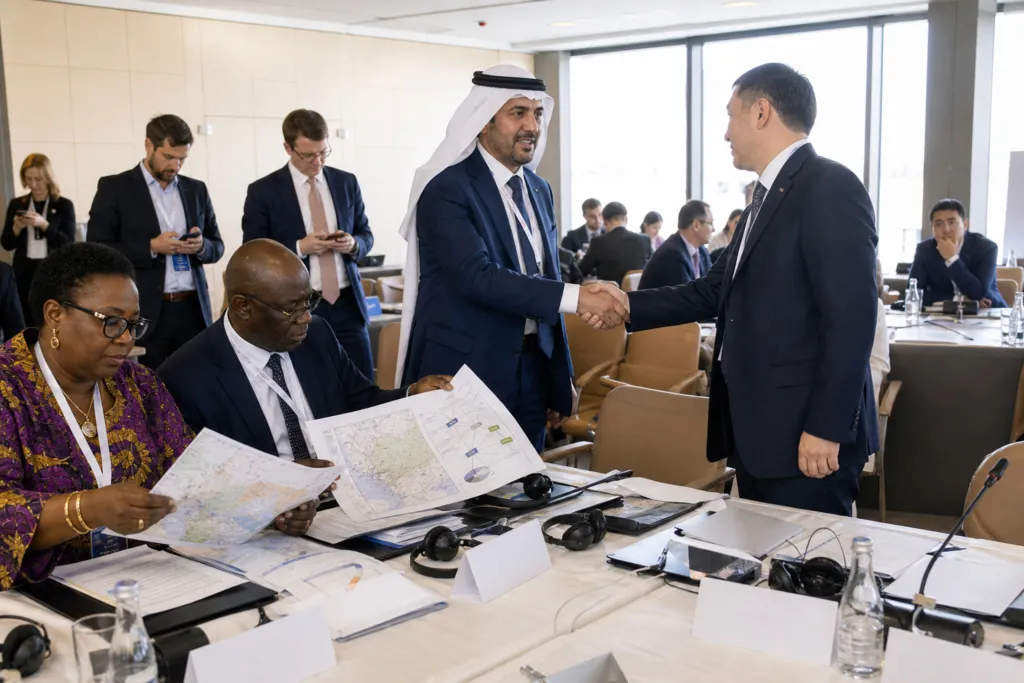
In that context, the Saudi Arabia Kazakhstan Africa mining partnership theme is less about a single deal and more about a network that could reshape supply chains and capital flows. On 22 June 2026, Saudi Arabia and Kazakhstan signed a strategic mining MoU during an official visit, signed by Saudi Minister of Industry and Mineral Resources Bandar Alkhorayef and Kazakhstan’s Minister of Industry and Construction Yerlan Nagaspayev. Reporting around the MoU stresses investor-relevant caution: outcomes depend on later commercial negotiations, regulatory alignment, private sector participation, and market conditions. Saudi officials have also described an ambition to act as a global minerals hub connecting Africa, Europe, and Asia through integrated value chains, which frames Kazakhstan as one node in a wider strategy.
What the Kazakhstan Link Signals About Value Chains
Saudi messaging on Kazakhstan emphasizes cooperation that moves beyond extraction into industrial value creation. Speaking at the Astana Mining and Metallurgy Congress, Alkhorayef called Kazakhstan a trusted strategic partner and argued that stronger mining partnerships can accelerate investment flows, reinforce supply chains, and generate long-term industrial value. The discussion highlighted integrated value chains spanning exploration, processing, refining, and advanced manufacturing, and positioned minerals like nickel and copper as strategic raw materials for modern electricity systems and advanced manufacturing. For investors, the key signal is a policy push toward downstream capabilities, including mineral processing and metallurgy, at a time when processing capacity is concentrated in a limited number of markets.
Africa is the other critical vector in Saudi Arabia’s mineral diplomacy, because the continent is home to an estimated 30% of the world’s proven critical mineral reserves. Africa possesses around 55% of the world’s cobalt, almost half of total manganese supply, and more than 20% of natural graphite, among other resources. Saudi Arabia has signed MoUs with the Democratic Republic of Congo (DRC), Egypt, and Morocco to explore cooperation in “the field of mineral wealth,” and it launched Manara Minerals as a joint venture between PIF and Maaden with a mandate to invest in critical minerals. Climate-focused reporting also notes Riyadh is working with the World Bank on funding opportunities for seven planned infrastructure corridors to accelerate minerals development in Africa and Latin America and help get resources to market.
For investors, the opportunity sits alongside competition and political economy constraints. Regional peers have moved aggressively: in July 2023 the UAE signed a $1.9bn deal with DRC state miner Sakima to develop four critical mineral mines, and in December that year it completed a $1.1bn investment in Zambia for a 51% stake in Mopani Copper Mines. Saudi Arabia’s approach is also scaling: Maaden announced it would invest $110 billion in metals and mining over the next decade, and Saudi Arabia’s budget for exploratory mining increased 595% between 2021 and 2025, per S&P Global. At the same time, analysts warn there is “tension” between Saudi plans to process minerals and African countries’ ambitions to add value domestically, and Saudi commentary on the Kazakhstan MoU underlines that concrete investment outcomes still hinge on negotiations and regulatory alignment.
What does Saudi Arabia’s minerals diplomacy aim to achieve for investors?
How does the Saudi-Kazakhstan mining MoU affect near-term investment certainty?
Why is Africa central to Saudi Arabia’s critical minerals strategy?
How much is Maaden planning to invest, and over what period?
What should investors watch in the Saudi Arabia–Kazakhstan–Africa mining partnership theme?